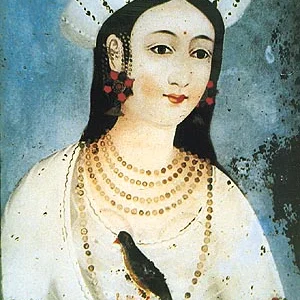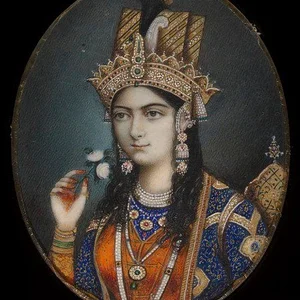

Mughal empress and favorite wife of Emperor Shah Jahan. Her death in childbirth in 1631 inspired the construction of the Taj Mahal, a marble mausoleum raised to her memory that became one of the most famous monuments in the world.
Mumtaz Mahal(1593 — 1631)
Arjumand Banu Begum
6 min read
Frequently asked questions
Key Facts
- Born in 1593 in Agra into a noble family of Persian origin close to the Mughal court.
- Married Shah Jahan in 1612 and became his favorite wife, accompanying him even on his military campaigns.
- Received the imperial seal (Mehr Uzaz), a sign of the trust and influence she enjoyed at court.
- Died in 1631 at Burhanpur while giving birth to her fourteenth child.
- The Taj Mahal, commissioned by Shah Jahan in her memory, was built in Agra from roughly 1632 to 1653.
Works & Achievements
Marble tomb raised in her memory by Shah Jahan, a masterpiece of Mughal architecture and her most enduring legacy.
As empress, she held the seal used to validate official documents, thereby exercising a trusted political role alongside the emperor.
Tradition credits her with acts of charity toward widows, orphans, and the needy, in keeping with the role expected of a Mughal empress.
She accompanied Shah Jahan during his years of rebellion and then his campaigns, an adviser and confidante at his side as far as the Deccan.
She gave birth to fourteen children, including the princes Dara Shikoh and Aurangzeb and the princesses Jahanara and Roshanara, who left their mark on the Empire's history.
Anecdotes
Her real name was Arjumand Banu Begum. It was Emperor Shah Jahan who gave her the title “Mumtaz Mahal,” which can be translated as “the chosen one of the palace” or “the jewel of the palace.” It is under this name that she has remained famous throughout the world.
Mumtaz Mahal belonged to a Persian family that was highly influential at the Mughal court: her aunt Nur Jahan was the all-powerful wife of Emperor Jahangir, and her grandfather, the minister I'timad-ud-Daula, rests in Agra in an inlaid marble tomb often nicknamed the “Baby Taj.”
Unlike many empresses who stayed at the palace, she accompanied Shah Jahan on his military campaigns, even along the roads of the Deccan. It was in fact at the camp of Burhanpur, in 1631, that she died while giving birth to her fourteenth child.
Shah Jahan entrusted her with the imperial seal (the Mehr Uzaz), which was used to validate the Empire's official documents. Entrusting such an object to his wife was a mark of exceptional trust and a sign of the influence she held over him.
To house her remains, Shah Jahan had the Taj Mahal built in Agra. Her body was first buried temporarily in Burhanpur, then transferred near the Yamuna. It took more than twenty years and thousands of laborers and craftsmen to complete the entire complex, which has become one of the most visited monuments in the world.
Primary Sources
The chronicle recounts the death of the empress at Burhanpur during the birth of her child and describes the deep mourning of the emperor, who is said to have given up the entertainments of the court for a time.
The author reports that the empress died in childbirth in the Deccan camp and that she was first buried in a garden at Burhanpur before her remains were transferred to Agra.
The account emphasizes the emperor's particular affection for Mumtaz Mahal, mother of most of his surviving children, and his plan to raise a mausoleum worthy of her memory.
Tavernier reports that work continued for many years on the tomb of Shâh Jahân's wife, employing a very large number of workmen, and that the project cost considerable sums.
Key Places
Birthplace of Mumtaz Mahal and capital of the Mughal Empire at the time. It is here that the Taj Mahal stands.
City in central India where the Mughal army was encamped in 1631. Mumtaz Mahal died there in childbirth and was first buried there in a garden.
White marble mausoleum built by Shah Jahan to house her remains, on the bank of the Yamuna. The empress's final resting place.
Great city of the Mughal Empire (in present-day Pakistan) where the court regularly resided and where Mumtaz stayed with Shah Jahan.
Typical Objects

A seal used to authenticate the Empire's official documents. Shah Jahan entrusted it to Mumtaz Mahal, a sign of the trust and influence she enjoyed.

Marble from Rajasthan used for the Taj Mahal, the mausoleum raised in her memory. Its whiteness, which shifts with the light, is what makes the monument famous.

A technique of inlaying semi-precious stones into marble, used to decorate the cenotaph and walls of the Taj Mahal with floral patterns and verses.

A seat carried on men's shoulders or mounted on an elephant, used by the ladies of the court. Mumtaz traveled this way when she accompanied the emperor on campaign.

Pearls, emeralds, rubies, and diamonds set into refined ornaments, marks of rank at the Mughal court and worn by the empress.

A vast canvas encampment that recreated the comfort of the palace as the army moved. It was in such a camp, at Burhanpur, that Mumtaz Mahal died.

Verses carved in Arabic script on the gateways and walls of the mausoleum, the work of the calligrapher Amanat Khan, framing the empress's tomb.
School Curriculum
Vocabulary & Tags
Key Vocabulary
Daily Life
Morning
A Mughal empress's day began in the zenana, the apartments reserved for women, guarded by eunuchs. She washed, performed her ablutions and prayed, assisted by numerous servants and ladies-in-waiting.
Afternoon
The afternoon might be devoted to managing the harem, receiving close relatives, overseeing expenses and charitable donations, and discussing the affairs of the court. As a close adviser to the emperor, Mumtaz was kept informed of important decisions.
Evening
Evenings were spent in refined entertainments: music, recitations of Persian poetry, games and strolls through the four-part gardens (charbagh). The empress often shared these moments with Shah Jahan.
Food
Mughal cuisine blended Persian and Indian influences: fragrant rice dishes (pilaf and biryani), meats simmered with spices, dried fruits, almonds, and fresh fruit such as melons and pomegranates. Sweet drinks (sharbat) accompanied meals served on precious tableware.
Clothing
She wore finely embroidered fabrics of silk and muslin, loose trousers, long tunics and veils, set off with jewels of gold, pearls and precious stones. Perfume and henna were part of her daily grooming.
Housing
She lived in the palaces of the imperial fortresses of Agra and Lahore, with their marble courtyards, fountains and gardens. During military campaigns, she stayed in vast imperial tents furnished with the same luxury as the palace.
Historical Timeline
Period Vocabulary
Liens externes & ressources
Références
Œuvres
Le Taj Mahal (mausolée d'Agra)
1632-1653
Gardienne du sceau impérial
1628-1631
Œuvres de bienfaisance et de patronage
années 1620-1630
Compagne des campagnes impériales
1612-1631
Mère de la lignée impériale
1613-1631