 flip
flipAuvergne Dry-Cured Sausage for Storage
Auvergne Dry-Cured Sausage for Storage
Why this dish? The maquis's supply depended on farms and everything that could be preserved without refrigeration. Dry-cured sausage, salted and dried for weeks, slipped into a haversack and eaten with a knife between marches—exactly the kind of food that kept Nancy Wake's men moving.
Chopped pork, salted and spiced, stuffed into casings and slowly dried until firm and flavorful: meat that keeps for months without ice.
In the maquis, you don't put anything cool, there is no cool. So you quickly learn what lasts. A good sausage hung from a barn beam, you slice it with your knife, put it in your pocket with a crust, and you're set for the day. The local farmers gave us some in secret, at the risk of their lives. I never forgot that—a piece of sausage, in the times we lived in, was a king's gift.
- •Lean pork — most of it (meat)
- •Pork fat (back fat) — about a third (softness and binding)
- •Salt — exact proportion (preservation)
- •Black pepper — generous (spice)
- •Garlic — a few cloves (flavor)
- •Pork casing — as needed (envelope)
Auvergne Dry-Cured Sausage for Storage
Chopped pork, salted and spiced, stuffed into casings and slowly dried until firm and flavorful: meat that keeps for months without ice.
Why this dish? The maquis's supply depended on farms and everything that could be preserved without refrigeration. Dry-cured sausage, salted and dried for weeks, slipped into a haversack and eaten with a knife between marches—exactly the kind of food that kept Nancy Wake's men moving.
In the maquis, you don't put anything cool, there is no cool. So you quickly learn what lasts. A good sausage hung from a barn beam, you slice it with your knife, put it in your pocket with a crust, and you're set for the day. The local farmers gave us some in secret, at the risk of their lives. I never forgot that—a piece of sausage, in the times we lived in, was a king's gift.
Ingredients (period version)
- Lean pork — most of it (meat)
- Pork fat (back fat) — about a third (softness and binding)
- Salt — exact proportion (preservation)
- Black pepper — generous (spice)
- Garlic — a few cloves (flavor)
- Pork casing — as needed (envelope)
Ingredients
- Lean pork shoulder — 700 g (meat)
- Hard pork fat — 300 g (softness)
- Fine salt (curing salt recommended for safety) — 28 g (preservation)
- Ground black pepper — 3 g (spice)
- Garlic — 2 cloves, crushed (flavor)
- Natural pork casing — 1 m, rinsed (envelope)
Method
- Grind the lean and fat meat coarsely, keeping very cold.
- Mix with salt, pepper, and garlic until sticky.
- Stuff firmly into the casing, avoiding air bubbles, tie into sausages.
- Sweat for 24 hours at cool room temperature (around 20 °C) to start fermentation.
- Dry in a cool, dark, ventilated place (12-15 °C, moderate humidity) for 3 to 5 weeks.
- The sausage is ready when it has lost about a third of its weight and is firm to the touch.
How it was made : In Auvergne, the winter 'tue-cochon' (pig slaughter) provided charcuterie for the year: sausages and hams salted then hung in the chimney or curing cellar. Slow drying and salt preserved the meat without any refrigeration, a vital skill for isolated farms… and for a maquis without regular supplies.
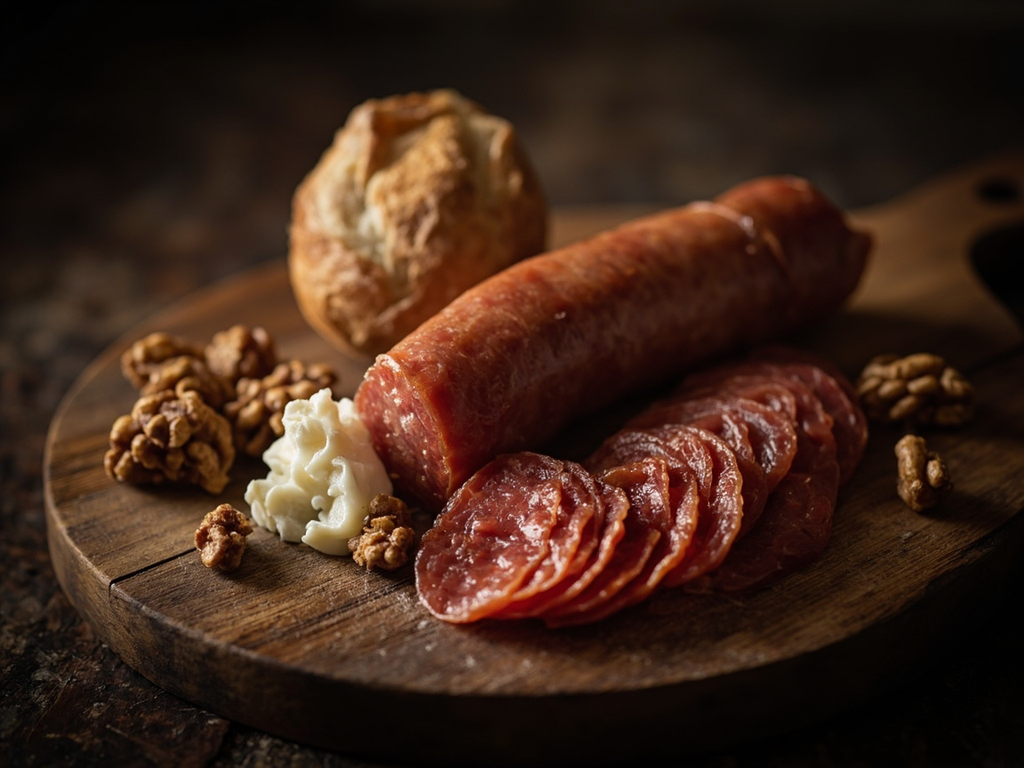
The contemporary twist : Sliced thin and served on a board with walnuts and rye bread, called 'the white mouse's haversack'.
Sources : Traités de charcuterie fermière auvergnate · Peter FitzSimons, Nancy Wake (2001)
Nancy Wake · Charactorium