 flip
flipRussian Black Tea with Lemon
Russian Black Tea with Lemon
Why this dish? The cup of tea is among Sarraute's typical objects, and it runs through her entire Russian childhood as well as her Parisian writer's life. Tea is not an end to a meal: it is the heart around which people gather and talk — ideal ground for her ear attuned to the minute movements of conversation, those 'tropisms' she spent her life capturing.
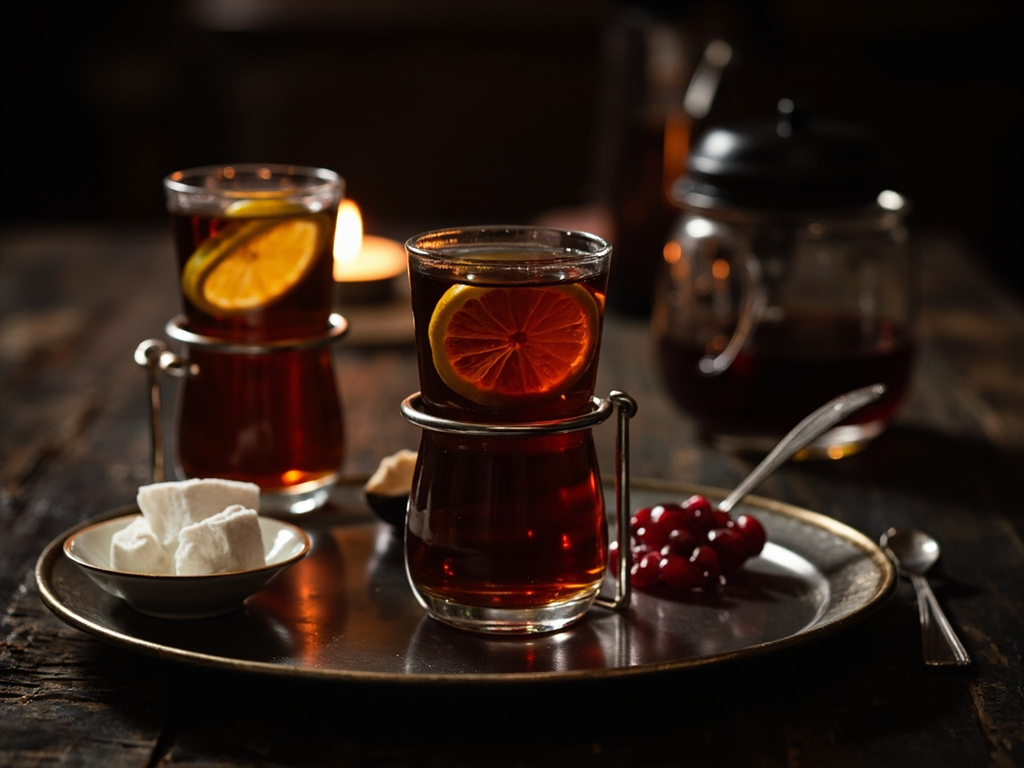
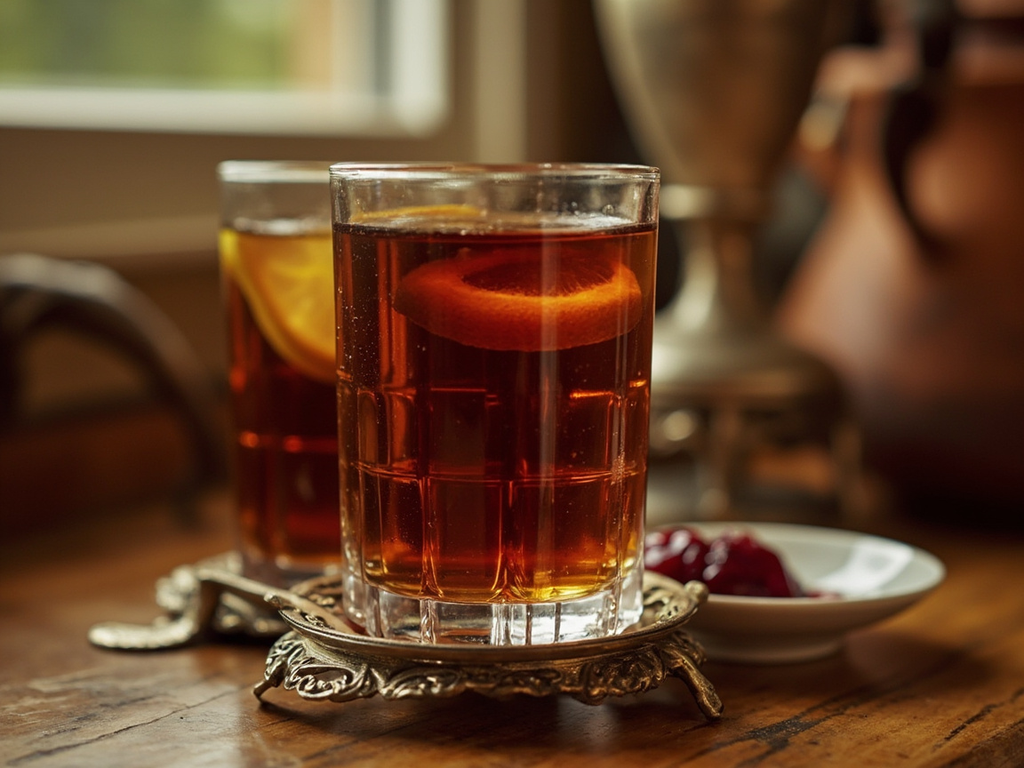
A strong black tea, prepared as a concentrate (zavarka) then diluted with boiling water in the glass, brightened with a lemon slice. Bitter and sharp, sweetened to taste with a spoonful of jam rather than sugar.
At our house, tea didn't wait for the end of the meal: it was there all the time, scalding, in glasses that we held by the rim. We kept a very strong base, almost black, and we poured a finger of it before diluting with boiling water — each person made it to their own strength. A slice of lemon, never milk. And if you wanted sweetness, you took the jam on a small spoon, on the side, while talking. It was in those hours, I think, that I learned to listen to what is said beneath the words.
- •Black tea leaves — for a concentrate (zavarka) (mother infusion)
- •Water from the samovar — as needed (dilution)
- •Lemon — sliced (acidity)
- •Jam (varenye) — served separately (sweetness (vprikousku))
Russian Black Tea with Lemon
A strong black tea, prepared as a concentrate (zavarka) then diluted with boiling water in the glass, brightened with a lemon slice. Bitter and sharp, sweetened to taste with a spoonful of jam rather than sugar.
Why this dish? The cup of tea is among Sarraute's typical objects, and it runs through her entire Russian childhood as well as her Parisian writer's life. Tea is not an end to a meal: it is the heart around which people gather and talk — ideal ground for her ear attuned to the minute movements of conversation, those 'tropisms' she spent her life capturing.
At our house, tea didn't wait for the end of the meal: it was there all the time, scalding, in glasses that we held by the rim. We kept a very strong base, almost black, and we poured a finger of it before diluting with boiling water — each person made it to their own strength. A slice of lemon, never milk. And if you wanted sweetness, you took the jam on a small spoon, on the side, while talking. It was in those hours, I think, that I learned to listen to what is said beneath the words.
Ingredients (period version)
- Black tea leaves — for a concentrate (zavarka) (mother infusion)
- Water from the samovar — as needed (dilution)
- Lemon — sliced (acidity)
- Jam (varenye) — served separately (sweetness (vprikousku))
Ingredients
- Black tea leaves (Ceylon or Russian Caravan) — 3 tsp (concentrate)
- Simmering water — 1 small teapot + extra kettle (infusion and dilution)
- Lemon — 1, thinly sliced (acidity)
- Sour cherry or red berry jam — to taste (sweetness served separately)
Method
- Prepare a zavarka: steep the tea in a small teapot with a little simmering water for 5 minutes to create a concentrate.
- Pour a base of concentrate into each glass (about one-third full).
- Top up with very hot water to desired strength.
- Add a lemon slice.
- Serve the jam separately, to be eaten by the spoonful between sips rather than stirred in.
How it was made : The samovar kept water boiling for hours; the teapot (tchaïnik) of concentrate sat on its lid to stay warm. Drinking tea 'vprikousku' — nibbling a lump of sugar or taking jam separately — was the popular custom, as opposed to sugar dissolved in the cup.
The contemporary twist : Served in a glass set in an engraved metal holder (podstakannik), Trans-Siberian dining-car style, for theatrical effect.
Nathalie Sarraute · Charactorium