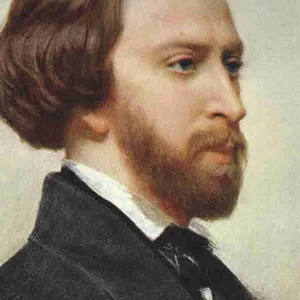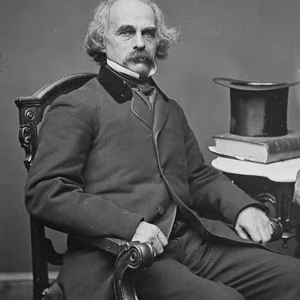

Nathaniel Hawthorne (1804-1864) was an American novelist and short-story writer, a major figure of dark romanticism. He explores guilt, sin, and the Puritan legacy of New England in a psychological and allegorical body of work.
Nathaniel Hawthorne(1804 — 1864)
Nathaniel Hawthorne
États-Unis
7 min read
Frequently asked questions
Famous Quotes
« No man, for any considerable period, can wear one face to himself and another to the multitude, without finally getting bewildered as to which may be the true.»
Key Facts
- Born in 1804 in Salem (Massachusetts), a descendant of a judge in the Salem witch trials
- Publishes the short-story collection Twice-Told Tales in 1837
- Publishes his masterpiece The Scarlet Letter in 1850
- Publishes The House of the Seven Gables in 1851
- Dies in 1864 in Plymouth (New Hampshire)
Works & Achievements
Collection of short stories that reveals his mastery of moral allegory and brings him his first critical recognition.
Collection written in Concord, containing famous short stories such as “Young Goodman Brown” and “The Birthmark.”
His masterpiece: in Puritan Boston, Hester Prynne wears an “A” of shame. A pinnacle of the American psychological novel.
A novel about a family curse and the weight of the past, blending the gothic with social criticism of New England.
Fiction inspired by his stay at Brook Farm, exploring the illusions and rivalries of a utopian community.
An accessible retelling of Greek myths for children, showcasing his gift as a storyteller for young readers.
A novel set in Rome, blending art, innocence, and sin, the fruit of his long stay in Italy.
Anecdotes
Nathaniel's great-great-grandfather, John Hathorne, was one of the judges at the Salem witch trials in 1692 and never showed the slightest remorse. Haunted by this family stain, the writer is said to have added a "w" to his name (Hathorne → Hawthorne) to set himself apart from it. This inherited guilt runs through his entire body of work.
In 1841, Hawthorne invested his savings in Brook Farm, a utopian community near Boston where intellectuals and artists hoped to live off the land. The reality was less poetic: he spent his days shoveling manure and left disappointed after a few months. He drew on the experience for his novel “The Blithedale Romance.”
In 1849, Hawthorne lost his job as a customs inspector in Salem following a change of government. Furious but set free, he threw himself into writing and within a few months completed “The Scarlet Letter,” which made him famous. He prefaced the novel with a vengeful essay, “The Custom-House,” mocking his former colleagues.
Hawthorne struck up an intense friendship with the young Herman Melville, his neighbor in Massachusetts. Full of admiration, Melville dedicated his masterpiece “Moby-Dick” to him in 1851. Hawthorne, more reserved, always kept a certain distance that pained his younger friend.
At the Old Manse in Concord, where he lived as a newlywed, Hawthorne and his wife Sophia scratched messages into the windowpanes with Sophia's diamond ring. These inscriptions can still be read today, one of them noting the date of a snowfall they watched together.
Primary Sources
A throng of bearded men, in sad-colored garments and gray steeple-crowned hats, intermixed with women, some wearing hoods and others bareheaded, was assembled in front of a wooden edifice, the door of which was heavily timbered with oak, and studded with iron spikes.
This rag of scarlet cloth—for time and wear and a sacrilegious moth had reduced it to little other than a rag—on careful examination, assumed the shape of a letter. It was the capital letter A.
When a writer calls his work a Romance, it need hardly be observed that he wishes to claim a certain latitude, both as to its fashion and material, which he would not have felt himself entitled to assume had he professed to be writing a Novel.
In token of my admiration for his genius, this book is inscribed to Nathaniel Hawthorne.
Key Places
Hawthorne's birthplace, a former great merchant port haunted by the memory of the 1692 witch trials. There he lived his *twelve lonely years* of apprenticeship and worked at the custom house.
The college where Hawthorne studied from 1821 to 1825. There he formed lasting friendships with the poet Longfellow and the future president Franklin Pierce.
A utopian farming community inspired by Transcendentalism, which Hawthorne joined in 1841. This disappointing experience fed into *The Blithedale Romance*.
A house near Concord where Hawthorne settled as a newlywed in 1842, at the heart of the transcendentalist circle of Emerson and Thoreau. There he wrote *Mosses from an Old Manse*.
A great English port where Hawthorne served as United States consul from 1853 to 1857, appointed by President Pierce. There he observed British industrial society.
A mountain town where Hawthorne died in his sleep in May 1864, during a restful journey with his friend Franklin Pierce. He was later buried in Concord.
Typical Objects

The everyday writing instrument of the 19th-century writer, cut from a goose feather and dipped in ink. Hawthorne used it to compose short stories and novels during his long years of seclusion in Salem.

A badge of red cloth sewn onto a garment, the symbol of the public punishment imposed by the Puritan community in “The Scarlet Letter.” It embodies the weight of sin, shame, and social judgment.

A stamp used to certify and mark goods in ports such as Salem's. Hawthorne used one during his employment as an inspector, a position that inspired his essay “The Custom-House.”

The first photographic process, fixing an image onto a polished silver plate, booming in the 1840s and 1850s. Hawthorne turned it into a modern and unsettling motif by giving a daguerreotypist a key role in “The House of the Seven Gables.”

A black headpiece with a conical crown and a wide brim, typical of the 17th-century Puritan settlers of New England. In Hawthorne's work it symbolizes the austerity and moral rigor of his ancestors.

An engagement ring whose diamond point could etch glass. At the Old Manse, Hawthorne and Sophia inscribed short messages on the windows that are still visible today.
School Curriculum
Vocabulary & Tags
Key Vocabulary
Tags
Daily Life
Morning
During his solitary years in Salem, Hawthorne would rise late and spend the morning shut away in his room reading and writing. Later, married and a father, he devoted his early hours to composing his tales and novels before the household stirred to life.
Afternoon
A great walker, he would go out in the afternoon for long rambles through the countryside, the woods, or along the shore, observing people and landscapes. During his years at the Custom House, by contrast, his afternoons were taken up with the administrative routine of the port.
Evening
In the evening he read by lamplight, recorded his observations in his notebooks (the “Notebooks”), or received a few close friends such as Melville. Deeply reserved, he shunned social life and preferred the intimacy of home.
Food
The diet of nineteenth-century New England rested on bread, potatoes, garden vegetables, fish, and the seafood that was abundant in Salem. Tea and coffee accompanied meals, rounded out by seasonal fruits such as apples.
Clothing
Hawthorne wore the middle-class attire of his time: a dark frock coat, waistcoat, high-collared shirt, and knotted cravat. A handsome man renowned for his neat appearance, he favored a sober style in keeping with the reserve of his character.
Housing
He lived in turn in the family home in Salem, in the old dwelling of the Old Manse at Concord, and then in his own house, The Wayside. These New England timber houses, with their wainscoted rooms heated by fireplaces, deeply shaped the atmosphere of his stories.
Historical Timeline
Period Vocabulary
Liens externes & ressources
Références
Œuvres
Twice-Told Tales (Contes deux fois contés)
1837
Mosses from an Old Manse
1846
La Lettre écarlate
1850
La Maison aux sept pignons
1851
Le Roman de Blithedale
1852
A Wonder-Book for Girls and Boys
1852
Le Faune de marbre
1860