 flip
flipSpelt and Cumin Bread from the Royal Table
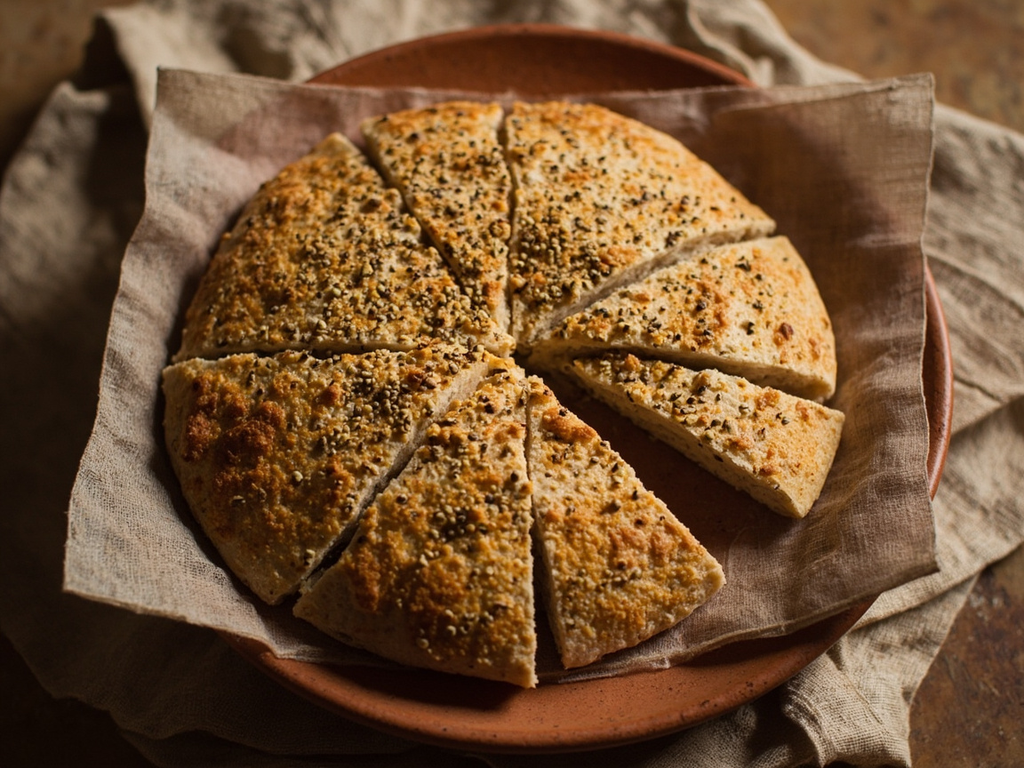
Spelt and Cumin Bread from the Royal Table
Why this dish? Quality white bread was the fundamental food of the Egyptian high aristocracy: at Nefertiti's table, fine wheat and spelt breads were served, far more refined than the coarse flatbread of the common people. The ovens and mills of Akhetaten houses, unearthed at Tell el-Amarna, attest to this daily production.
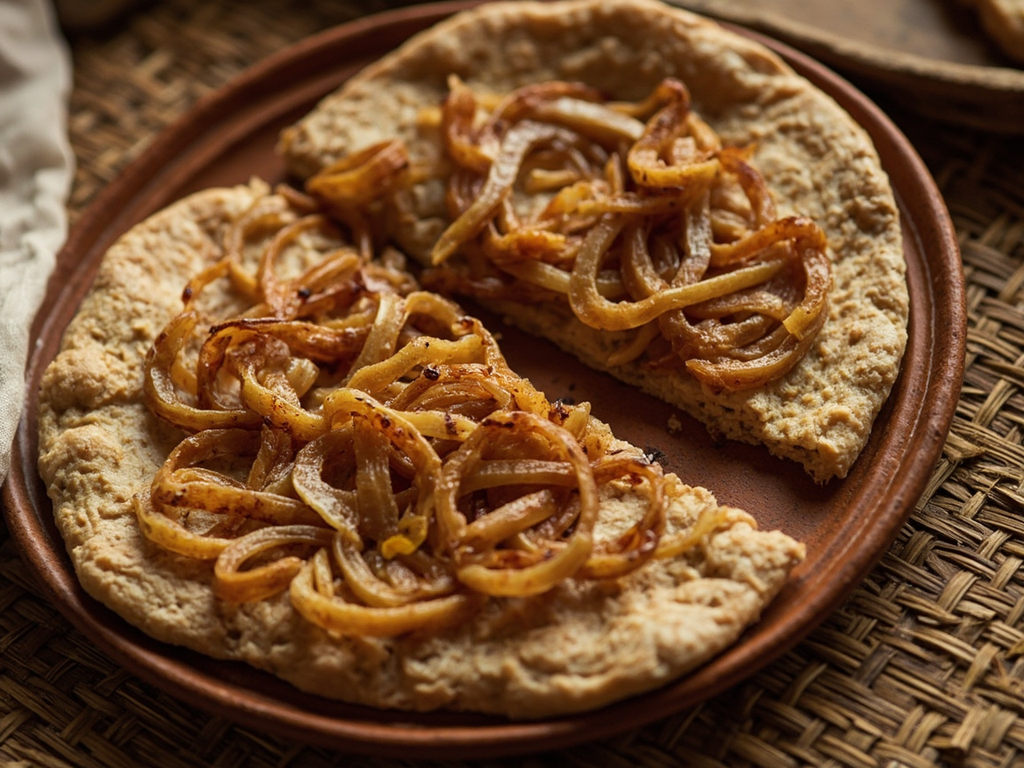
A golden, tender, cumin-scented bread, kneaded with fine flour and a touch of honey. It is the companion of all platters, the one broken before the meat and dipped in beer.
Approach, and look at the bread brought to my table. Under the light of Aten who nourishes all things, my servants grind the grain at dawn and shape a dough whiter than that of the fields. I have them mix in cumin and a tear of honey, for a queen's mouth cannot be content with the peasant's flatbread. Break off a piece, and you will taste what the Great Royal Wife tastes.
- •Finely sifted spelt flour — a full basket (base)
- •Natural sourdough starter — a portion of yesterday's dough (fermentation)
- •Cumin seeds — a handful (aroma)
- •Honey — a drizzle (sweetness and color)
- •Oasis salt — a pinch (seasoning)
- •Nile water — as needed (binder)
Spelt and Cumin Bread from the Royal Table
A golden, tender, cumin-scented bread, kneaded with fine flour and a touch of honey. It is the companion of all platters, the one broken before the meat and dipped in beer.
Why this dish? Quality white bread was the fundamental food of the Egyptian high aristocracy: at Nefertiti's table, fine wheat and spelt breads were served, far more refined than the coarse flatbread of the common people. The ovens and mills of Akhetaten houses, unearthed at Tell el-Amarna, attest to this daily production.
Approach, and look at the bread brought to my table. Under the light of Aten who nourishes all things, my servants grind the grain at dawn and shape a dough whiter than that of the fields. I have them mix in cumin and a tear of honey, for a queen's mouth cannot be content with the peasant's flatbread. Break off a piece, and you will taste what the Great Royal Wife tastes.
Ingredients (period version)
- Finely sifted spelt flour — a full basket (base)
- Natural sourdough starter — a portion of yesterday's dough (fermentation)
- Cumin seeds — a handful (aroma)
- Honey — a drizzle (sweetness and color)
- Oasis salt — a pinch (seasoning)
- Nile water — as needed (binder)
Ingredients
- Spelt flour (T80) — 500 g (base)
- Active sourdough starter (or 7 g baker's yeast) — 100 g (fermentation)
- Cumin seeds — 1 tbsp (aroma)
- Honey — 1 tbsp (sweetness and color)
- Salt — 8 g (seasoning)
- Warm water — 300 ml approx. (binder)
Method
- Mix the flour, salt, and cumin seeds in a large bowl.
- Dissolve the honey and sourdough starter (or yeast) in warm water, then pour over the flour.
- Knead for 10 minutes until a smooth, elastic dough forms.
- Let rise under a cloth for 1.5 to 2 hours, until doubled in size.
- Shape into two round, flat loaves; let rest for 30 minutes.
- Bake at 220°C for 20 to 25 minutes, until a beautiful golden crust.
How it was made : At Tell el-Amarna, archaeologists have found millstones, kneading troughs, and conical bread molds in terracotta. The grain (barley and emmer, ancestor of spelt) was ground by hand, sifted for noble tables, then baked in clay ovens. Bread also served as currency and wages in the Egyptian economy.
The contemporary twist : Serve the bread still warm, sprinkled with toasted cumin seeds, on an olive wood board, 'queen's bread' style.
Sources : Pierre Tallet, La cuisine des pharaons (Actes Sud, 2015) · Barry Kemp, The City of Akhenaten and Nefertiti: Amarna and its People (Thames & Hudson, 2012)
Nefertiti · Charactorium