 flip
flipApollo 11 Rehydratable Meal (Chicken and Rice)
Apollo 11 Rehydratable Meal (Chicken and Rice)
Why this dish? Aboard Apollo 11, mission commander Armstrong ate from pouches of freeze-dried or semi-liquid food rehydrated with cold or warm water from the module: chicken, starches, fruit packets. Chicken and rice was among the iconic rehydratable dishes of the program — the very definition of 'travel food' taken to the extreme.
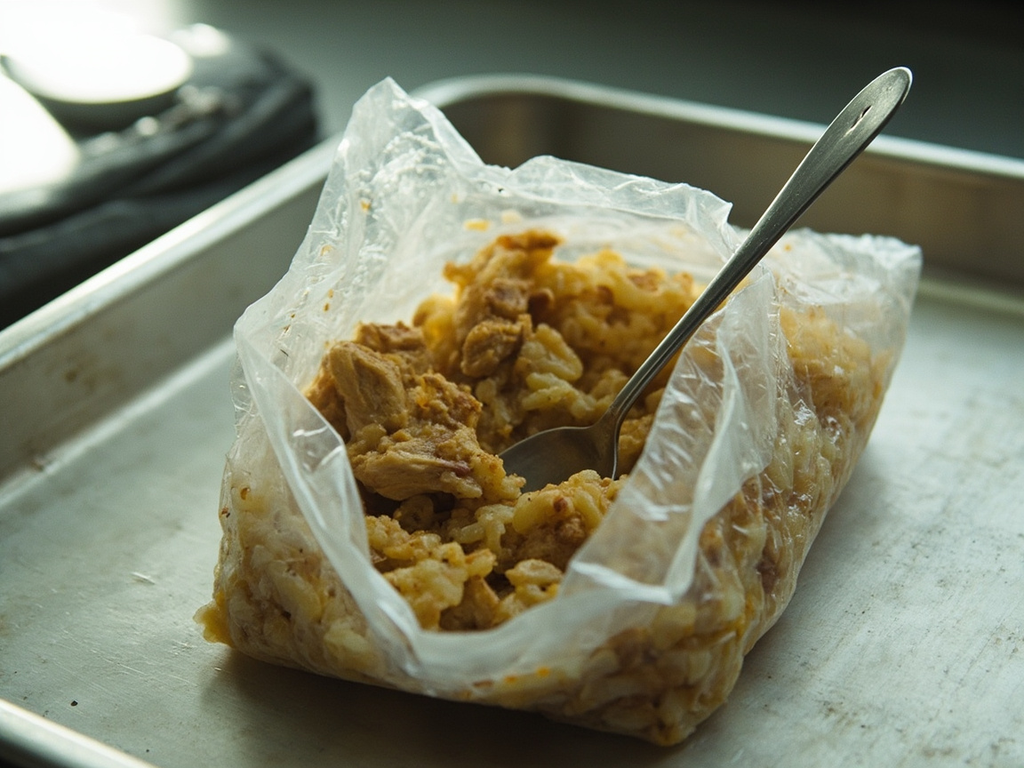
Sliced chicken with rice, dehydrated then brought back to life with water, eaten warm with a spoon directly from the pouch: zero-gravity cuisine, designed to fit in the palm and not produce crumbs.
Up there, eating wasn't a pleasure, it was a procedure. You cut the corner of the pouch, injected water with the gun, kneaded it, waited a few minutes, and ate with a spoon without letting anything escape — a floating crumb can lodge in an instrument. The chicken and rice held together well, it didn't scatter. We didn't go up there to dine; we went up to work, and food simply had to do its job, cleanly and without surprises.
- •Freeze-dried cooked chicken — one pouch portion (protein)
- •Dehydrated pre-cooked rice — one portion (starch)
- •Salt and powdered broth — a little (seasoning)
- •Water (from module system) — measured dose (rehydration)
Apollo 11 Rehydratable Meal (Chicken and Rice)
Sliced chicken with rice, dehydrated then brought back to life with water, eaten warm with a spoon directly from the pouch: zero-gravity cuisine, designed to fit in the palm and not produce crumbs.
Why this dish? Aboard Apollo 11, mission commander Armstrong ate from pouches of freeze-dried or semi-liquid food rehydrated with cold or warm water from the module: chicken, starches, fruit packets. Chicken and rice was among the iconic rehydratable dishes of the program — the very definition of 'travel food' taken to the extreme.
Up there, eating wasn't a pleasure, it was a procedure. You cut the corner of the pouch, injected water with the gun, kneaded it, waited a few minutes, and ate with a spoon without letting anything escape — a floating crumb can lodge in an instrument. The chicken and rice held together well, it didn't scatter. We didn't go up there to dine; we went up to work, and food simply had to do its job, cleanly and without surprises.
Ingredients (period version)
- Freeze-dried cooked chicken — one pouch portion (protein)
- Dehydrated pre-cooked rice — one portion (starch)
- Salt and powdered broth — a little (seasoning)
- Water (from module system) — measured dose (rehydration)
Ingredients
- Chicken breast — 200 g (protein)
- Pre-cooked long-grain rice — 150 g cooked (starch)
- Chicken broth — 200 ml (flavor and binding)
- Peas — 2 tbsp (vegetable)
- Onion powder, salt, pepper — to taste (seasoning)
Method
- For the 'homemade' educational version: poach the chicken in broth, shred finely.
- Mix chicken, pre-cooked rice, and peas; season.
- To evoke the space gesture: scoop a few spoonfuls into a ziplock bag, add a little warm broth, seal, knead for 1 minute, and eat with a spoon from an open corner.
- For a real freeze-drying demo: spread the mixture, freeze it, then dehydrate in a dehydrator; reconstitute later with warm water.
How it was made : The first Mercury astronauts ate purees from toothpaste-like tubes. By Gemini and then Apollo, NASA switched to freeze-dried foods in rehydratable pouches and gelatin-coated 'cubes,' which were more appetizing. The first meal actually consumed on the Moon by Aldrin and Armstrong included fruit and a drink pouch.
The contemporary twist : Serve kids the 'astronaut challenge': a ziplock pouch, a syringe of warm water, and the rule of no plate — eat as if 380,000 km from Earth.
Sources : NASA, Apollo 11 Press Kit, 1969 · Charles T. Bourland & Gregory L. Vogt, The Astronaut's Cookbook, Springer, 2010 · Smithsonian National Air and Space Museum — collections on Apollo mission food
Neil Armstrong · Charactorium