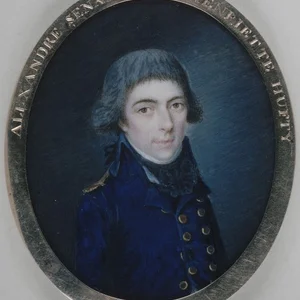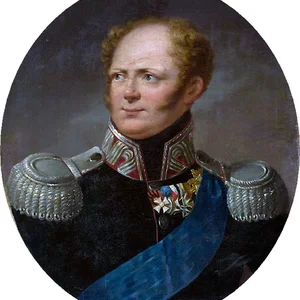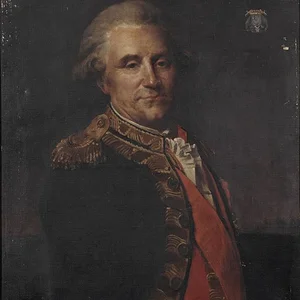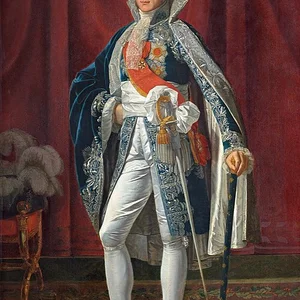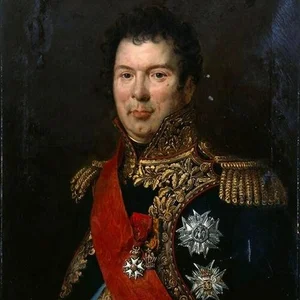

French general (1761–1810), Songis des Courbons was commander-in-chief of the artillery of the Grande Armée under Napoleon Bonaparte. A specialist in the technical arm of the military, he made decisive contributions to the great Napoleonic victories at Austerlitz, Jena, and Eylau.
Nicolas Marie Songis des Courbons(1761 — 1810)
Nicolas Marie Songis des Courbons
France
8 min read
Frequently asked questions
Key Facts
- Born on 2 March 1761 in Montauban (Tarn-et-Garonne)
- Appointed divisional general in 1799, under the Consulate
- Commander-in-chief of the artillery of the Grande Armée from 1803 to 1810
- Played a key role at the battles of Austerlitz (1805), Jena (1806), and Eylau (1807)
- Died on 5 April 1810 in Paris, while still on active military service
Works & Achievements
Songis organized the deployment of more than 130 French cannons on the Pratzen plateau, enabling a breakthrough through the Allied center. This action is regarded as a model of the tactical use of Napoleonic artillery.
A feat of logistics and tactics involving hauling heavy cannon up steep slopes overnight to take the Prussian army by surprise. This action contributed to the destruction of Frederick William III's main army in a single day.
In extreme winter conditions (blizzard, -20°C), Songis kept his batteries in action throughout the fierce battle against the Russians, playing a crucial role in holding the French line.
As commander-in-chief of the artillery, Songis standardized deployment procedures, improved the ammunition supply chain, and trained a generation of battery commanders who carried on his methods.
Songis oversaw the assembly of a battery of more than 100 guns that delivered a massive bombardment of the Austrian lines during the decisive phase of Wagram, foreshadowing the great artillery battles of the nineteenth century.
Anecdotes
At Austerlitz, on December 2, 1805, Songis des Courbons organized the deployment of the French artillery on the Pratzen plateau with remarkable precision. His cannons broke through the Austro-Russian lines in less than an hour, paving the way for Napoleon's most celebrated victory. The Emperor himself saluted the mastery of his chief of artillery after the battle.
Songis had been trained at the old royal artillery school, where he studied alongside officers schooled in the methods of Gribeauval. This rigorous training allowed him to rationalize the logistics of heavy guns within the Grande Armée, considerably reducing the time needed to bring batteries into action during major maneuvers.
During the Prussian campaign of 1806, at the Battle of Jena, Songis positioned his batteries on heights the Prussians considered inaccessible. His artillerymen hauled the cannons up steep slopes in the dead of night, using ropes — a technical feat that left the enemy stunned at daybreak.
At Eylau, in February 1807, in the midst of a freezing blizzard, Songis kept his batteries firing despite extreme temperatures and severe losses. He had the fuses and powder covered with coats stripped from the dead to protect them from moisture, improvising technical solutions under conditions of rare brutality.
Primary Sources
General Songis commanded the artillery with the talent and intrepidity that distinguish him; his dispositions contributed powerfully to the success of the day.
The 12-pound guns were brought into battery on the heights of Jena during the night of October 13 to 14; the gun crews accomplished this feat without faltering, despite the darkness and the slope of the terrain.
Songis was a man of profound learning, cool and methodical in action, whose presence on the battlefield reassured the Emperor as much as it unnerved the enemy chiefs of staff.
The artillery, under the orders of General Songis, rendered eminent services at Eylau; despite the cold and the snow, it did not cease for a single instant to blast the enemy columns.
Key Places
Birthplace of Songis des Courbons, born on June 26, 1761. This Provençal town in the Alpine hinterland shaped the son of minor nobility who would become one of the greatest artillery commanders of the Napoleonic era.
Site of Napoleon's most brilliant victory, on December 2, 1805, where Songis masterfully commanded the French artillery against the Austro-Russian armies. The Pratzen Plateau, where his cannons proved decisive, is today a memorial site.
Site of the battle of October 14, 1806, where Songis had his heavy guns hauled up the heights overlooking the town under cover of night, stunning the Prussians at daybreak and contributing to their total rout.
Scene of the bloody battle of February 8, 1807, where Songis kept his artillery operational under extreme blizzard conditions. It stood as one of his greatest feats of endurance and organizational skill.
Institutional heart of the Napoleonic army, where Songis worked between campaigns to organize the artillery, train officers, and draw up deployment plans for future campaigns.
Typical Objects

A heavy field artillery piece standardized under the *Ancien Régime* by Gribeauval, capable of firing a 12-pound cannonball over a kilometer. It was the principal weapon of the great Napoleonic batteries commanded by Songis.

A brass and leather optical instrument used to observe enemy positions and adjust artillery fire from a distance. Essential to the artillery general for directing his batteries from an elevated vantage point.

A detailed topographic map used alongside an ivory or brass protractor to calculate firing angles, distances, and battery positions. Songis relied on these tools to plan the placement of his artillery before each battle.

A horse-drawn vehicle made of reinforced wood, used to transport the cartridges, cannonballs, and black powder needed by the guns. Managing the logistics of these caissons was a central responsibility of Songis, who had to keep hundreds of pieces supplied throughout the battle.

A national blue coat with gold embroidery, fringed epaulettes, bicorne hat, and riding boots. The general's distinctive uniform allowed him to be identified on the smoke-filled and chaotic battlefield, ensuring visual command over his troops.

A precision instrument used by artillery crews to set the elevation angle of the cannon before firing. Songis personally ensured that his gunners were proficient with this tool, which was the key to accurate salvos.
School Curriculum
Vocabulary & Tags
Key Vocabulary
Daily Life
Morning
In the field, Songis rose before dawn, often at four or five in the morning. He personally inspected the artillery parks, checking the condition of the gun carriages, the quantity of powder available, and the fitness of the draft horses. He then received reports from his battery commanders around a table covered with maps.
Afternoon
Afternoons on the march were devoted to observing the terrain and preparing battery positions for the following day. Songis frequently rode ahead of the columns to scout out heights, fords, and areas favorable for placing his guns. During battles, he remained in the saddle for hours at a time, relaying orders to his aides-de-camp.
Evening
In the evening, in his tent or a requisitioned farmhouse, Songis drafted his reports to the Emperor and planned the next day's movements. He dined frugally — thick soup, boiled meat, army bread, and sometimes a glass of Burgundy wine — in the company of his staff. He rarely went to bed before midnight, reading through the march orders one last time.
Food
Generals' rations in the field remained frugal but superior to those of the common soldiers. Songis subsisted mainly on dark bread, dried-vegetable soup, salt pork, and cured meat. When stopping in towns, he could access roast poultry and local wine. Water was often boiled or mixed with vinegar to prevent illness.
Clothing
Songis wore the regulation uniform of a division general: a midnight-blue coat with lapels and gold embroidery, fringed epaulettes, white breeches or grey campaign trousers, and black leather riding boots. In bad weather, he added a grey cloak with a collar and a waterproofed bicorne hat. In the field, he favored functional comfort over ceremony.
Housing
When garrisoned in Paris, Songis resided in a well-appointed apartment near the Invalides, as befitted a division general of the Empire. On campaign, he lodged in his headquarters tent, furnished with a camp bed, a folding map table, and a chest for his instruments. In major conquered cities (Berlin, Warsaw, Vienna), he occupied requisitioned palaces or bourgeois townhouses.
Historical Timeline
Period Vocabulary
Liens externes & ressources
Références
Œuvres
Commandement de l'artillerie à Austerlitz
2 décembre 1805
Campagne de Prusse — mise en batterie sur les hauteurs d'Iéna
14 octobre 1806
Direction de l'artillerie à Eylau
8 février 1807
Réorganisation de l'artillerie de la Grande Armée (1804-1809)
1804-1809
Campagne de Wagram — grande batterie centrale
5-6 juillet 1809