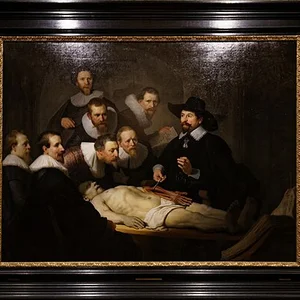

A Dutch physician and anatomist of the 17th century, Nicolas Tulp is famous for his public anatomy lessons in Amsterdam. He was immortalized by Rembrandt's painting *The Anatomy Lesson of Dr. Nicolaes Tulp* (1632).
Nicolas Tulp
Nicolas Tulp
8 min read
Frequently asked questions
Key Facts
- Born in 1593 in The Hague, died in 1674 in Amsterdam
- Praeceptor chirurgorum (master of surgeons) of the Amsterdam surgeons' guild from 1628
- His 1632 anatomy lesson was immortalized by Rembrandt's painting
- Published *Observationes Medicae* in 1641, a landmark medical reference work
- Burgomaster of Amsterdam four times between 1654 and 1672
Works & Achievements
Tulp's principal scientific work, bringing together 228 clinical observations ranging from tropical diseases to rare anatomical malformations. Translated and reprinted several times, it established Tulp as an international medical authority in the 17th century.
Tulp was among the first to precisely describe the valve separating the small intestine from the colon, long referred to as the "Tulp valve" by the medical community. This anatomical contribution speaks to the quality of his dissections and the sharpness of his observations.
Tulp played a central role in drafting this first official compendium of approved medicines in Amsterdam. This pioneering regulatory text aimed to protect residents from falsified or dangerous remedies sold by charlatans.
Although the work is by Rembrandt, Tulp was its patron and principal subject, reflecting his exceptional social standing. This group portrait, painted for the surgeons' guild, immortalized an actual dissection and stands as an extraordinary document on medicine during the Dutch Golden Age.
As *praelector anatomiae* for twenty-five years, Tulp transformed surgical education by imposing rigorous scientific standards and official examinations on candidates. This reform made a lasting contribution to the professionalization of medicine in the Netherlands.
Anecdotes
His real name was Claes Pieterszoon. He adopted the name “Tulp” (meaning tulip in Dutch) after the tulip-shaped sign he had hung above his front door. This was a particularly shrewd choice at a time when tulip mania was sweeping the Netherlands, making him an instantly recognizable physician in Amsterdam.
The anatomy lesson painted by Rembrandt in 1632 was no ordinary class: Tulp was dissecting the corpse of Aris Kindt, a criminal hanged for theft. These public dissections, permitted only once or twice a year in winter to prevent decomposition, drew physicians, surgeons, and curious onlookers who paid for admission as if attending a theatre performance.
Tulp discovered and accurately described the ileocecal valve, the fold that separates the small intestine from the large intestine and prevents the backflow of matter. This anatomical structure was long known as “Tulp’s valve” in his honor, a testament to the precision of his observations on the human body.
Although he is remembered above all as a physician, Tulp was also a prominent politician: he served as burgomaster (burgemeester) of Amsterdam on four separate occasions. This dual role allowed him to make concrete improvements to the sanitary conditions of what was then the wealthiest city in the world.
Eager to protect Amsterdam’s residents from charlatans, Tulp contributed to drafting the first Amsterdam pharmacopoeia in 1636, standardizing the composition of medicines sold in the city. This pioneering work was one of the earliest attempts at pharmaceutical regulation in Europe.
Primary Sources
Tulp records 228 detailed clinical observations, including descriptions of tropical diseases, anatomical malformations, and extremely rare surgical cases. The work was reprinted several times in the 17th century, attesting to its importance in European medicine.
The first official register of approved medicines in Amsterdam, drawn up under the aegis of Tulp and the Collegium Medicum. It aimed to standardize pharmaceutical preparations and combat fraudulent remedies sold to the population.
The guild's archives record Tulp's appointment as praelector anatomiae in 1628 and document the dates and conditions of the public anatomy lessons he led for twenty-five years.
This work commissioned by the surgeons' guild depicts Tulp dissecting the left arm of an executed criminal before seven assistants. The painting is a valuable visual document on 17th-century medical practice, the instruments used, and the social standing of the physician.
Key Places
Tulp's birthplace and the setting of his entire medical and political career. In the 17th century, Amsterdam was the foremost commercial and intellectual hub in the world, providing an ideal environment for the development of modern, institutionalized medicine.
The anatomical theatre housed in the Waag, a former medieval city gate repurposed as a public building, where Tulp presided over numerous public dissection lectures. The sessions, open to paying audiences, brought together health professionals and curious onlookers alike, all drawn to this scientific spectacle.
The most prestigious university in the Dutch Republic, where Tulp earned his doctorate in medicine in 1614. Leiden was at the time one of Europe's great centres of medical education and anatomical research, attracting students from across the continent.
The city where Tulp retired in his later years and where he died in 1674. As the seat of the Dutch Republic's political institutions, The Hague was the heart of the Dutch government that Tulp had long moved in as a former burgomaster of Amsterdam.
Typical Objects

A thin-bladed forged steel instrument used to incise flesh during dissections. The wooden or bone handle allowed for precise grip during demonstrations before large audiences in the anatomical amphitheatre.

The founding treatise of modern anatomy published in 1543, enriched with engraved plates of unmatched precision. Tulp drew on it for his lessons and cited it as the authoritative scientific reference.

The official garment worn by Tulp during public anatomy lessons, clearly visible in Rembrandt's painting. This solemn attire distinguished the learned physician from barber-surgeons and lent authority and prestige to the ceremony.

A large solid-wood table on which the cadaver was laid during public lessons at the Theatrum Anatomicum. Slightly tilted so the audience could see, it was the centrepiece of Amsterdam's anatomical theatre.

A compendium of medicinal formulas listing the ingredients, dosages, and preparation methods of approved remedies. The official Amsterdam pharmacopoeia, to which Tulp contributed, was the first to be printed and distributed throughout the city.

A set of metal instruments used to grasp, explore, and examine organs during dissections. These tools, stored in leather cases, were essential equipment for every anatomist physician of the 17th century.
School Curriculum
Vocabulary & Tags
Key Vocabulary
Tags
Daily Life
Morning
Tulp began his day with house calls to his wealthy patients, traveling through Amsterdam on horseback or by carriage along the canals. He also held consultations at his own home on the Keizersgracht, where he received patients and colleagues in his well-equipped medical study.
Afternoon
Afternoons were often devoted to his duties at the surgeons' guild, where he oversaw teaching and arbitrated disputes between practitioners. In winter, during dissection sessions, he presided over public lessons at the Theatrum Anatomicum, methodically narrating his gestures before an attentive — and sometimes awestruck — audience.
Evening
As a burgomaster and member of the Collegium Medicum, Tulp frequently spent his evenings at city council meetings and municipal affairs. He also entertained merchants, artists, and scholars at his table, taking an active part in the intense intellectual and social life of seventeenth-century Amsterdam.
Food
The table of a prosperous Dutch physician in the seventeenth century was generous: salted herring, smoked fish, meat dishes in sauce, white bread, a variety of cheeses, and light ales. Tulp, ever the prudent physician, advocated dietary restraint in his writings, recommending moderate eating and varied foods as the foundation of good health.
Clothing
In daily life, Tulp wore the sober, dark attire of Amsterdam's Calvinist bourgeoisie: black doublet and breeches, a wide starched white collar (either a ruff or the flat collar fashionable at the time), and a broad-brimmed hat. For official ceremonies, he donned his black *praelector*'s gown — visible in Rembrandt's painting — a mark of his recognized scientific authority.
Housing
Tulp lived in a large townhouse on one of Amsterdam's main canals, as attested by the city's tax records. His home included a medical consulting room on the ground floor, a library stocked with scholarly treatises, and most likely a cabinet of curiosities where he kept anatomical specimens and rare natural objects.
Historical Timeline
Period Vocabulary
Liens externes & ressources
Références
Œuvres
Observationes Medicae
1641
Description de la valvule iléo-cæcale (valvule de Tulp)
vers 1630
Pharmacopoea Amstelredamensis (contribution majeure)
1636
La Leçon d'anatomie du docteur Tulp (sujet du tableau de Rembrandt)
1632
Réforme de l'enseignement chirurgical à Amsterdam
1628-1653