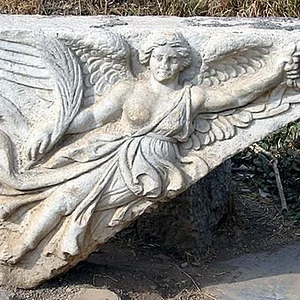

Nike is the personified goddess of victory in Greek mythology. Daughter of Pallas and Styx, she is depicted as winged, holding a laurel wreath or a palm branch. She accompanies Zeus and Athena and presides over both military and athletic victories.
Nike
Nike
8 min read
Frequently asked questions
Key Facts
- Nike is the daughter of the Titan Pallas and the nymph Styx
- She is depicted with wings, a symbol of speed and divine elevation
- Her most famous statue, the Winged Victory of Samothrace (c. 190 BCE), is housed in the Louvre
- She lends her name to the Wingless Nike (Nike Apteros) statue on the Acropolis in Athens (c. 420 BCE)
- Her image was adopted by the Romans under the name Victoria, tutelary goddess of the legions
Works & Achievements
Masterpiece of Hellenistic sculpture depicting Nike alighting on the prow of a ship, wings outstretched. Housed in the Louvre, it is one of the most admired ancient sculptures in the world.
Elegant Ionic temple designed by Callicrates, dedicated to the winged goddess of victory. Its sculpted friezes depicted battles against the Persians, linking military victory with divine protection.
Marble statue by Paionios showing Nike in full flight, her drapery billowing in the wind, mounted on a nine-metre triangular pedestal. Dedicated by the Messenians as a votive offering to Zeus after their victory.
Colossal chryselephantine statue in which Athena held in her palm a one-metre winged Nike. Though long lost, it is known through numerous ancient copies and written accounts.
The goddess Nike appears on several metopes and panels of the Parthenon frieze, presiding over processions and sacrifices in honour of the victorious gods.
Many Greek cities in Sicily (Syracuse, Akragas) and Macedonia minted coins depicting Nike in flight or crowning a charioteer, associating their political power with divine victory.
Anecdotes
During the Titanomachy, the war between the Olympian gods and the Titans, Nike was one of the first to join Zeus's side. Her mother Styx had led her children — Nike, Zelus (Emulation), Kratos (Strength), and Bia (Violence) — to Olympus to offer their help. As a reward, Zeus granted Styx the privilege of being the sacred oath of the gods, and Nike remained forever at the side of the master of Olympus.
On the Athenian Acropolis stood a temple dedicated to Athena Nike, completed around 420 BCE. The cult statue inside depicted a wingless Nike — a unique distinction. According to Pausanias, the Athenians had deliberately removed the goddess's wings so that she could never fly away from their city and abandon them.
The Winged Victory of Samothrace, sculpted around 190 BCE, is one of the most famous statues of Antiquity. It depicts the goddess alighting on the prow of a stone ship, her wings spread against the wind, as if she had just landed to announce a naval victory. Discovered in 1863 on the island of Samothrace, it is now displayed at the Louvre Museum in Paris.
At the Olympic and Panhellenic Games, Nike was ever-present. The winner of an event received a laurel wreath — the goddess's emblematic attribute — and poets such as Pindar invoked Nike in their odes to celebrate victorious athletes. Athletic victory was thus experienced as a divine gift, a grace bestowed by the goddess herself.
In the famous chryselephantine statue of Athena created by Phidias for the Parthenon (around 438 BCE), the goddess of wisdom held in her right hand a small winged figurine of Nike about one meter tall. This iconographic detail illustrated the close alliance between wisdom and victory in Greek thought: lasting triumph can only be achieved through intelligence.
Primary Sources
And Styx, daughter of Ocean, was joined to Pallas and bore in her halls Zelus and trim-ankled Nike, and she brought forth Kratos and Bia, glorious children.
Golden-winged Nike, you who preside over the sacred games, hear my prayer: grant glory to him whose feet were swiftest on the track at Olympia.
There is also a sanctuary of Athena Nike. The statue is wingless; the Athenians call her Apteros. I have heard that this is so Victory may always remain among them and never depart.
The father Zeus took up his golden scales and placed in them the fates of the two armies; he lifted the balance, and the fatal day of the Trojans sank down toward Hades.
Victory wreathed in gold, daughter of Zeus, governs the destiny of mortals; her wings bear aloft those she chooses.
Key Places
Home of the Olympian gods, where Nike sits alongside Zeus and Athena. It is from Olympus that she descends to crown victors on earth.
Small Ionic temple built around 427 BC on the southwest bastion of the Acropolis, housing the statue of the Apteros Nike (wingless). It is one of the main cult sites of the goddess in Greece.
Religious heart of the Olympic Games, where the Nike of Paionios stood and where victors received their crown under the symbolic gaze of the goddess. Numerous votive offerings to Nike have been found there.
Island in the Aegean Sea where the famous Winged Victory of Samothrace was discovered in 1863. This Hellenistic statue likely commemorated a great naval victory and adorned a sanctuary on the rock overlooking the sea.
Temple of Athena on the Acropolis where the colossal chryselephantine statue by Phidias stood, depicting Athena holding a figurine of Nike in her hand — a symbol of the union between divine wisdom and victory.
Typical Objects

Nike's primary attribute, the woven laurel crown symbolizes the glory bestowed upon the victor. The goddess places it with her own hands upon the heads of heroes and athletes to consecrate their triumph.

A palm branch that Nike frequently holds in her depictions, a symbol of victory and immortality. Winners at the Panhellenic Games received a palm branch in addition to their crown.

Nike's great wings are her most recognizable iconic attribute. They symbolize the swiftness of victory and its often unexpected nature — glory swoops down upon the chosen one like a bird from the sky.

A shallow cup used to pour liquid offerings to the gods. Nike is often depicted holding a phiale to perform libations celebrating military or athletic successes.

A structure erected on battlefields using weapons taken from the enemy, dedicated to Nike. The goddess is sometimes depicted erecting this monument herself to mark the turning point of victory.

A votive plaque offered to Nike in her sanctuaries by those who had won a victory. These tablets often bore the victor's name and the nature of the success achieved.

A strip of white cloth or colored wool tied around the victor's forehead or arms. Nike is depicted tying this ribbon, a symbolic gesture of the divine consecration of triumph.
School Curriculum
Vocabulary & Tags
Key Vocabulary
Daily Life
Morning
At dawn on Olympus, Nike rises with the gods, ready to attend Zeus or Athena in their divine councils. She watches over the prayers of soldiers and athletes who make offerings to her before their trials, drinking in the scents of myrrh and incense rising from Greek sanctuaries.
Afternoon
When a battle or competition unfolds, Nike descends in swift flight from the celestial heights. She soars over battlefields or stadiums, invisible to mortals, tipping the scales in favor of those chosen by the gods. Her passing is sometimes felt as a sudden gust of wind or a flash of light.
Evening
As night falls, Nike crowns the day's victors, placing the laurel stephanos on their brow or tying the band of glory around their arm. She then joins the banquets on Olympus, where she sometimes serves as cupbearer to the gods, pouring divine nectar, celebrated as the messenger of Zeus's victory.
Food
Like all Olympian gods, Nike feeds on ambrosia and drinks nectar, the divine foods that grant immortality and preserve eternal youth. She shares these feasts with Zeus, Athena, and the other Olympians after every great victory celebrated on Olympus.
Clothing
Nike is depicted wearing a thin chiton with soft, flowing drapery, often white or saffron in color, which billows in the wind as she flies. A belt (zona) cinches her waist, and her winged or gilded sandals complete her attire. Her great white or golden wings are her most distinctive feature.
Housing
Nike resides on Olympus, in Zeus's dwelling, which she has rarely left since Styx brought her there during the Titanomachy. She holds a place of honor near the throne of the supreme god, ever ready to fly at his right hand during great cosmic battles or divine decisions.
Historical Timeline
Period Vocabulary
Liens externes & ressources
Références
Œuvres
Niké de Samothrace
Vers 190 avant J.-C.
Temple d'Athéna Niké (Acropole d'Athènes)
427-424 avant J.-C.
Niké de Paionios (Olympie)
Vers 421 avant J.-C.
Athéna Parthénos de Phidias (reconstitution)
438 avant J.-C.
Frise des Panathénées (Parthénon)
Vers 442-438 avant J.-C.
Monnaies à l'effigie de Niké (Sicile et Macédoine)
Ve-IVe siècles avant J.-C.