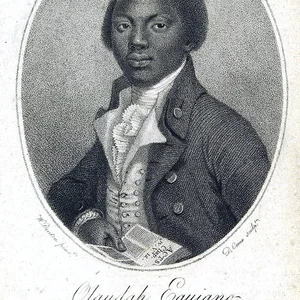

Olaudah Equiano (c. 1745-1797), also known as Gustavus Vassa, was a deported African slave who bought his own freedom before becoming one of the leading figures of the British abolitionist movement. His autobiography, published in 1789, brought the horror of the slave trade to a wide audience.
Olaudah Equiano(1745 — 1797)
Olaudah Equiano
7 min read
Frequently asked questions
Key Facts
- Born around 1745, deported as a child into slavery from Africa (Igbo region, present-day Nigeria) through the triangular trade
- Bought his freedom in 1766 with the savings he had earned through trade
- Published his autobiography 'The Interesting Narrative of the Life of Olaudah Equiano' in 1789
- Became a major figure of the British abolitionist movement (the 'Sons of Africa' group)
- Died in London in 1797, ten years before Parliament abolished the slave trade (1807)
Works & Achievements
A pioneering autobiography and the first major slave narrative written in English; it exposed the horror of the slave trade to British public opinion and became a best-seller of its time.
Equiano travelled across England, Scotland and Ireland to sell his book and plead the cause of abolition before the public, working as a travelling activist.
Equiano informed the abolitionist Granville Sharp of the massacre of enslaved people thrown overboard from the ship Zong, helping to bring this affair to public attention.
A public letter addressed to the Queen of England imploring her compassion on behalf of the enslaved people of the West Indies, asserting the political voice of a free African.
Appointed to manage supplies for the colony intended for London's poor Black community; he denounced the organisation's abuses before being removed from his post.
Equiano was a leading figure in this group of London Africans who wrote letters and opinion pieces against the slave trade, one of the first Black political organisations in Britain.
Anecdotes
Kidnapped as a child from his village in Igboland (present-day Nigeria) around the age of eleven, Equiano was sold several times before being loaded onto a slave ship bound for the West Indies. In his book, he describes his terror upon discovering the ocean and the white men, whom he at first believed to be cannibals come to devour him.
Renamed Gustavus Vassa by a captain in the British navy — after a sixteenth-century Swedish king — Equiano at first hated this imposed name and tried to refuse it, which earned him beatings. He ended up bearing it his whole life while signing his autobiography with both of his names.
Equiano learned to read, write, and do arithmetic during his years of servitude, notably from sailors and through the Bible. Having become a sailor and small trader, he saved enough money by reselling goods in ports to buy his own freedom in 1766, for the sum of 40 pounds sterling.
His 1789 autobiography met with resounding success: nine editions appeared during his lifetime and the book was translated into several languages. Equiano travelled across Great Britain and Ireland to sell it himself and give lectures, becoming one of the first Africans to undertake a genuine campaigning tour.
In 1773, Equiano took part in an expedition to the Arctic seeking a sea passage to India by way of the North Pole, alongside the future admiral Horatio Nelson, then a young officer. The ship was nearly trapped in the ice near Spitsbergen.
Primary Sources
The shrieks of the women, and the groans of the dying, rendered the whole a scene of horror almost inconceivable.
My master then said he would not be worse than his promise; and, taking the money, told me to go to the Register Office, and get my manumission drawn up.
I supplicate your Majesty's compassion for millions of my African countrymen, who groan under the lash of tyranny in the West Indies.
One day, when all our people were gone out to their works as usual, and only I and my dear sister were left to mind the house, two men and a woman got over our walls, and in a moment seized us both.
Key Places
Equiano's region of origin, where he was born in a village before being kidnapped as a child. He describes its customs in his book.
Island in the British West Indies where Equiano was landed after the Middle Passage and briefly put up for sale.
Capital where Equiano spent much of his free life, published his autobiography and campaigned for abolition. He died there in 1797.
Island where Equiano worked for the Quaker merchant Robert King and saved the money that allowed him to buy his freedom in 1766.
Polar archipelago approached during the 1773 expedition in which Equiano took part as a sailor, searching for a passage to India.
Town in England where Equiano married Susannah Cullen in 1792, sealing his place within British society.
Typical Objects

Equiano's memoir, published in 1789, sold by subscription and during his speaking tours. A central tool of abolitionist propaganda.

A legal document attesting that Equiano had bought his freedom in 1766. He kept it carefully as proof of his status as a free man.

Equiano, an experienced sailor, learned to use the instruments for calculating a ship's position at sea. Navigation was part of his work as a seaman.

Iron shackles used to chain captives in the holds of slave ships. Equiano describes their cruel use in his account of the Middle Passage.

Equiano converted to Christianity and was baptized; reading the Bible nourished his faith and his moral case against slavery.

An engraved portrait of Equiano placed at the front of his autobiography, showing him dressed as a European gentleman holding a Bible. The image was meant to assert his dignity and his humanity.
School Curriculum
Vocabulary & Tags
Key Vocabulary
Daily Life
Morning
Now a free man and a sailor, Equiano often began his days aboard a ship or in a port, checking the cargo and preparing the maneuvers. On land in London, he devoted his mornings to correspondence and to preparing his lectures.
Afternoon
In the afternoon, as a sailor and small trader, he bought and resold goods (glassware, fruit, fabrics) to supplement his earnings. Later, he spent this time meeting publishers, subscribers, and abolitionist campaigners.
Evening
In the evening, Equiano read the Bible and other books, wrote his memoirs, or talked with other members of London's Black community. His Christian faith held a large place in his moments of reflection.
Food
His food evolved from the yams and other foods of his African childhood to the ordinary fare of sailors: ship's biscuits, salted meat, fish, and whatever the ports of call allowed him to buy. As a free man, he shared the diet of Britain's urban working classes.
Clothing
Once freed, Equiano dressed in the European style, in the coat, waistcoat, and shirt of a gentleman, as shown in the portrait in his book. This careful attire deliberately asserted his dignity and his status as a free and educated man.
Housing
As a slave, he lodged wherever his masters sent him, in the holds of ships or the outbuildings of plantations. As a free man, he lived mainly in lodgings in London, within a rapidly expanding city.
Historical Timeline
Period Vocabulary
Liens externes & ressources
Références
Œuvres
The Interesting Narrative of the Life of Olaudah Equiano, or Gustavus Vassa, the African
1789
Tournées de conférences abolitionnistes
1789-1794
Alerte sur le massacre du Zong
1783
Pétition à la reine Charlotte
1788
Commissaire du projet de Sierra Leone
1787
Engagement au sein des Sons of Africa
1787-1790