 flip
flipSplit pea soup with fine herbs
Split pea soup with fine herbs
Why this dish? This was the everyday fare of a modest Parisian woman: a pulse soup that sticks to the ribs, economical and nourishing, as eaten by city dwellers during the revolutionary days of scarcity when bread and vegetables made the meal.
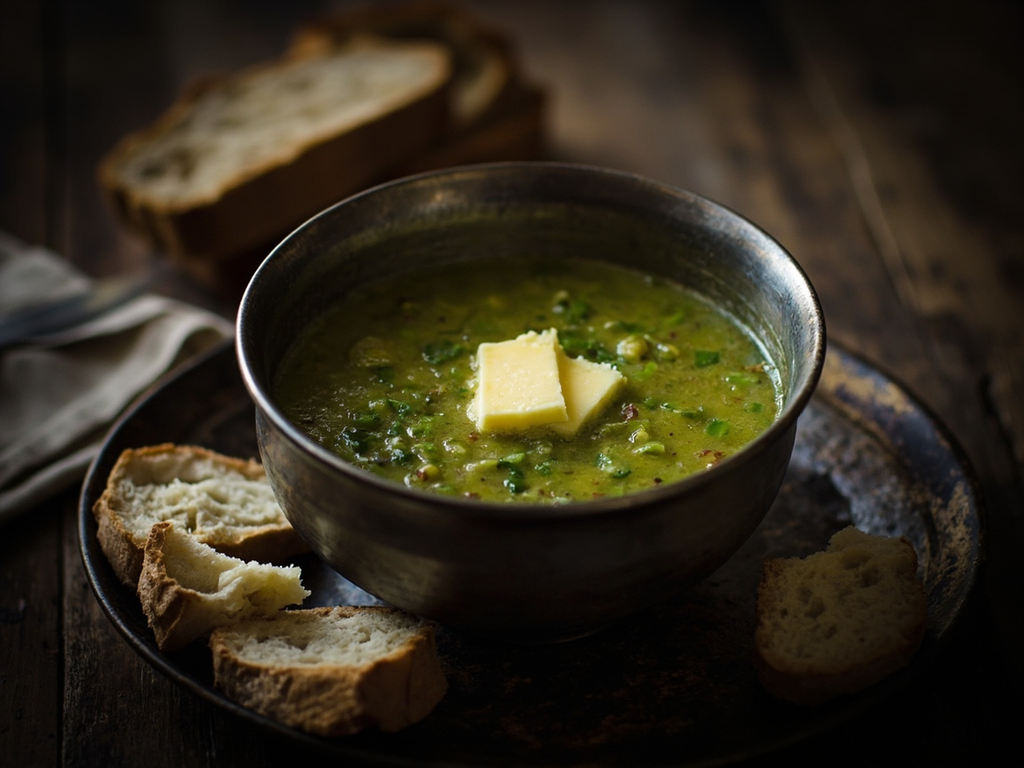
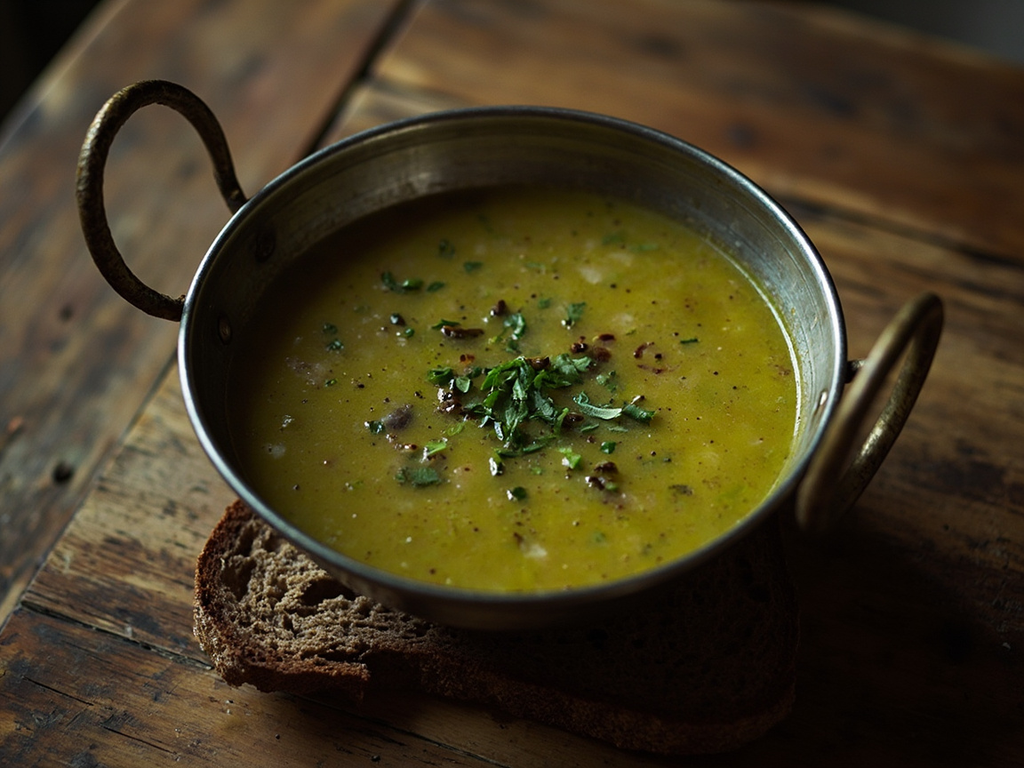
A velvety split pea soup, bound with broth, brightened with a generous bouquet of fresh fine herbs, and served over slices of stale bread. The quintessential daily dish.
You see, citizen: when the city rumbled and bread ran short, it was this soup that I fed my table. Soak the peas overnight, let them melt gently on the corner of the fire, and never forget, at the last moment, to throw in a handful of garden herbs — for even in poverty, I have always said, the mind and the stomach deserve to be treated with dignity. Dip your stale bread into it, and you will see that a frugal meal can be an honest one.
- •Split peas — a good bowlful (base of the soup)
- •Broth (or water) — enough to cover generously (cooking and binding)
- •Onion and leek — one of each (aromatic base)
- •Butter — a good knob (binding and flavor)
- •Fine herbs (parsley, chervil, spring onion) — a bouquet (flavor (signature))
- •Stale bread — a few slices (support at the bottom of the bowl)
Split pea soup with fine herbs
A velvety split pea soup, bound with broth, brightened with a generous bouquet of fresh fine herbs, and served over slices of stale bread. The quintessential daily dish.
Why this dish? This was the everyday fare of a modest Parisian woman: a pulse soup that sticks to the ribs, economical and nourishing, as eaten by city dwellers during the revolutionary days of scarcity when bread and vegetables made the meal.
You see, citizen: when the city rumbled and bread ran short, it was this soup that I fed my table. Soak the peas overnight, let them melt gently on the corner of the fire, and never forget, at the last moment, to throw in a handful of garden herbs — for even in poverty, I have always said, the mind and the stomach deserve to be treated with dignity. Dip your stale bread into it, and you will see that a frugal meal can be an honest one.
Ingredients (period version)
- Split peas — a good bowlful (base of the soup)
- Broth (or water) — enough to cover generously (cooking and binding)
- Onion and leek — one of each (aromatic base)
- Butter — a good knob (binding and flavor)
- Fine herbs (parsley, chervil, spring onion) — a bouquet (flavor (signature))
- Stale bread — a few slices (support at the bottom of the bowl)
Ingredients
- Split peas — 250 g (base of the soup)
- Vegetable or chicken broth — 1.2 L (cooking)
- Onion — 1 (aromatic base)
- Leek — 1 white part (aromatic base)
- Butter — 30 g (binding and flavor)
- Parsley, chervil, and chives — 1 small bunch (flavor (signature))
- Country-style bread, stale — 4 slices (support)
- Salt, pepper — to taste (seasoning)
Method
- Rinse the split peas (no need to soak long, but an hour softens them).
- Melt the butter, sweat the chopped onion and leek without browning.
- Add the peas and broth, bring to a simmer and cook covered for 45 minutes, until the peas fall apart.
- Blend (or mash with a fork for a rustic period texture), season with salt and pepper.
- Place a slice of stale bread in each bowl, pour the soup over it.
- Finely chop the fine herbs and sprinkle generously just before serving.
How it was made : Pulses (peas, lentils, broad beans) were the poor man's meat: filling, storable, and cheap. They were cooked for hours in the family 'pot' and the soup was thickened by passing it through a sieve, lacking blenders. The stale bread placed at the bottom of the bowl, called 'la trempette', avoided any waste.
The contemporary twist : A drizzle of hazelnut oil and a few croutons browned in butter transform this poverty soup into a bistro-style velouté.
Sources : Menon, La Cuisinière bourgeoise, 1746
Olympe de Gouges · Charactorium