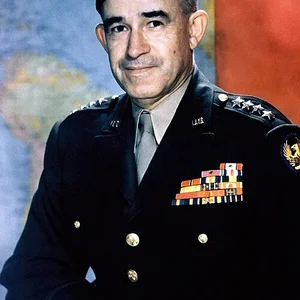

American general of World War II, he commanded U.S. ground forces during the Normandy landings in June 1944. Nicknamed "the G.I.'s general," he later became the first Chairman of the Joint Chiefs of Staff and the last five-star general in the United States.
Omar Bradley(1893 — 1981)
Omar Bradley
États-Unis
7 min read
Frequently asked questions
Key Facts
- Born February 12, 1893 in Clark, Missouri; graduated from West Point in 1915
- Commanded the U.S. II Corps in Tunisia and then Sicily in 1943
- Led the U.S. First Army during the Normandy landings on June 6, 1944
- Commanded the 12th Army Group (over 1.3 million men) during the liberation of Western Europe
- First Chairman of the Joint Chiefs of Staff (1949–1953) and promoted to five-star general in 1950; died April 8, 1981
Works & Achievements
Command of the 1st US Army during the Normandy landings. Bradley coordinated the landings on Utah and Omaha Beach, then the advance toward Cherbourg and Caen, demonstrating remarkable tactical skill under extreme pressure.
Direction of operations that led to the entry of American forces into Paris and the liberation of the French capital. A crucial symbolic event of World War II in Western Europe.
Management of the American response to the last major German offensive. Bradley quickly coordinated the redeployment of forces, blocking the enemy advance and initiating a victorious counteroffensive.
Command of the final advance of the 1st Army to the Rhine, then toward Berlin. Bradley halted his forces at the Elbe to let the Soviets take Berlin, a significant strategic decision.
Bradley's autobiographical account covering his career up to 1951. An essential work for understanding the perspectives of a major American World War II commander and the early years of the Cold War.
First senior U.S. military officer unifying the three armed services. Bradley guided American military strategy in the face of the early Cold War challenges and the Korean War.
Anecdotes
Omar Bradley was nicknamed "the G.I.'s general" because he regularly spent time with his troops, slept in a tent like them, and spoke directly to men of all ranks. This closeness, rare among high-ranking officers, earned him the respect and affection of his soldiers.
During the Normandy landings in June 1944, Bradley commanded the 1st U.S. Army from a small flagship off the Norman coast. Despite difficult communications and initial chaos, he maintained his legendary calm and coordinated thousands of soldiers landing on Utah and Omaha beaches.
Bradley always refused excessive honors and preferred a modest life. Even as a five-star general, he continued to personally write his letters and share morning coffee with his officers, setting him apart from rival generals like Montgomery.
After World War II, Bradley became the first Chairman of the Joint Chiefs of Staff, guiding the U.S. military during the early tensions of the Cold War with the Soviet Union. He advocated for a robust defense without giving in to panic.
In 1950, during the Korean War, Bradley declared that fighting the Chinese mainland in Asia would be "the wrong war, at the wrong place, at the wrong time" — a phrase that became historic, expressing military strategic wisdom.
Primary Sources
"A leader must not only know his craft, but also understand the men who practice it. Soldiers do not follow an officer simply because he wears stripes; they follow him if they trust him and know he cares about them."
"We are going to liberate Europe from Nazi tyranny. Each of you will play a crucial role in this mission. Remember your families, your homes — you will see them again once we have achieved victory."
"Ground operations in Europe have demonstrated the critical importance of coordination between armies and logistics. Victory was only possible thanks to the support of supply lines and unity of command."
Key Places
Site of Bradley's first assignment in 1917, where he gained his initial military experience and associated with other officers of the World War II generation.
Bradley studied here from 1911 to 1915, forming lasting friendships with other future generals. He also taught here after World War I, passing on his experiences to young officers.
Site of Bradley's command during Operation Overlord in June 1944. His decisions there directed thousands of American soldiers through one of the largest amphibious landings in history.
Bradley entered the French capital with the First Army in August 1944, liberating the city after four years of German occupation. This symbolic moment cemented his reputation as a victorious general.
Critical area of the Battle of the Bulge (December 1944 – January 1945) where Bradley coordinated the American counteroffensive against Germany's last major offensive. His handling of this crisis bolstered his military prestige.
Headquarters of the Joint Chiefs of Staff, where Bradley served from 1949 to 1953. Center of American military strategy during the early Cold War, site of his crucial decisions for national defense.
Typical Objects

The olive drab combat uniform bore five-star general shoulder boards, 1st Army insignia, and ribbons for his citations. Bradley refused excessive decorations, keeping a clean, functional appearance in the field.

Bradley traveled in an open jeep, visible to the troops, unlike rival generals who rode in armored convoys. This reinforced his image as a "soldier's general" and his closeness to the men.

The detailed maps of Normandy, the Ardennes, and Germany, annotated with his directives, were essential for coordinating millions of soldiers. Bradley spent hours studying every terrain detail to optimize strategies.

The famous American steel helmet, simply marked with a cross or insignia, which Bradley wore when moving to the front lines. This symbol of simplicity and shared risk with the soldiers made him recognizable and respected.

Bradley used precision military binoculars to observe battlefields and enemy positions. An essential tool for a commander making decisions after direct observation of the terrain.

Bradley constantly took notes during meetings and briefings, writing his orders and correspondence personally. These notes, preserved in military archives, attest to his meticulous preparation.
School Curriculum
Vocabulary & Tags
Key Vocabulary
Tags
Daily Life
Morning
Bradley rose before dawn with his men, often in a Spartan command tent. He started with black, cold coffee, then reviewed the night reports sent by his subordinates. His first calls always concerned the state of the troops and supply lines.
Afternoon
Inspections of positions and troops, tactical briefings with his staff. Bradley toured the lines in his open jeep, spoke directly to soldiers, listened to their concerns. He also spent hours studying detailed maps, planning every move with meticulous precision.
Evening
Writing dispatches, correspondence with Washington and other Allied commanders. Bradley had a simple dinner with his officers (field rations or communal meals), then returned to his makeshift office for late phone calls. He rarely slept more than 5-6 hours, preoccupied with the next day's decisions.
Food
Soldier's diet: field rations (C-rations), black coffee, hard bread, and canned goods. Bradley refused the luxury meals reserved for generals, sharing his troops' austere food. This asceticism bolstered his prestige — no officer could criticize him for excessive privileges.
Clothing
Olive drab combat uniform, discreet gold five-star general's shoulder boards, plain M1 steel helmet. No sartorial pomp: polished but worn boots, faded military shirt. Bradley maintained a functional appearance, without seeking ostentation — unlike some European generals.
Housing
Sparsely furnished command tent: cot, map table, military radio and phone, a few wooden chairs. After victory, austere military quarters in occupied Germany, then at the Pentagon. Bradley always refused spacious residences, living modestly even as commander in chief.
Historical Timeline
Period Vocabulary
Visual Style
Style visuel austère et fonctionnel du commandement américain en Europe (1944-1945) : uniformes kaki et olive usés, cartes d'état-major sur tables en bois, équipements radio et communication, insignes de général cinq étoiles en or discret. Photographies documentaires en noir et blanc contrastées, montrant à la fois l'austérité du commandement et la proximité humaine avec les soldats.
Sound Ambience
Les bruits caractéristiques du commandement militaire de Bradley : transmissions radio, cliquetis de machines à écrire des ordres, discussions tactiques d'officiers, grondements d'artillerie lointaine, moteurs de jeeps, rapports téléphoniques urgents. Ambiance de responsabilité maîtrisée et de leadership ferme dans un contexte de guerre.
Liens externes & ressources
Références
Œuvres
Campagne de Normandie (Opération Overlord)
juin-août 1944
Bataille des Ardennes (riposte et contre-offensive)
décembre 1944 - janvier 1945
Campagne finale vers Berlin et l'Elbe
mars-mai 1945
A Soldier's Story (Mémoires)
1951
Présidence du Comité des chefs d'état-major
1949-1953