 flip
flipCucumber sandwiches for five o'clock
Cucumber sandwiches for five o'clock
Why this dish? In *The Importance of Being Earnest* (1895), Algernon devours all the cucumber sandwiches before his aunt arrives: it is Wilde's most famous gag, become the comic emblem of Victorian tea. Wilde himself lived by the rhythm of these social teas where one showed off as much as one ate.
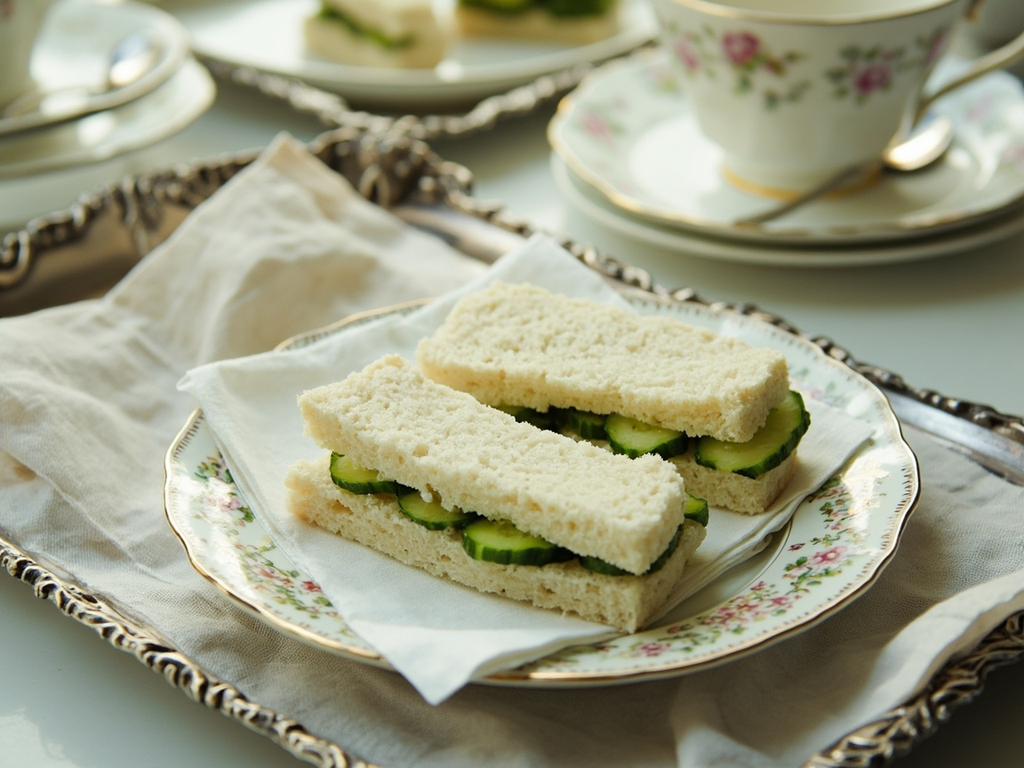
Very thin slices of white bread, buttered, filled with peeled cucumber cut into translucent slivers, lightly salted and brightened with a dash of vinegar. The crusts are removed and they are cut into triangles or fingers. Light, fresh, made to be swallowed casually between witty remarks.
Allow me to serve you, but make haste: there is nothing more tragic than a plate of cucumber sandwiches emptied before one's aunt arrives. The secret, you see, lies in the thinness — the cucumber should be almost an idea, the bread barely a pretext. I have eaten mountains of them while talking too much, for the cucumber has that rare virtue of never contradicting the conversation. Take it from me: one can survive anything except badly served tea.
- •Day-old white bread — a few very thin slices (support)
- •Cucumber — one, firm (filling)
- •Fresh butter — as needed (binder and seal)
- •Fine salt — a pinch (seasoning)
- •Wine vinegar — a few drops (acidity)
Cucumber sandwiches for five o'clock
Very thin slices of white bread, buttered, filled with peeled cucumber cut into translucent slivers, lightly salted and brightened with a dash of vinegar. The crusts are removed and they are cut into triangles or fingers. Light, fresh, made to be swallowed casually between witty remarks.
Why this dish? In *The Importance of Being Earnest* (1895), Algernon devours all the cucumber sandwiches before his aunt arrives: it is Wilde's most famous gag, become the comic emblem of Victorian tea. Wilde himself lived by the rhythm of these social teas where one showed off as much as one ate.
Allow me to serve you, but make haste: there is nothing more tragic than a plate of cucumber sandwiches emptied before one's aunt arrives. The secret, you see, lies in the thinness — the cucumber should be almost an idea, the bread barely a pretext. I have eaten mountains of them while talking too much, for the cucumber has that rare virtue of never contradicting the conversation. Take it from me: one can survive anything except badly served tea.
Ingredients (period version)
- Day-old white bread — a few very thin slices (support)
- Cucumber — one, firm (filling)
- Fresh butter — as needed (binder and seal)
- Fine salt — a pinch (seasoning)
- Wine vinegar — a few drops (acidity)
Ingredients
- White bread — 8 slices (support)
- Cucumber — 1 medium (filling)
- Unsalted butter, softened — 50 g (binder)
- Fine salt — 2 pinches (seasoning)
- White wine vinegar — 1 tsp (acidity)
Method
- Peel the cucumber and slice it very thinly (a mandoline is ideal). Salt the slices, sprinkle with vinegar, and let them drain on paper towels for 15 minutes.
- Butter each slice of bread generously right to the edges (the butter prevents the bread from getting soggy).
- Pat the cucumber dry and arrange it in a single even layer.
- Close the sandwiches, press gently, then cut off the crusts with a sharp knife.
- Cut into triangles or three fingers. Serve immediately on a plate covered with a napkin.
How it was made : In the 19th century, cucumbers were expensive because they were grown in heated greenhouses: serving them signaled refinement. Mrs. Beeton already recommended slicing them very thinly and salting them to draw out moisture. Day-old bread cut better than fresh.
The contemporary twist : A dab of herbed cream cheese under the cucumber and a touch of chopped mint: Aunt Augusta's sandwich updated for today's taste.
Sources : Isabella Beeton, Mrs Beeton's Book of Household Management, 1861 · Oscar Wilde, The Importance of Being Earnest, 1895
Oscar Wilde · Charactorium