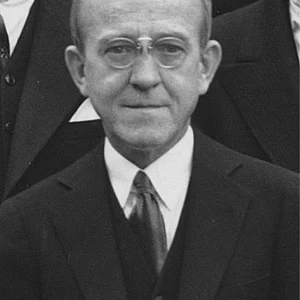

American-Canadian physician and researcher in microbiology and immunology. In 1944, together with Colin MacLeod and Maclyn McCarty, he demonstrated that DNA is the carrier of heredity, laying one of the foundations of molecular genetics.
Oswald Avery(1877 — 1955)
Oswald Avery
Canada, États-Unis
5 min read
Frequently asked questions
Key Facts
- Born on 21 October 1877 in Halifax (Canada), he became an American citizen and spent his career at the Rockefeller Institute in New York
- Studied the pneumococcus and the bacterial transformation discovered by Frederick Griffith in 1928
- In 1944, together with MacLeod and McCarty, published the experiment demonstrating that DNA (and not proteins) is the carrier of hereditary information
- His discovery paved the way for the double helix of Watson and Crick (1953)
- Died on 20 February 1955 in Nashville, without having received the Nobel Prize despite the importance of his work
Works & Achievements
Together with MacLeod and McCarty, Avery proved that it is DNA, not proteins, that carries hereditary traits. A founding discovery of molecular genetics.
Avery showed that the sugar capsule surrounding the pneumococcus determines its virulence and how it is recognized by the immune system, opening the way to modern immunochemistry.
His research established that precise chemical molecules explain how the body tells apart the different types of bacteria.
Avery refined rigorous techniques to isolate and identify active molecules, the methodological basis for his discovery of DNA.
Anecdotes
In 1944, in a small laboratory at New York's Rockefeller Institute, Avery and his colleagues identified DNA as the molecule that carries heredity. At the time, however, almost all biologists believed that genes were made of proteins: their discovery ran against the prevailing view.
Avery was a man of extreme caution: he spent years ruling out every other possible explanation before daring to publish his results. This attention to detail explains why his discovery, revolutionary as it was, was long met with skepticism.
Nicknamed “Fess” (short for “Professor”) by those close to him and his collaborators, Avery was a discreet, unmarried man who lived for his laboratory. He shunned the spotlight and never made any grand public statements about the importance of his discovery.
His work built on a strange experiment carried out in 1928 by Frederick Griffith: dead bacteria could “transform” harmless living bacteria into dangerous ones. Avery devoted years to figuring out which substance caused this transformation — and the answer was DNA.
Although his discovery is now regarded as one of the most important of the 20th century, Avery never received the Nobel Prize. Many historians of science consider this oversight one of the greatest injustices in the history of the Nobel committee.
Primary Sources
The evidence presented supports the belief that a nucleic acid of the desoxyribose type is the fundamental unit of the transforming principle of Pneumococcus Type III.
If we are right, and of course this is not yet proven, it means that nucleic acids are not merely structurally important but that they are functionally active substances determining the biochemical properties of cells.
When the active substance was treated with an enzyme that specifically degrades deoxyribonucleic acid, the transforming power disappeared entirely.
Key Places
Port city where Oswald Avery was born in 1877. His family lived there before emigrating to the United States.
Research center where Avery worked from 1913 to 1948 and made his foundational discovery about DNA.
University where Avery earned his medical degree in 1904 at the College of Physicians and Surgeons.
City where Avery retired to live near his brother and where he died in 1955.
Typical Objects

Instrument used to observe bacteria such as the pneumococcus, invisible to the naked eye. The microbiologist's everyday tool.

Circular glass container in which colonies of bacteria are grown on a nutrient medium. Essential for studying pneumococci.

Small glass tube used to mix, store, and treat bacterial extracts during transformation experiments.

Device that spins tubes at high speed to separate the components of a mixture according to their density. Used to purify cell extracts.

Thin graduated tube used to draw up and precisely measure small quantities of liquid. A basic laboratory gesture.

Notebook in which the researcher meticulously records each experiment, result, and observation. Avery noted his protocols there with painstaking rigor.
School Curriculum
Vocabulary & Tags
Key Vocabulary
Tags
Daily Life
Morning
Avery arrived early at the Rockefeller Institute, where he spent most of his days. The morning was devoted to the meticulous preparation of pneumococcus cultures and the setting up of experiments.
Afternoon
The afternoon unfolded in the laboratory, between observations under the microscope, the handling of test tubes, and discussions with his collaborators MacLeod and McCarty. Avery thought long and hard about each result before drawing a conclusion.
Evening
A discreet and solitary man, Avery often came home late. In the evening, he read scientific publications and carefully prepared the next day's protocols, living almost entirely for his research.
Food
Avery led a sober and frugal life, without excess. Like many New York researchers of his time, he ate simple meals, often quick ones so as not to interrupt his work.
Clothing
At work, he wore the researcher's white coat over the plain suit and tie of the period. Outside the laboratory, he dressed in a classic and understated manner, true to his reserved character.
Housing
Avery lived modestly in New York, close to the Rockefeller Institute. A bachelor, he led an orderly existence centered on his work, with no taste for luxury.
Historical Timeline
Period Vocabulary
Liens externes & ressources
Références
Œuvres
Démonstration que l'ADN est le principe transformant
1944
Travaux sur la capsule polysaccharidique du pneumocoque
années 1920-1930
Études sur la spécificité immunologique des bactéries
années 1920
Mise au point de méthodes de purification des extraits bactériens
années 1940