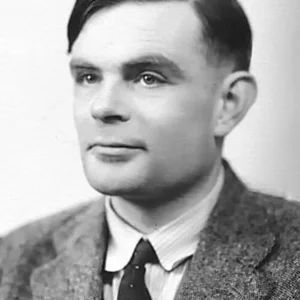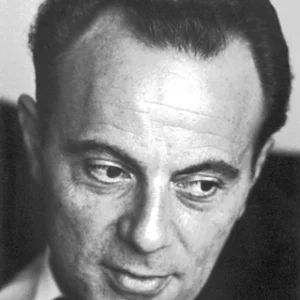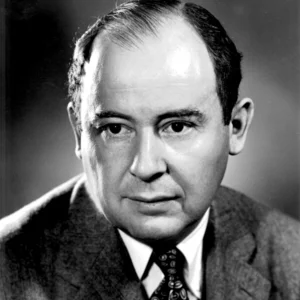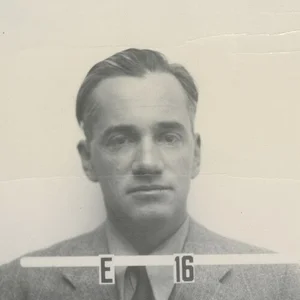

Austrian-born physicist who became a naturalized British citizen, and nephew of Lise Meitner. Together with his aunt, he provided the first theoretical explanation of nuclear fission in 1939. During the Second World War, he took part in the Manhattan Project and co-wrote the Frisch-Peierls memorandum demonstrating the feasibility of an atomic bomb.
Otto Frisch(1904 — 1979)
Otto Frisch
Autriche, Royaume-Uni
6 min read
Frequently asked questions
Key Facts
- Born in 1904 in Vienna, died in 1979 in Cambridge
- In 1938-1939, explained nuclear fission together with Lise Meitner and coined the term “fission”
- In 1940, co-wrote the Frisch-Peierls memorandum with Rudolf Peierls on the feasibility of an atomic bomb
- Took part in the Manhattan Project at Los Alamos (1943-1945)
- Became a professor of physics at the University of Cambridge in 1947
Works & Achievements
First interpretation of the splitting of the uranium nucleus based on the liquid-drop model. The conceptual birth of nuclear energy.
Detection of the high-energy fragments produced by bombarded uranium, proving the reality of the phenomenon.
Frisch borrowed from biology the word for cell division to name the process, and it took hold throughout scientific language.
Calculation showing that a small amount of uranium-235 is enough for a bomb. The trigger for the British and American nuclear programmes.
Work at Los Alamos on critical mass and uranium assemblies, contributing to the development of the atomic bomb.
A career as a respected teacher and researcher, training a new generation of physicists.
A lively autobiography recounting from the inside the discovery of fission and the Los Alamos adventure.
Anecdotes
In December 1938, Otto Frisch spent the Christmas holidays in Sweden with his aunt Lise Meitner. During a walk in the snow, they scribbled calculations on scraps of paper and realized that a uranium nucleus could split in two. It was this discussion in the forest that gave rise to the explanation of nuclear fission.
It was Otto Frisch who gave the phenomenon its name. Searching for a way to describe the splitting of the nucleus, he asked an American biologist for advice: the word “fission” comes from *binary fission*, the division of living cells in biology. The vocabulary of the cell thus passed into atomic physics.
To prove fission experimentally, Frisch set up a rudimentary apparatus in Copenhagen in January 1939 and within a few days detected the highly energetic fragments produced by uranium. He then telephoned his aunt to confirm that their theory held up.
In 1940, having taken refuge in England, Frisch and the physicist Rudolf Peierls wrote a short memorandum estimating that an atomic bomb could be built with only a few kilograms of uranium 235. This document of just a few pages set off first the British and then the American nuclear programs.
At the Los Alamos laboratory, during the Manhattan Project, Frisch carried out the dangerous experiment nicknamed “tickling the dragon's tail”: he brought pieces of enriched uranium together up to the threshold of a chain reaction, coming perilously close to a runaway. One day, his own body reflected enough neutrons to make the counters jump.
Primary Sources
It seems therefore possible that the uranium nucleus has only small stability of form, and may, after neutron capture, divide itself into two nuclei of roughly equal size.
As a weapon, the super-bomb would be practically irresistible. There is no material or structure that could be expected to resist the force of the explosion.
Gradually the idea took shape that this was no chipping or cracking of the nucleus but rather a process to be explained by Bohr's idea that the nucleus was like a liquid drop.
By bombarding uranium with neutrons, heavy nuclear fragments of very high energy were observed, confirming the splitting of the uranium nucleus.
Key Places
Frisch's birthplace, into a cultured family of Jewish descent. He studied physics there before going into exile.
Danish laboratory where Frisch worked in the late 1930s and carried out the experimental confirmation of fission in 1939.
Site of the 1938 Christmas holidays where, together with Lise Meitner, Frisch worked out the theoretical explanation of fission during a walk in the snow.
Where Frisch, as a refugee, collaborated with Rudolf Peierls and in 1940 wrote the founding memorandum on the atomic bomb.
Secret laboratory of the Manhattan Project where Frisch conducted experiments on the critical mass of enriched uranium.
City where Frisch became a professor of physics in 1947; he continued his career there and died there in 1979.
Typical Objects

Gas-filled detector that measures the energy of charged particles. Frisch used it to spot the very energetic fragments that proved fission.

Small radioactive source emitting neutrons used to bombard uranium nuclei. A basic tool of fission experiments.

A few-page typed document estimating the critical mass needed for a uranium-235 bomb. A founding text of the Allied nuclear programmes.

Analog sliding calculation instrument used by physicists before the computer to multiply and quickly estimate orders of magnitude.

An arrangement of enriched uranium elements brought rapidly together to briefly reach criticality. Frisch used it at Los Alamos during high-risk experiments.

Tube that detects ionizing radiation through a click or a needle deflection. Essential for tracking radioactivity in the laboratory.
School Curriculum
Vocabulary & Tags
Key Vocabulary
Tags
Daily Life
Morning
Like many physicists of his era, Frisch often began his day in the laboratory, checking his detectors and radioactive sources. Mornings were devoted to delicate experiments demanding calm and precision.
Afternoon
Afternoons combined calculations on the slide rule, reading journals like *Nature*, and long discussions with his colleagues. At Los Alamos, these informal exchanges at the blackboard advanced research as much as the hands-on experiments did.
Evening
An excellent pianist, Frisch relaxed in the evening by playing music, a talent inherited from his Viennese family. He also enjoyed conversation, humour and writing, which he later took up in his memoirs.
Food
His diet followed that of mid-twentieth-century Europe, then wartime rationing in England. At Los Alamos, isolated in the desert, he shared the simple communal meals of the laboratory community.
Clothing
Frisch wore the sober suit, shirt and tie of the academic of his time, with a lab coat for experiments. In the secret zone, his identification badge was mandatory.
Housing
An émigré again and again, he lodged in modest boarding houses and rooms in Hamburg, London and then Birmingham. At Los Alamos, he lived in the temporary barracks of the military site surrounded by barbed wire.
Historical Timeline
Period Vocabulary
Liens externes & ressources
Références
Œuvres
Explication théorique de la fission nucléaire (avec Lise Meitner)
1939
Confirmation expérimentale de la fission
1939
Invention du terme « fission »
1939
Mémorandum Frisch-Peierls
1940
Participation au projet Manhattan
1943-1945
Chaire de physique à Cambridge (laboratoire Cavendish)
1947
Mémoires « What Little I Remember »
1979