 flip
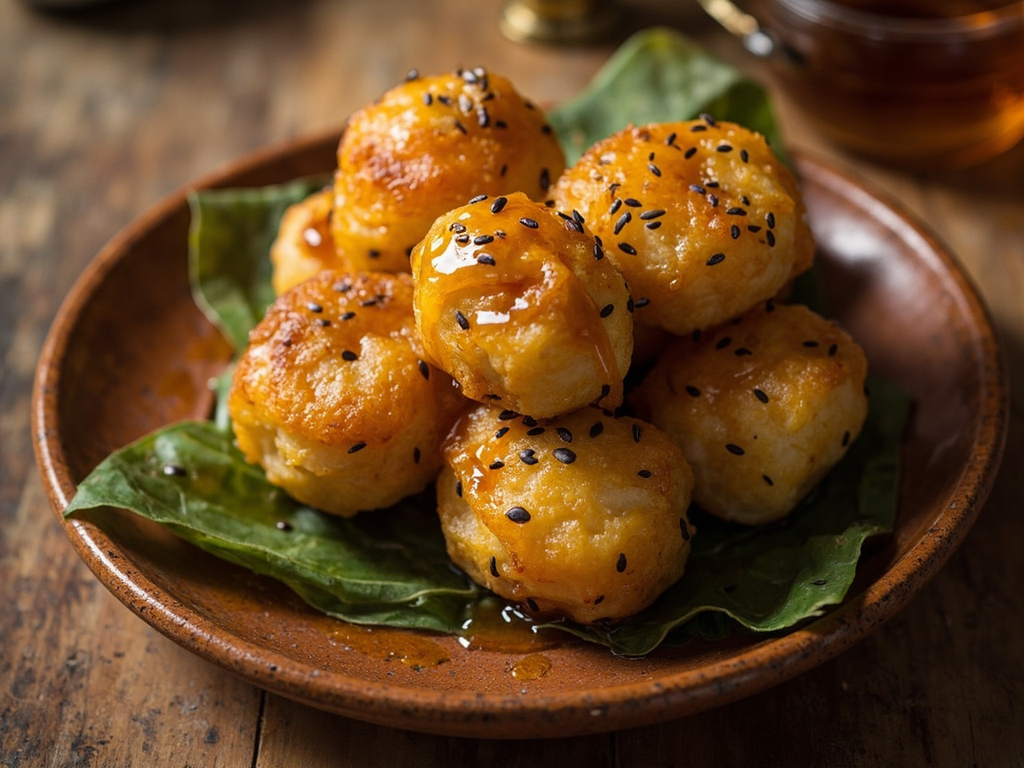
flipGlobi with honey and poppy seeds
Globi with honey and poppy seeds
Why this dish? Poet of pleasures and elegant banquets, which he describes in *The Art of Love*, Ovid frequented refined Roman society where the cena ended with honeyed sweets. These round fritters opened the mensae secundae, that festive moment when poetry and wine flowed.
Small balls of semolina and fresh cheese, fried then rolled in warm honey and poppy seeds. A festive dessert already described by Cato, crunchy outside, melting inside.
Ah, the sweet moment when, the dishes cleared, the honey is brought! Trust a poet who knows the price of pleasures: we knead fresh cheese with the finest flour, roll small balls, plunge them into bubbling fat until they turn golden like a summer evening. Then we bathe them in honey and sprinkle poppy seeds — and there, reader, the tongue itself begins to compose verses. At my table, that is how we prolonged the night.
- •Fresh cheese (curd) — equal parts with flour (melting binder)
- •Fine wheat flour (spelt semolina) — equal parts (structure)
- •Honey — generously (sweet coating)
- •Poppy seeds — a pinch (garnish)
- •Fat or oil for frying — a bath (cooking medium)
Globi with honey and poppy seeds
Small balls of semolina and fresh cheese, fried then rolled in warm honey and poppy seeds. A festive dessert already described by Cato, crunchy outside, melting inside.
Why this dish? Poet of pleasures and elegant banquets, which he describes in *The Art of Love*, Ovid frequented refined Roman society where the cena ended with honeyed sweets. These round fritters opened the mensae secundae, that festive moment when poetry and wine flowed.
Ah, the sweet moment when, the dishes cleared, the honey is brought! Trust a poet who knows the price of pleasures: we knead fresh cheese with the finest flour, roll small balls, plunge them into bubbling fat until they turn golden like a summer evening. Then we bathe them in honey and sprinkle poppy seeds — and there, reader, the tongue itself begins to compose verses. At my table, that is how we prolonged the night.
Ingredients (period version)
- Fresh cheese (curd) — equal parts with flour (melting binder)
- Fine wheat flour (spelt semolina) — equal parts (structure)
- Honey — generously (sweet coating)
- Poppy seeds — a pinch (garnish)
- Fat or oil for frying — a bath (cooking medium)
Ingredients
- Well-drained ricotta (or brousse cheese) — 150 g (melting binder)
- Fine durum wheat semolina (or spelt flour) — 150 g (structure)
- Liquid honey (mixed flower or thyme) — 6 tbsp (coating)
- Poppy seeds — 2 tsp (garnish)
- Neutral oil for deep frying — 1 bath (approx. 500 ml) (cooking medium)
Method
- Mix the ricotta and semolina until a smooth, homogeneous dough forms; let rest for 15 min.
- Form small balls the size of a walnut.
- Heat the oil to 170 °C and fry the globi in small batches until golden.
- Drain on a cloth, then immediately roll in warmed honey.
- Sprinkle with poppy seeds and serve warm.
How it was made : Cato the Elder describes globi in his *De Agricultura*: they were made with cheese and semolina, fried in hot fat, then coated with honey and sprinkled with poppy seeds. They were a festive sweet, ancestor of our doughnuts.
The contemporary twist : Presented in a shiny pyramid on a fig leaf, with a drizzle of rosemary honey spooned over in front of guests.
Sources : Cato the Elder, De Agricultura, 79
Ovid · Charactorium