
Pandora is the first female figure in Greek mythology, created by the gods to punish humanity. She receives a jar (or box) containing all the evils of the world, which she opens out of curiosity, releasing suffering among humankind. Her myth illustrates the consequences of disobedience and the human condition.
Pandora
Pandora
8 min read
Frequently asked questions
Key Facts
- Pandora was created by Hephaestus on Zeus's orders, in response to Prometheus stealing fire
- Gifted with various qualities by the gods (beauty, eloquence, grace) in the Homeric versions
- Receives a jar (according to Hesiod) or box containing all the evils of humanity
- Opens the jar out of curiosity, or at the encouragement of Epimetheus (her husband), releasing suffering upon the world
- Represents the first mortal woman in Greek cosmogony according to Hesiod (Theogony and Works and Days)
Works & Achievements
A vessel containing all the evils of the world (diseases, suffering, vices) that Pandora opens out of curiosity, releasing plagues upon humanity. This is the founding event of the myth, explaining the origin of human suffering.
Pandora is fashioned by the god Hephaestus at Zeus's command to punish humans for receiving fire from Prometheus. She represents the first female figure in Greek mythology.
The union between Pandora and Epimetheus, brother of Prometheus, which seals humanity's fate. This marriage symbolizes the union between feminine curiosity and masculine weakness in the face of temptation.
Hope alone remains in the jar after it is opened, giving humans the ability to endure their suffering. This detail enriches the myth by showing that even in misfortune, humanity retains one consolation.
Anecdotes
Pandora was created by Hephaestus, the blacksmith god, on Zeus's orders as punishment for humanity having received fire from Prometheus. Every Olympian god gave her a gift: Athena taught her the arts, Aphrodite granted her beauty, Hermes gave her the gift of persuasion. Her name means 'she who received all gifts,' reflecting her nature as a being shaped entirely from divine offerings.
In Hesiod's account, Pandora receives a sealed jar (pithos) containing all the evils of mankind: disease, old age, suffering, and death. She is sent to Prometheus and his brother Epimetheus, with a strict prohibition against opening it. This mysterious object represents hidden danger and the consequences of human curiosity.
According to the myth, Pandora opens the jar out of curiosity, despite Epimetheus's warning, releasing all the evils into the world. Only hope (elpis) remains trapped at the bottom of the jar, giving humanity a reason to keep living despite its suffering. This story explains why the world contains so much misfortune while still preserving the capacity to hope.
The myth of Pandora has been passed down primarily through Hesiod's works Theogony and Works and Days, composed in the 8th century BCE. These texts are our main attested sources for the character, making Pandora one of the earliest literary symbols of human fragility in Western culture.
In ancient Greek thought, Pandora embodies the figure of a woman created to be flawed and a source of misfortune for humanity — a portrayal that reflects the prejudices of the time. Her myth shaped Western views of women for centuries and remains a key classroom example for understanding how mythology expresses the values and fears of a civilization.
Primary Sources
And the father of gods and men smiled when he saw this. Then he commanded the renowned Hephaestus to mix earth with water as quickly as possible, and to give her a human voice and the strength equal to that of the immortal goddesses, and to shape the features of a beautiful young girl.
So spoke Zeus who sees far and wide. And all the gods obeyed the eternal father. Straightaway the renowned Pandora, that ruinous gift, emerged from the earth, clothed as a goddess by the wisdom of Pallas Athena.
Pandora was fashioned from a mixture of earth and water. Each god wished to add their gifts: one gave her beauty, another persuasion, a third grace. Thus adorned with all the gifts of the immortals, she was sent to mankind as the most ruinous of all presents.
Zeus commanded Hephaestus to create a woman from earth, to whom all the gods would give a gift. Thus was Pandora born, who received a jar containing all the evils destined for humanity.
Key Places
Home of the Greek gods, where Pandora was created by Hephaestus on Zeus's orders. This is the place of her origin and where the fateful jar containing all the world's evils was crafted.
Major Greek city-state where the myth of Pandora was particularly revered and taught. Athena, patron goddess of Athens, played a role in adorning and shaping Pandora's creation.
The place where Pandora was sent as a gift to Epimetheus, and where she opened the jar, releasing evils upon humankind. This location symbolizes the human condition marked by suffering.
Region of ancient Greece associated with certain versions of the Pandora myth, and home to Epimetheus, the husband to whom Pandora was given as a gift.
The subterranean realm representing the afterlife in Greek mythology, where Pandora is linked to the concepts of death and suffering that she unleashed upon the earth.
Typical Objects

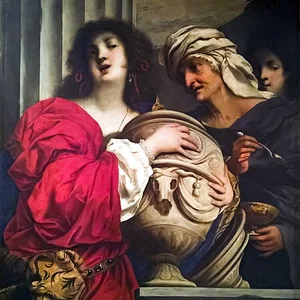
The mythic container holding all the evils of the world, which Pandora opens out of curiosity. It is the central object of the myth, symbolizing the irreversible consequences of disobedience and the unleashing of human suffering.

A linen or wool tunic worn by women in ancient Greece. The emblematic garment associated with Pandora, reflecting the fashion and social status of women in ancient Greek society.

A golden headpiece associated with Pandora, emphasizing her status as a divine creation and her exceptional beauty — a gift from the gods at the time of her making.

A ceramic vessel used in everyday ancient Greek life to carry and store water. A representative object of women's domestic life in that era.

A grooming and beauty accessory used by women in ancient Greece. It symbolizes Pandora's vanity and the importance placed on appearance in Greek mythology.

A terracotta or bronze implement used to light the interiors of ancient Greek homes. A typical domestic object representing women's daily life and household lighting.

A spinning tool characteristic of women's work in ancient Greece, representing domestic tasks and the primary female occupation: weaving and spinning wool.

A basket used to hold wool and weaving tools. An emblematic object of women's domestic work and the craft skills expected of women in ancient Greece.
School Curriculum
Vocabulary & Tags
Key Vocabulary
Daily Life
Morning
Pandora wakes in the divine dwelling assigned to her after her creation. She performs her morning ritual using water and scented oils provided by the gods. She puts on her divine adornments and pays careful attention to her appearance, for she embodies the beauty fashioned expressly by the gods.
Afternoon
Pandora spends the afternoon in typically divine feminine pursuits: conversing with other deities, strolling through the divine gardens, or practicing weaving and embroidery. She is often observed or visited, as her creation makes her an object of fascination and curiosity among the inhabitants of Olympus.
Evening
As day fades, Pandora joins the divine banquets or gatherings in the halls of the gods. She engages in conversation with deities and celestial beings. Before rest, she may gaze down upon the mortal world from above, still unaware of the consequences the act that will mark the history of humanity.
Food
Pandora, as a divine being, feeds on nectar and ambrosia — the immortal foods reserved for the gods of Olympus. These substances grant her immortality and set her apart from mortals. She may also partake of the refined fruits and delicacies prepared at the celestial feasts.
Clothing
Pandora wears divine garments of great beauty, crafted with exquisite skill by deities such as Athena. She is adorned with precious ornaments, golden jewelry, and crowns. Her appearance is deliberately alluring and captivating, reflecting her creation as an instrument of punishment intended for humankind.
Housing
Pandora resides in the divine palaces of Olympus, surrounded by splendor and superhuman luxury. She inhabits magnificent architectural structures adorned with columns, fine marble, and gilded decoration. The setting belongs to the eternal divine world — inaccessible to mortals and governed by laws of its own.
Historical Timeline
Period Vocabulary
Visual Style
Un style pictural inspiré de la céramique grecque antique combinant les techniques du potier (motifs géométriques et décors classiques) avec une atmosphère dramatique de fresque murale. L'éclairage doré et chaleureux souligne le moment fatidique de la création divine et la fragilité humaine face aux forces du destin.
Sound Ambience
Une ambiance sonore mystérieuse et inquiétante évoquant le moment fatidique où Pandore libère les maux du monde, oscillant entre la sérénité tendue d'avant l'ouverture et le chaos musical symbolisant les souffrances humaines déchaînées.
Liens externes & ressources
Références
Œuvres
La Jarre (ou Boîte) de Pandore
mythologie grecque antique
Création de Pandore par Héphaïstos
mythologie grecque antique
Mariage avec Épiméthée
mythologie grecque antique
Libération de l'Espérance (Elpis)
mythologie grecque antique