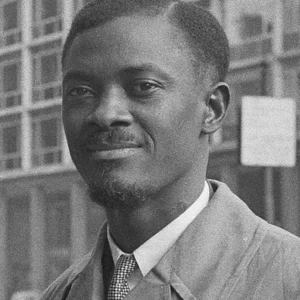

Patrice Lumumba was a Congolese politician and a leading figure in the independence of the Belgian Congo. As the first head of government of the Democratic Republic of the Congo in 1960, he became a symbol of African anti-colonialism before his assassination in 1961.
Patrice Lumumba(1925 — 1961)
Patrice Lumumba
République du Congo (Léopoldville)
6 min read
Frequently asked questions
Famous Quotes
« We are no longer your macaques.»
« History will one day have its say, but it will not be the history taught in Brussels, Paris, Washington or the United Nations; it will be the history taught in the countries freed from colonialism and its puppets.»
Key Facts
- Founded the Congolese National Movement (MNC) in 1958, the first major nationalist party in the Belgian Congo
- Delivered a resounding speech on 30 June 1960 during the independence ceremony, in the presence of King Baudouin
- Became the first Prime Minister of the Republic of the Congo in June 1960
- Removed from office during the Congo Crisis and the secession of Katanga, arrested in the autumn of 1960
- Assassinated on 17 January 1961 in Katanga, with the complicity of foreign powers and local rivals
Works & Achievements
The first Congolese political party with a national, unifying purpose, rising above ethnic and regional divisions.
An address that became emblematic of African anti-colonialism, delivered before King Baudouin.
The first head of government of the independent Democratic Republic of the Congo.
An essay published posthumously setting out his thinking on the future of the Congo.
A diplomatic effort to secure international help against the Katangese secession and Belgian interference.
A meeting with Kwame Nkrumah and other leaders that placed his struggle within the Pan-African movement.
Anecdotes
On June 30, 1960, the day of the Congo's independence, King Baudouin delivered a speech praising Belgium's colonial work. Lumumba, who was not scheduled to speak, then took the floor and bluntly denounced the humiliations and suffering of colonization. This improvised speech became one of the most famous in African history.
Before entering politics, Lumumba worked as a postal clerk in Stanleyville, then as the commercial director of a brewery. It was while selling Polar beer that he travelled across the country and built the network of contacts that would fuel his activist commitment.
In 1956, Lumumba was imprisoned for embezzling postal funds. Far from sidelining him, this ordeal strengthened his political resolve: upon his release, he threw himself fully into the Congolese National Movement, which he helped found in 1958.
Becoming Prime Minister at just 34, Lumumba led the Congolese government for less than three months before being ousted. His downfall came with brutal speed amid the chaos of independence and the Cold War.
After his assassination in January 1961, his body was dissolved in acid to erase all trace of it. In 2022, Belgium returned to his family the only relic ever recovered: a tooth, kept for decades by a Belgian police officer who had taken part in the operation.
Primary Sources
We have known the mockery, the insults, the blows that we had to endure morning, noon and night because we were *negroes*. We have known that the law was never the same depending on whether it concerned a White man or a Black man.
Neither brutality, nor mistreatment, nor torture itself have ever led me to beg for mercy, for I prefer to die with my head held high, my faith unshakable and a deep confidence in the destiny of my country.
A work in which Lumumba sets out his vision of a gradual emancipation and of collaboration between Congolese and Belgians, reflecting his positions before the radicalization of the independence struggle.
Appeal from the Congolese government to the United Nations for military assistance against Belgian aggression and the secession of Katanga proclaimed by Moïse Tshombé.
Key Places
Lumumba's native village, among the Tetela people, in central Congo.
City where Lumumba worked as a postal clerk and which became a stronghold of his supporters.
Capital of the Congo where Lumumba served as Prime Minister in 1960.
Site of the 1960 Round Table Conference that negotiated independence, and where Lumumba championed the Congolese cause.
Secessionist region where Lumumba was transferred and then assassinated in January 1961.
Typical Objects

Lumumba's thin glasses became one of his most recognizable visual attributes, tied to his image as an intellectual and orator.

The manuscript of the 30 June 1960 speech, delivered in French, which denounced colonialism and asserted the dignity of the Congolese people.

The blue flag adorned with a yellow star, symbol of the young Democratic Republic of the Congo proclaimed in 1960.

Lumumba often wore a dark suit, sometimes finished with a bow tie, a mark of the educated Congolese urban elite.

Before politics, Lumumba was a sales manager for a brewery; selling beer allowed him to travel the country and build his network.

Rallies and radio broadcasts were major tools for Lumumba to mobilize a population scattered across an immense territory.
School Curriculum
Vocabulary & Tags
Key Vocabulary
Daily Life
Morning
During his term, Lumumba's mornings were devoted to government meetings and managing a fledgling state in the midst of crisis. From the early hours, he had to mediate between military tensions, secessions, and diplomatic negotiations.
Afternoon
His afternoons were shaped by meetings with provincial officials, foreign diplomats, and UN envoys. Lumumba also drafted numerous telegrams and memos to defend the unity of the country.
Evening
In the evening, he prepared his speeches and radio addresses, honing the eloquence that was his main weapon. His evenings were often extended by consultations with his close collaborators.
Food
Congolese food at the time was based on cassava, rice, river fish, and plantain. As a member of the urban elite, Lumumba also had access to a cuisine influenced by Western habits.
Clothing
Lumumba usually wore Western-style clothing, a shirt and tie or bow tie, along with his distinctive glasses. This attire asserted his status as an intellectual and a modern statesman.
Housing
He first lived in the African neighborhoods of colonial cities such as Stanleyville, where comfort remained modest. Once he became Prime Minister, he occupied an official residence in Léopoldville.
Historical Timeline
Period Vocabulary
Liens externes & ressources
Références
Œuvres
Fondation du Mouvement national congolais (MNC)
1958
Discours d'indépendance du 30 juin 1960
1960
Accession au poste de Premier ministre
1960
Le Congo, terre d'avenir, est-il menacé ?
1961
Appel à l'ONU pour préserver l'unité du Congo
1960
Participation à la Conférence panafricaine d'Accra
1958