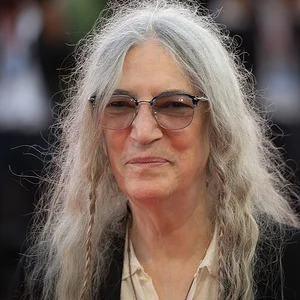

American singer, poet, and artist born in 1946, a pioneer of New York's punk rock movement in the 1970s. Her album *Horses* (1975) blends beat poetry with raw rock, making her an icon of the counterculture.
Patti Smith(1946 — ?)
Patti Smith
États-Unis
8 min read
Frequently asked questions
Famous Quotes
« I'm not a rebel without a cause. I'm a rebel because I have a cause.»
« Art is the only thing that saved me.»
Key Facts
- 1946: Born in Chicago, Illinois
- 1975: Release of the album *Horses*, produced by John Cale, considered the first great punk album
- 1978: Release of *Easter*, which includes *Because the Night*, co-written with Bruce Springsteen
- 2005: *Horses* ranked among the 100 greatest albums of all time by Rolling Stone
- 2010: Publication of *Just Kids*, a memoir about her relationship with Robert Mapplethorpe, winner of the National Book Award
Works & Achievements
Patti Smith's debut album, produced by John Cale of the Velvet Underground. A fusion of beat poetry and raw rock, it is considered one of the founding records of punk and regularly appears in rankings of the greatest albums of all time.
Her third album, containing the single Because the Night, co-written with Bruce Springsteen. Patti Smith's first commercial success, the album blends punk energy, mystical themes, and feminist statements.
Her first published poetry collection, which established Patti Smith as a major poetic voice of the New York counterculture even before her music career began.
A collection of poems and prose pieces illustrating the continuity between her poetic and musical work, cementing her standing in the literary world as much as in the world of rock.
A memoir tracing her intimate friendship with photographer Robert Mapplethorpe in New York during the 1960s and 70s. Winner of the National Book Award, it is now considered a classic of American autobiographical literature.
A meditative account of grief, writing, and memory, in which Patti Smith unfolds a poetic prose that makes this book a fully realized literary work, acclaimed by critics worldwide.
Anecdotes
In 1967, Patti Smith arrived in New York with no money, after working in a toy factory in New Jersey. She met the young photographer Robert Mapplethorpe in Brooklyn: the two broke artists shared their lives for several years, supporting each other in their creative work. This deep friendship is at the heart of her memoir *Just Kids* (2010), which won the National Book Award.
In December 1974, Patti Smith self-produced her first single Hey Joe / Piss Factory with a loan from Robert Mapplethorpe. This handcrafted record, pressed in a run of 1,500 copies and hand-distributed to New York record stores, foreshadowed the DIY spirit of punk: create it yourself, no record label, no permission needed.
The cover of the album *Horses* (1975), photographed by Robert Mapplethorpe, shows Patti Smith in a white shirt with a jacket slung over her shoulder, in a deliberately androgynous pose. This iconic image broke the conventions of feminine representation in rock and remains one of the most recognized photographs in the history of popular music.
In December 1977, during a concert in Tampa, Florida, Patti Smith fell off the stage and fractured several cervical vertebrae. After months of rehabilitation, she returned to the stage more determined than ever, saying that the ordeal had forced her to slow down and deepen her poetic writing.
A great admirer of Arthur Rimbaud, Patti Smith has traveled to Charleville-Mézières, the birthplace of the *poète maudit*, on several occasions to give public readings. She claims this French Symbolist heritage as the foundation of her entire body of work, stating that Rimbaud taught her to “transform language into action.”
Primary Sources
Jesus died for somebody's sins but not mine / My sins my own, they belong to me.
I had nothing but a longing. New York. I needed to be in the city and the city needed me, even if it did not yet know it.
I am an American artist and I have no guilt. I seek to fuse poetry with rock and to create a new language for the dispossessed.
Rimbaud is my religion. He taught me that the poet must make himself a seer by a long, prodigious and rational disordering of all the senses.
A writer is a conduit for something that has already happened. The writer doesn't feel compelled to explain; he just tells the story.
Key Places
A working-class town where Patti Smith grew up in a modest family. This provincial setting, which she longed to escape, fueled her burning desire for New York, Paris, Rimbaud, and artistic freedom.
Manhattan's legendary hotel where Patti Smith and Robert Mapplethorpe lived between 1969 and 1971, rubbing shoulders with Janis Joplin, Bob Dylan, and Allen Ginsberg. A landmark of New York bohemian life and an incubator for both of their careers.
The founding club of New York punk and new wave. Patti Smith performed some of her most memorable concerts there from 1974 onward, alongside the Ramones, Television, and Blondie.
Patti Smith settled here in 1980 to live with Fred Sonic Smith. This deliberate retreat from the spotlight gave her space to write, raise her children, and recharge away from the music industry.
The birthplace of Arthur Rimbaud, which Patti Smith has visited multiple times on literary pilgrimages. She has read poems aloud there in public, paying tribute to the poet who shaped her entire aesthetic.
The city that forged the artist: from the Chelsea Hotel to CBGB, through the galleries of the East Village, New York is where Patti Smith invented a wholly original art form blending poetry, rock, and performance.
Typical Objects

Patti Smith, a poet before she was a musician, has written all her texts on an old typewriter since her bohemian years in New York. For her, the typewriter is as fundamental an instrument as the electric guitar.

She constantly carries Rimbaud's works, whom she considers her absolute spiritual master. Her lyrics merge the French 19th-century Symbolist tradition with 20th-century American electric rock.

On stage, the Fender is the instrument through which Patti Smith translates her poetic lyrics into raw sonic energy. She plays in a minimalist style, leaving all the room to the power of the declaimed words.

Her iconic stage outfit of the 1970s: a white men's shirt, open collar, jacket slung over the shoulder. This androgynous look, immortalized by Mapplethorpe on the cover of *Horses*, became a symbol of freedom and defiance of femininity's dictates.

Patti Smith constantly jots down impressions, verses, and dreams in notebooks she keeps her entire life. These notebooks are the raw material for her albums and books, dissolving the boundary between writing and music.

Shaped by her friendship with Robert Mapplethorpe, Patti Smith practices photography as a natural extension of writing. Her Polaroid shots feed her memoirs *Just Kids* and *M Train*.
School Curriculum
Vocabulary & Tags
Key Vocabulary
Tags
Daily Life
Morning
Patti Smith rises early, often before dawn, to write in her notebooks by lamplight. Her mornings are devoted to reading — Rimbaud, Blake, Ginsberg — and to drafting verses, before the rest of the world wakes up and breaks that creative silence.
Afternoon
During the 1970s, her New York afternoons are filled with rehearsals alongside her band in makeshift spaces. She also wanders through secondhand bookshops and East Village galleries, feeding her imagination with images and texts gathered along the way.
Evening
Evenings belong to the stage: concerts at CBGB or other Lower East Side clubs, where she delivers performances blending spoken word, improvisation, and electric rock. After the shows, conversations stretch on in the cafes and artists' lofts that make up her world.
Food
Coming from a working-class background, Patti Smith eats simply and cheaply during her early New York years: large quantities of black coffee, bread, cheese, cheap soups. Her priority is to spend what little money she has on books and records rather than food.
Clothing
Her style is deliberately masculine and anti-glamour: men's white shirts, worn jeans, military or leather jackets, flat shoes. She rejects the feminine codes imposed on female singers of the era and claims an aesthetic rooted in the bohemian poets of the nineteenth century.
Housing
Between 1969 and 1971, she shares a room at the Chelsea Hotel with Robert Mapplethorpe — the legendary haunt of New York artists and outsiders. Conditions are precarious — unreliable heating, meager income — but the artistic energy of that world more than makes up for the material discomfort.