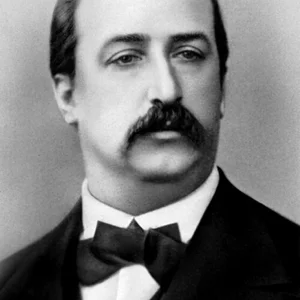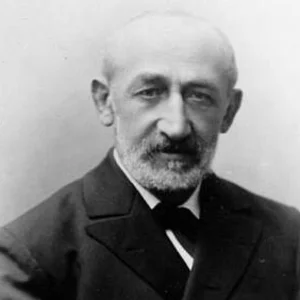

Paul Gordan was a 19th-century German mathematician, famous for his work on invariant theory. Nicknamed the “king of invariant theory,” he left his mark on algebra through his mastery of calculations.
Paul Gordan(1837 — 1912)
Paul Gordan
royaume de Prusse
6 min read
Frequently asked questions
Famous Quotes
« This is not mathematics, this is theology.»
Key Facts
- Born in 1837 in Breslau (present-day Wrocław), died in 1912 in Erlangen
- Professor of mathematics at the University of Erlangen from 1875
- A recognized specialist in invariant theory, nicknamed the “king of invariants”
- Author in 1868 of a major theorem on binary forms (Gordan's theorem)
- Reacted in 1888 to David Hilbert's non-constructive existence proof with his now-famous remark about “theology”
Works & Achievements
Proof that every binary form possesses a finite system of base invariants and covariants. A major result that earned him the nickname “the king of invariant theory.”
Arising from his work with Clebsch, these coefficients are today essential in quantum physics for combining angular momenta.
A foundational treatise on abelian functions that cemented the reputation of both authors.
A definitive two-volume course methodically setting out the symbolic techniques of invariant theory.
A result on the integer solutions of systems of linear inequalities, still used in convex geometry and optimization.
Supervision of **Emmy Noether**'s doctoral thesis at Erlangen, an indirect but decisive contribution to the birth of modern algebra.
Anecdotes
When the young David Hilbert proved the « finite basis theorem » in 1888 using an abstract method, without explicitly computing the invariants, Paul Gordan is said to have exclaimed: “This is not mathematics, it is theology!” This quip has remained famous as a symbol of the clash between the old computational school and the new abstract mathematics.
Gordan was nicknamed “the king of invariant theory” because of his virtuosity in algebraic calculations of dizzying length, which few mathematicians dared to tackle. It is said that he thought while pacing back and forth and speaking aloud, rather than by writing.
In 1868, Gordan managed to prove that binary forms possess only a finite number of basic invariants — a result so difficult that it was long called the “Gordan theorem”. Twenty years later, Hilbert generalized it in one stroke, rendering Gordan's proof almost obsolete.
Paul Gordan was the thesis advisor of Emmy Noether, one of the greatest mathematicians in history, who defended her thesis at Erlangen in 1907. An irony of history: Noether later abandoned her teacher's computational style to become a pioneer of abstract algebra — the very thing Gordan deemed “theological”.
Despite his initial skepticism, Gordan eventually came to recognize the value of Hilbert's ideas. He is said to have later admitted, with humor, that “even theology has its merits”, showing that a great scholar can change his mind when faced with a new idea.
Primary Sources
Here Gordan establishes that every covariant and every invariant of a binary form can be expressed as an integral function of a finite number of fundamental forms — the so-called “Gordan's theorem.”
A landmark two-volume treatise setting out the symbolic methods for computing invariants, the fruit of Gordan's teaching at Erlangen.
A joint work in which Clebsch and Gordan develop the theory of Abelian functions, illustrating their fruitful collaboration.
A memoir systematizing the complete system of binary forms, the high point of the computational method that Gordan brought to perfection.
Key Places
City in Silesia where Paul Gordan was born in 1837 and where he earned his doctorate in 1862. A major university center of eastern Prussia.
University in Bavaria where Gordan was a professor from 1874 to 1910 and supervised Emmy Noether's thesis. The hub of his scientific influence.
City in Hesse where Gordan joined Alfred Clebsch and where their collaboration on invariants and abelian functions began.
Birthplace of a great German mathematical school (heir to Jacobi) where Gordan trained in algebra and analysis.
The Prussian capital and a major mathematical center of the 19th century, where Gordan completed his training under the masters of the era.
Typical Objects

Slate surface on which Gordan and his students lined up the long chains of symbols of invariant theory. A central tool of university teaching in the 19th century.

An everyday writing instrument for drafting articles, letters, and proofs before the age of typewriting. The mathematician would blacken entire pages with formulas by hand.

A scientific article published in journals such as the Mathematische Annalen, a vehicle for spreading discoveries. Gordan's work circulated this way throughout scholarly Europe.

A notebook in which the symbolic developments piled up, sometimes running to several dozen pages, the hallmark of Gordan's computational style.

The 19th-century scholar's workstation, lit in the evening by an oil or kerosene lamp before electricity became widespread. The setting for long sessions of reflection.

Letters exchanged with other mathematicians such as Clebsch or Klein, the principal means of debating ideas between distant universities.
School Curriculum
Vocabulary & Tags
Key Vocabulary
Daily Life
Morning
In the morning, Gordan would head to the University of Erlangen to deliver his lectures in front of the blackboard. Known for thinking aloud, he developed his reasoning by pacing the room rather than staying seated.
Afternoon
The afternoon was devoted to research: long sessions of symbolic calculation, sometimes spread across dozens of pages. He also liked to walk while thinking, pacing back and forth as he murmured his proofs.
Evening
In the evening, by the light of a lamp, he wrote articles and letters to his colleagues Clebsch and Klein or to his young students. The social life of German professors often continued around a café or brasserie table.
Food
Like the German academic middle class of his time, his diet was based on bread, potatoes, meat, sausages and beer, the daily drink in Bavaria. Coffee accompanied the long hours of work.
Clothing
Gordan wore the dark attire of the 19th-century professor: a frock coat or woollen jacket, a stiff-collared shirt, a waistcoat and a tie. A strict, formal outfit that was the norm in academic circles.
Housing
He lived in Erlangen, a small Bavarian university town, in a typical middle-class dwelling of the period. His living conditions reflected the respected but modest status of a German university professor.
Historical Timeline
Period Vocabulary
Liens externes & ressources
Références
Œuvres
Théorème de Gordan (finitude des invariants des formes binaires)
1868
Coefficients de Clebsch-Gordan
1866-1875
Theorie der Abel'schen Functionen (avec A. Clebsch)
1866
Vorlesungen über Invariantentheorie
1885-1887
Lemme de Gordan
1873
Direction de la thèse d'Emmy Noether
1907