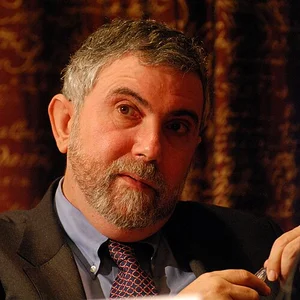

Paul Krugman is an American economist born in 1953, a specialist in international trade and economic geography. Winner of the Nobel Prize in Economics in 2008, he is also an influential columnist at the New York Times.
Paul Krugman(1953 — ?)
Paul Krugman
États-Unis
6 min read
Frequently asked questions
Key Facts
- Born on February 28, 1953, in Albany (New York State)
- Develops the “new theory of international trade” starting in 1979-1980
- Receives the Nobel Prize in Economics in 2008 for his work on trade and the location of economic activity
- Regular columnist at the New York Times since 2000
- Professor at MIT, Princeton, and later the City University of New York (CUNY)
Works & Achievements
Founding article of the “new international trade” theory, which explains exchanges between similar countries through increasing returns. It overturned the classical theory of trade.
Founding article of the “new economic geography,” explaining why activities concentrate in certain regions. It would earn its author part of the Nobel Prize.
A popular-audience work on the state of the American economy that revealed his talent as a teacher. It marked the beginning of his public career.
An essay warning of the possible return of 1930s-style crises. Its republication after 2008 gave it a prophetic resonance.
A book in which Krugman defends a progressive vision of American economic policy. It would also lend its title to his blog.
An award crowning his work on trade and economic geography. It established him as one of the great economists of his generation.
A standard university textbook co-written with his wife. It has educated generations of economics students.
Anecdotes
In 2008, Paul Krugman won the Nobel Prize in Economics in the midst of the global financial crisis, honored for his work on international trade explaining why similar countries trade similar products. The timing was striking: he became famous as a "prophet of the crisis" at the very moment he was being honored.
Krugman recounts that his calling as an economist was born when, as a teenager, he read Isaac Asimov's science-fiction saga *Foundation*, in which a fictional science called "psychohistory" makes it possible to predict the future of societies. Unable to find such a discipline, he settled on economics, which he judged to be the closest thing to it.
Before becoming famous, the young Krugman worked briefly in 1982-1983 as an adviser on the White House Council of Economic Advisers under President Ronald Reagan, even though he would later become a fierce critic of conservative policies.
In his New York Times columns, Krugman often uses a recurring fictional character and the image of "economic zombies
: false ideas believed to be dead but that always come back
like the idea that cutting taxes on the rich would benefit everyone.
In 1991, Krugman forged a central idea of the "new economic geography
: why do economic activities cluster in certain cities or regions rather than spreading out evenly? His answer blends transport costs
economies of scale
and agglomeration effects.
Primary Sources
For now, the world economy is not in a depression, and probably won't be, despite our best efforts. But as depression economics has made its comeback, it is time to relearn the lessons of the past.
The idea that increasing returns play a key role in trade and in the location of economic activity was in the air; what remained was to formalize it in a simple and rigorous way.
The economics profession went astray because economists, as a group, mistook beauty, clad in impressive-looking mathematics, for truth.
A model of international trade based on increasing returns rather than on differences in endowments or technology is presented here.
Key Places
City where Paul Krugman was born in 1953 before growing up in the suburbs of Long Island.
University where Krugman earned his doctorate in 1977 and taught for much of his career.
Institution where he was a professor of economics and international affairs from 2000 to 2015.
Newspaper for which he has written his opinion columns since 1999, the platform of his public influence.
Capital where he received the Nobel Prize in Economics on 10 December 2008 from the hands of the King of Sweden.
Academic center he joined in 2015 as a professor, continuing his research and teaching.
Typical Objects

His twice-weekly opinion column, the main platform for his economic analyses aimed at the general public since 1999. It made him one of the most widely read economists in the world.

Award received in 2008 for his work on trade and economic geography. It crowned a career of theoretical research.

A set of equations formalizing why similar countries exchange similar goods, thanks to increasing returns. This abstract tool is the hallmark of the “new international trade theory.”

A university economics textbook co-written with his wife Robin Wells, used in many universities. It spreads his ideas to students around the world.

The columnist's everyday working tool, the medium for his blog “The Conscience of a Liberal.” It allows him to react in real time to economic news.
School Curriculum
Vocabulary & Tags
Key Vocabulary
Tags
Daily Life
Morning
Krugman's morning often begins with reading the financial press and freshly published statistical data. As a professor, he prepares his lectures or research papers, surrounded by graphs and tables of figures.
Afternoon
His afternoon is divided between university teaching, seminars with colleagues and students, and writing his academic work. It is also the time for conferences and public appearances.
Evening
In the evening, he frequently writes his columns for the New York Times, responding to the day's news. He also keeps his blog active and exchanges ideas online with other economists.
Food
Like many American academics, his diet is that of a twenty-first-century city dweller: meals grabbed between meetings, coffees, and working lunches. He has spoken of his fondness for cooking and culinary travel.
Clothing
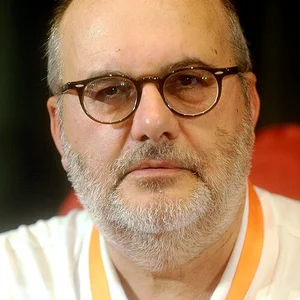
He wears the typical attire of the academic and op-ed writer: an understated suit or a casual jacket for conferences and television appearances. His salt-and-pepper beard has become a recognizable signature.
Housing
Krugman lives in the major cities of the northeastern United States, near the university campuses of Princeton and later New York. His living environment is that of a modern urban intellectual.
Historical Timeline
Period Vocabulary
Liens externes & ressources
Références
Œuvres
Increasing Returns, Monopolistic Competition, and International Trade
1979
Increasing Returns and Economic Geography
1991
The Age of Diminished Expectations
1990
The Return of Depression Economics
1999 (augmenté en 2008)
The Conscience of a Liberal
2007
Prix Nobel d'économie
2008
Economics (manuel, avec Robin Wells)
2005