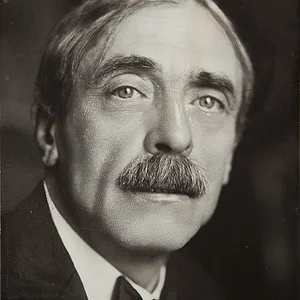

Paul Valéry (1871-1945) was a French poet, essayist and philosopher, a major figure of late Symbolist poetry. The author of the celebrated poem *The Graveyard by the Sea*, he was elected to the Académie française in 1925 and embodied the ideal of the intellectual meditating on creation and knowledge.
Paul Valéry(1871 — 1945)
Paul Valéry
France
7 min read
Frequently asked questions
Famous Quotes
« The wind is rising!... We must try to live!»
« A difficulty is a light. An insurmountable difficulty is a sun.»
« What is simple is always false. What is not simple is unusable.»
« Politics is the art of preventing people from getting involved in what concerns them.»
Key Facts
- Born in 1871 in Sète, died in 1945 in Paris, where he was given a state funeral
- Published *La Jeune Parque* in 1917, which made him famous after a long poetic silence
- Released the collection *Charmes* in 1922, containing *The Graveyard by the Sea* (1920)
- Elected to the Académie française in 1925
- Wrote his *Cahiers* throughout his life, an intellectual journal of more than 26,000 pages
Works & Achievements
An early essay in which Valéry analyzes the universal mind of Leonardo, a model of creative intelligence. Here he already lays out his reflection on thought at work.
A short tale featuring a character entirely devoted to the exercise of the mind. Monsieur Teste embodies Valéry's ideal of pure intellect.
A long poem of 512 alexandrines that marks Valéry's return to poetry after twenty years of silence. Its difficulty and its beauty made it famous at once.
A poem meditating before the sea at Sète, on death, time and the desire to live. Its final line, “The wind is rising!... We must try to live!”, has remained famous.
A collection bringing together his greatest poems, including *The Graveyard by the Sea*. It established Valéry as one of the masters of French poetry.
A philosophical dialogue in the ancient manner on the art of building and on creation. In it Valéry unites poetry with reflection on beauty.
A series of essay collections on literature, history and civilization. It contains his famous meditation *The Crisis of the Mind*.
Private notebooks kept every morning for more than fifty years, published after his death. Nearly 28,000 pages that reveal the secret workshop of his thought.
Anecdotes
On the night of 4–5 October 1892, in Genoa, the young Valéry lived through a violent storm and an inner crisis that came to be known as the “Night of Genoa.” He resolved to give up the “idols” — love and poetry — in order to devote himself entirely to the worship of intelligence and rigour. He would almost cease publishing poems for some twenty years.
Every morning before dawn, around four or five o'clock, and for more than fifty years, Valéry would sit down at his desk to write in his “Notebooks.” There he jotted down thoughts, sketches, and ideas about knowledge and creation. These notebooks amount to nearly 28,000 pages: they were, he said, his true work, accomplished in the silence of daybreak.
Elected to the Académie française in 1925, Valéry was expected, by tradition, to deliver a eulogy of his predecessor, the writer Anatole France. Yet in his reception speech in 1927, he did not utter his name a single time: Valéry had little liking for his work, and this famous omission caused quite a stir.
Born in Sète, on the shore of the Mediterranean, Valéry composed his most famous poem, *The Graveyard by the Sea*, with the cemetery overlooking the sea in his native town in mind. As fate would have it, he was himself buried there: today one can read on his grave two lines from the poem.
In January 1941, under the Occupation, Valéry delivered at the Academy the funeral eulogy of the philosopher Henri Bergson, who had died a few days earlier. Bergson was Jewish, and the Vichy regime was enforcing antisemitic laws: to pay public tribute to this great thinker was an act of courage that few dared to make.
Primary Sources
The wind is rising!... We must try to live! / The vast air opens and shuts my book again, / The wave in spray dares burst forth from the rocks!
Who weeps there, if not the simple wind, at this hour / Alone with utmost diamonds?... But who weeps, / So close to my own self at the moment of weeping?
Stupidity is not my strong point.
What is deepest in man is the skin.
Key Places
Mediterranean port town where Valéry was born in 1871. The cemetery overlooking the sea would inspire *Le Cimetière marin* (The Graveyard by the Sea) and become his final resting place.
Town where Valéry studied law at the university starting in 1889. It was there that he began to move in literary circles.
Setting of the famous “Night of Genoa” in October 1892, an inner crisis that led Valéry to devote himself to thought rather than poetry.
City where Valéry settled, worked as a secretary at the Havas agency, frequented the salons, and died in 1945. There he led his life as a celebrated intellectual.
Prestigious Parisian institution where Valéry was appointed in 1937 to hold the Chair of Poetics, created especially for him.
Saint-Charles Cemetery overlooking the Mediterranean, immortalized by his poem. Valéry rests there, and two lines from the work adorn his tomb.
Typical Objects

Notebook in which Valéry recorded thoughts, sketches and reflections each morning. His *Cahiers*, kept for over fifty years, amount to nearly 28,000 pages.

Writing instruments from the early 20th century, set on the poet's desk before the invention of the ballpoint pen. The nib dipped in ink set the rhythm of the writer's hand.

Official costume embroidered with olive leaves worn by members of the **Académie française**. Valéry donned it for his induction beneath the Dome in **1927**.

Ceremonial sword presented to each newly elected member of the **Académie française**, engraved with personal symbols. It accompanies the green coat during the induction ceremony.

A light source essential to Valéry, who wrote before daybreak. Its glow lit the *Cahiers* through the long mornings before dawn.

A printed book gathering poems, such as *Charmes* (1922). It was in this form that Valéry's poetry reached his readers.
School Curriculum
Vocabulary & Tags
Key Vocabulary
Daily Life
Morning
Valéry rose very early, often around four or five in the morning, in the silence before dawn. By the light of his lamp, with coffee and a cigarette within reach, he filled his *Cahiers* with thoughts, sketches and reflections. These solitary hours were for him the most precious moment of the day.
Afternoon
For twenty-two years, until 1922, he spent his afternoons as private secretary to **Édouard Lebey**, head of the Havas news agency, reading newspapers and mail. Once he had become a famous writer, he then devoted his days to lectures, correspondence and the obligations of a public figure.
Evening
Evenings were often given over to salons, dinners and long conversations with his writer friends, such as **André Gide**. In his youth, he attended the famous “Tuesdays” of the poet **Stéphane Mallarmé**, his admired master, on the rue de Rome.
Food
Sparing at the table, Valéry above all enjoyed coffee, which he drank in great quantities to sustain his mornings of work. A heavy smoker, he always had a cigarette in hand. His diet remained that of the Parisian bourgeoisie of his time.
Clothing
He wore the dark, well-kept suits of the educated bourgeois of the early 20th century: jacket, stiff collar and tie. For the ceremonies of the **Académie française**, he donned the embroidered green coat, the bicorne hat and the ceremonial sword.
Housing
Valéry lived in a comfortable Parisian apartment, notably on the rue de Villejust — today the rue Paul-Valéry. This bourgeois home housed his study, where he spent his mornings writing and kept his precious collection of *Cahiers*.
Historical Timeline
Period Vocabulary
Liens externes & ressources
Références
Œuvres
Introduction à la méthode de Léonard de Vinci
1895
La Soirée avec Monsieur Teste
1896
La Jeune Parque
1917
Le Cimetière marin
1920
Eupalinos ou l'Architecte
1923