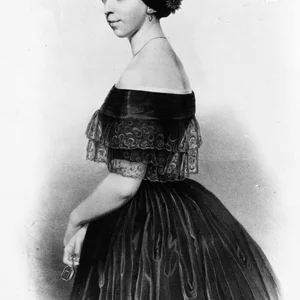

French mezzo-soprano and composer (1821–1910), daughter of tenor Manuel García and sister of La Malibran. She was one of the great opera singers of the 19th century, muse to Ivan Turgenev and many Romantic composers.
Pauline Viardot(1821 — 1910)
Pauline Viardot
France
9 min read
Frequently asked questions
Key Facts
- Born on July 18, 1821, in Paris, into a family of renowned Spanish musicians
- Stage debut in 1837, followed by an international career at Europe's greatest opera houses
- Created the role of Fidès in Meyerbeer's *Le Prophète* in 1849, to resounding acclaim
- Composed more than 100 songs, operettas, and piano pieces throughout her life
- Hosted a major artistic salon in Paris, frequented by Chopin, Berlioz, Gounod, and Brahms
Works & Achievements
Pauline Viardot created this technically demanding mezzo-soprano role at the Paris Opéra in close collaboration with Meyerbeer. Her performance revolutionized the way mother roles were interpreted in opera.
This revival of a forgotten 18th-century work, with Viardot in the title role, was one of the major artistic events of the Second Empire and helped rediscover Gluck's repertoire in France.
Set to a libretto by Ivan Turgenev and premiered in Weimar under Liszt's baton, this comic opera bears witness both to Viardot's gifts as a composer and to the unique artistic partnership that bound her to the Russian novelist.
Viardot adapted around twenty of Chopin's mazurkas for voice and piano by setting them to poetic texts. These arrangements, which enjoyed great success, speak to her deep friendship with Chopin and her dual mastery of the stage and the keyboard.
Composed throughout her life on French, Spanish, Russian, and German texts, these songs reveal Viardot's multilingual command and refined poetic sensibility, and form her most personal legacy as a composer.
Composed when she was over eighty and performed in her Parisian salon, this work illustrates Viardot's exceptional creative longevity and her conviction that chamber and salon music held just as much value as the grand stage.
Anecdotes
George Sand drew inspiration from Pauline Viardot to write her novel *Consuelo* (1842–1843), whose heroine is an exceptional opera singer raised in poverty yet gifted with pure genius. The two women were close friends, and Viardot was deeply moved to find herself at the heart of this major work of French Romanticism.
The Russian novelist Ivan Turgenev fell hopelessly in love with Pauline Viardot at her first concert in Saint Petersburg in 1843. He followed her across Europe for more than forty years, living near her family in Paris and then in Baden-Baden, and wrote the libretto for several of her comic operas, including *Le Dernier Sorcier* (1869).
In 1859, Viardot revived Gluck's *Orpheus and Eurydice* at the Paris Opéra — a work that had fallen into obscurity for decades. Her performance in the title role, unusually entrusted to a mezzo-soprano, stirred extraordinary emotion and received unanimous praise from Parisian critics.
For the world premiere of Meyerbeer's *Le Prophète* in 1849, Viardot spent months preparing the role of Fidès in direct collaboration with the composer. The performance was an absolute triumph and definitively cemented her status as prima donna, with an ovation lasting several minutes at the end of the show.
Frédéric Chopin, a regular at the Viardots' musical soirées, admired in her a complete artist of rare excellence: an accomplished pianist trained by Liszt, an outstanding performer, and an active composer. Such versatility was nearly unique for a woman of the operatic stage in the nineteenth century.
Primary Sources
In his letters to Viardot, Turgenev repeatedly evokes “the sovereign art” of the singer and describes their collaboration on *Le Dernier Sorcier* as one of the happiest experiences of his creative life.
Sand presents Consuelo as a voice “without rival in Europe,” endowed with absolute musical intelligence and moral purity — a portrait drawn directly from her admiration for her friend Pauline Viardot.
Berlioz describes Viardot as an artist of “superior intelligence,” whose voice, wielded with uncommon mastery, produced dramatic effects without equal on the operatic stage of her time.
“Madame Viardot has surpassed all expectations; the role of Fidès, in her hands, has become a creation of unforgettable greatness and pathetic truth, placing this artist at the very forefront of the world’s lyric stage.”
Chopin repeatedly mentions the musical evenings at the Viardots' and the admiration he holds for Pauline’s many talents — as a performer, a composer, and an accomplished pianist.
Key Places
Birthplace and place of death of Pauline Viardot, and the center of her entire career. She held a celebrated musical salon there, frequented by Chopin, Berlioz, Brahms, and Saint-Saëns, and taught at the Conservatoire.
In this hall, demolished in 1873, Viardot created the role of Fidès in 1849 and triumphed in *Orphée et Eurydice* in 1859. It was the principal operatic stage in Paris during the July Monarchy and the Second Empire.
The city where Viardot met Turgenev in 1843 during a triumphant tour. She returned there on several occasions and was adored by Russian audiences, who regarded her as an artist of genius.
The Viardot family's residence from 1863 to 1870, this spa town was a hub of European artistic life. Turgenev lived in a neighboring villa and Brahms was a regular visitor to their home.
The Viardots' country retreat on the outskirts of Paris, where Turgenev died in 1883 surrounded by the entire family. Turgenev's house, since restored, is today a museum.
Viardot performed regularly at Covent Garden and lived there for several years in republican exile following the coup d'état of 1852. London was at the time one of the world's opera capitals.
Typical Objects

A high-level pianist trained by Liszt, Viardot was never without a concert grand piano. She composed her melodies and opéras-comiques on it, and accompanied her students herself during lessons.

Viardot worked from scores covered in her personal annotations, particularly the Gluck version she revived in 1859. These handwritten markings bear witness to a deeply considered musical and dramatic vision.

Viardot's costumes, designed to heighten the expressiveness of her characters, were the subject of numerous engravings and illustrations. Her costume as Fidès in *Le Prophète* became an iconic image of Romantic opera.

An indispensable accessory of 19th-century social life, the fan served as a prop both on stage and in drawing rooms. Great singers like Viardot owned precious ones, often given as gifts by admirers.

Viardot jotted down her musical ideas in portable notebooks she took with her on tour. Over the course of her life, she composed more than a hundred songs for voice and piano as well as several opéras-comiques.

Viardot maintained a vast correspondence in French, German, English, Spanish, and Russian with the greatest artists of her century. Her letters, preserved in several European archives, constitute a primary historical source.
School Curriculum
Vocabulary & Tags
Key Vocabulary
Daily Life
Morning
Pauline Viardot began her day with vocal exercises and technical work at the piano, every morning, even on performance days. Born into a family of professional musicians, she had developed an iron discipline from childhood, inherited from her father Manuel García. She also devoted these quiet hours to composition, jotting down musical ideas before social obligations filled the rest of her day.
Afternoon
Afternoons were reserved for rehearsals at the Opéra or the theatre — often long and demanding, conducted in direct collaboration with conductors and composers. Viardot approached each role with remarkable intellectual rigor, drawing on her deep knowledge of languages and literature. She also received her singing pupils at her Parisian home, teaching according to the pedagogy of the García school.
Evening
Evenings were given over to operatic performances or, out of season, to the musical salons she hosted at home. Her Parisian salon was one of the most sought-after in the capital, bringing together composers, novelists, painters, and politicians in a republican and cosmopolitan spirit. Conversations ranged freely across music, politics, and literature, in several languages.
Food
Like many professional singers, Viardot was careful about what she ate in order to protect her voice, avoiding highly spiced foods, strong alcohol, and very cold drinks before singing. The table at the Viardot household reflected their mixed heritage: Spanish, French, and Russian influences mingled according to the season and the guests. Meals shared with family and friends were essential moments of conviviality in a house that was always open.
Clothing
Viardot dressed with the understated elegance characteristic of the Parisian upper-middle class: crinoline gowns and tight-waisted silhouettes under the Second Empire, straighter lines under the Third Republic. On stage, her costumes were spectacular and carefully designed to suit each character and heighten their expressiveness. In her portraits, she is often seen in black or dark colors, a reflection of a serious personality with little taste for ostentation.
Housing
The Viardots lived in spacious Parisian apartments with a large reception room for musical gatherings, furnished with several instruments including a concert grand piano. In Baden-Baden, a comfortable villa surrounded by a garden allowed them to lead a life that was both secluded and frequently visited by passing artists. The house in Bougival, on the outskirts of Paris, served as a summer residence; Turgenev had a chalet built nearby so as never to be separated from the family.