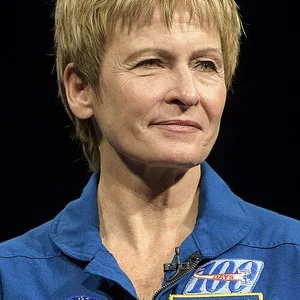

An American NASA astronaut, Peggy Whitson is the woman who has spent the most time in space (665 cumulative days). She commanded the International Space Station on two separate occasions.
Peggy Whitson(1960 — ?)
Peggy Whitson
États-Unis
8 min read
Frequently asked questions
Key Facts
- 1998: first spaceflight, aboard the Mir space station
- 2002: first female commander of the ISS, during Expedition 16
- 2017: breaks the American record for cumulative time in space (534 days), eventually reaching 665 days
- Completed 10 spacewalks, a record for a woman
- Holding a doctorate in biochemistry, she conducted numerous scientific experiments in orbit
Works & Achievements
With 665 days spent in orbit, Whitson holds the world record for cumulative time in space by a woman. This record reflects her exceptional contribution to understanding the physiological effects of long-duration spaceflight.
Whitson became the first woman to command the International Space Station, leading an international crew through five spacewalks. A historic first in the history of human spaceflight.
Throughout her missions, Whitson conducted dozens of experiments studying how weightlessness affects cells, bones, muscles, and the cardiovascular system, informing the protocols for future journeys to Mars.
Whitson commanded the first fully commercial crewed mission to the ISS aboard a SpaceX Crew Dragon, opening a new era of private access to space. At 62, she proved that age is no barrier to exploration.
As head of NASA's Astronaut Corps, Whitson oversaw the selection, training, and assignment of all American astronauts, underscoring the breadth of her influence within the space agency.
Whitson performed 10 spacewalks totaling more than 60 hours of extravehicular activity — a world record for a woman — including critical repairs to the exterior hull of the ISS.
Anecdotes
In 2017, floating aboard the ISS, Peggy Whitson received a live call from President Donald Trump, who congratulated her for breaking the American record for cumulative time in space (534 days). She replied from orbit that pushing the boundaries of human achievement is exactly what astronauts train for. This symbolic exchange, broadcast live, illustrated the connection between space exploration and national pride.
Peggy Whitson did not follow a straight path to the stars: she applied to NASA twice before finally being selected in 1996. The daughter of farmers from Iowa, she was inspired by the Apollo 11 moon landing in 1969, when she was just 9 years old. That evening, she decided she wanted to become an astronaut — a dream she never gave up.
During her long-duration missions, Whitson conducted biochemistry research on the effects of microgravity on the human body — including bone and muscle loss. This work, directly related to her doctoral thesis at Rice University, helped scientists understand how to maintain astronaut health during future voyages to Mars. She thus combined the roles of scientist and explorer.
In 2022, at age 62, Peggy Whitson returned to space aboard a SpaceX Crew Dragon capsule as part of Axiom Space Mission 1 — the first entirely private mission to the ISS. She served as its commander, becoming the astronaut who has commanded the greatest number of missions to the Space Station. She proved that the era of commercial exploration is very much real.
Whitson holds the record of 10 spacewalks for a female astronaut, totaling more than 60 hours in the vacuum of space. Each EVA requires hours of preparation, a 130 kg suit, and considerable risk. During one of them, she helped repair a critical system on the ISS, demonstrating that technical skill matters more than gender in space.
Primary Sources
Peggy A. Whitson was selected as an astronaut candidate by NASA in December 1996. She has a Ph.D. in biochemistry and served as Chief of the Astronaut Office. She has logged 665 days in space over the course of four missions.
Commander Whitson led the Expedition 16 crew aboard the International Space Station from October 2007 to April 2008, becoming the first woman to command the ISS. The mission included five spacewalks totaling 33 hours and 46 minutes.
Whitson described the experience of spending nearly a year in space as transformative, noting that scientific research conducted aboard the ISS directly informs the planning of future deep space exploration missions.
During a live call from the ISS, Whitson stated: 'We're so fortunate to be able to continue to do this research up here, and hopefully we'll break more records as we continue to push the boundaries of what humans can do.'
Key Places
Small rural town in Iowa where Peggy Whitson was born on February 9, 1960, and grew up on a family farm. It was while watching Apollo 11 on television from this home that she decided to become an astronaut.
University where Whitson earned her doctorate in biochemistry in 1985, a scientific foundation that underpinned her career as a researcher-astronaut at NASA.
NASA's training and mission control center where Whitson began training in 1996, served as Chief of the Astronaut Corps, and from which her missions were coordinated.
Orbital laboratory located approximately 400 km above Earth where Whitson spent a total of 665 days, commanded two missions, and completed her 10 spacewalks, setting world records.
Russian space launch facility from which Whitson lifted off aboard Soyuz capsules to reach the ISS during her second and third missions. The oldest and largest cosmodrome in the world.
Typical Objects

A pressurized 130 kg suit that Whitson wore during her 10 spacewalks. A true miniature spacecraft, it protects the astronaut from the vacuum, radiation, and extreme temperatures ranging from -120°C to +120°C.

The Russian spacecraft that carried Whitson to the ISS during her missions in 2007 and 2015. After the Space Shuttle program ended in 2011, the Soyuz was for nearly a decade the only means of access to the ISS for American astronauts.

A strength-training machine designed specifically for the ISS, simulating resistance exercises in weightlessness. Whitson used it for two hours every day to limit muscle and bone loss — a vital concern during long-duration stays.

The American scientific laboratory aboard the ISS where Whitson conducted numerous biochemistry experiments on the effects of microgravity on human cells. It serves as the heart of American scientific research on the Station.

A set of medical instruments used by Whitson — a trained biochemist — to collect and analyze blood, urine, and saliva samples from crew members in order to study the physiological adaptations to weightlessness.

Everyday work tools aboard the ISS used to log experiment data, communicate with Houston, and plan activities. Whitson also used them to stay in touch with her family from orbit.
School Curriculum
Vocabulary & Tags
Key Vocabulary
Tags
Daily Life
Morning
After waking up to an audible alarm at 6:00 AM GMT, Whitson dedicates two mandatory hours to physical exercise — stationary bike or weight training on the ARED — to counteract the muscle and bone loss caused by weightlessness. She then eats a freeze-dried breakfast rehydrated with hot water, floating in the ISS living module.
Afternoon
Afternoons are dedicated to scientific experiments in the ISS laboratories: biological sampling, biochemical analyses, cell cultures, or materials testing. Whitson also takes part in daily video conferences with the Houston Mission Control Center to review mission progress and station maintenance.
Evening
After dinner, Whitson has an hour of free time to observe Earth through the cupola's windows, or to communicate with her family by email and video. She then slips into her sleeping bag attached to the wall of a private cabin, in an environment where the sun rises every 90 minutes.
Food
Food aboard the ISS consists of freeze-dried, thermostabilized, or irradiated rations prepared on Earth and rehydrated with recovered water, including water recycled from astronaut urine. Meals are eaten with magnetic utensils to prevent food from floating away, and flavors are muted due to nasal congestion caused by blood rushing to the head in weightlessness.
Clothing
Aboard the ISS, Whitson wears lightweight work clothes (t-shirts, cargo pants) with velcro patches to secure objects to surfaces. For extravehicular activities, she dons the EMU suit after several hours of preparation including pre-oxygenation — a suit that is a true self-contained spacecraft weighing 130 kg on Earth.
Housing
Whitson lives in a small private cabin of roughly one cubic meter aboard the ISS, equipped with a laptop, adjustable lighting, and storage compartments. The station itself spans 109 meters in length with a habitable area comparable to a six-room apartment, shared by six astronauts of different nationalities.
Historical Timeline
Period Vocabulary
Liens externes & ressources
Références
Œuvres
Record mondial de duree cumulee dans l'espace pour une femme
2017
Premier commandement feminin de l'ISS — Expedition 16
Octobre 2007 - Avril 2008
Recherches en biochimie sur les effets de la microgravite
2002-2017
Commandement d'Axiom Space Mission 1
Avril - Mai 2022
Chef du Corps des astronautes NASA (Chief of the Astronaut Office)
2009-2012
10 sorties extravehiculaires — record feminin mondial
2002-2017