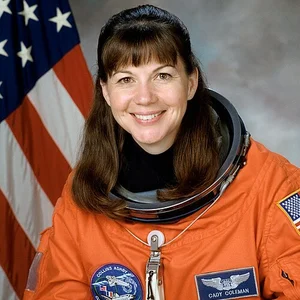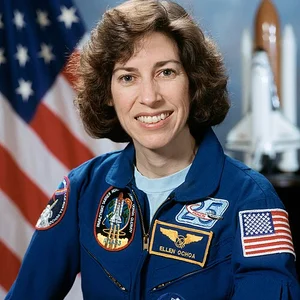

Ellen Ochoa is an American engineer and astronaut, the first woman of Hispanic origin to travel into space in 1993. A specialist in optical systems, she flew four missions aboard the space shuttle and later directed NASA's Johnson Space Center.
Ellen Ochoa(1958 — ?)
Ellen Ochoa
États-Unis
5 min read
Frequently asked questions
Key Facts
- Born on May 10, 1958, in Los Angeles, California
- Earned a doctorate in electrical engineering from Stanford University in 1985
- First Hispanic woman in space during the STS-56 mission in 1993
- Flew on four spaceflights totaling nearly 1,000 hours in orbit
- Directed NASA's Johnson Space Center from 2013 to 2018
Works & Achievements
Three patents for object recognition and image enhancement methods, the result of her engineering research.
First spaceflight; first Hispanic woman in space, dedicated to the study of the atmosphere and ozone.
Second flight devoted to observing solar radiation and atmospheric chemistry.
First docking of a shuttle with the International Space Station; she operated the robotic arm.
Fourth flight, dedicated to the assembly of the International Space Station.
First Hispanic-origin director of this key NASA center, overseeing crewed spaceflight.
Anecdotes
Before becoming an astronaut, Ellen Ochoa applied to NASA without success. Rather than giving up, she earned her private pilot's license and strengthened her scientific credentials. She was finally selected in 1990, after years of perseverance.
On April 8, 1993, aboard the Space Shuttle Discovery (mission STS-56), Ellen Ochoa became the first Hispanic woman to fly in space. There she studied the atmosphere and the ozone layer using optical instruments.
An accomplished classical flutist, Ellen Ochoa brought her flute into space and played it in zero gravity. During her studies, she had even hesitated between a career as a professional musician and physics.
Before joining NASA, Ellen Ochoa filed three patents in the field of optical systems, including methods for automatically recognizing objects and sharpening images.
In 2013, Ellen Ochoa became director of the Johnson Space Center in Houston: the first Hispanic person and the second woman to lead this major NASA center. More than a dozen American schools now bear her name.
Primary Sources
What everyone in the astronaut corps shares in common is not gender or ethnic background, but motivation, perseverance, and desire — the desire to participate in a voyage of discovery.
An optical system designed to enhance the fine detail of images, filed by Ellen Ochoa and her colleagues.
An optical method for recognizing objects independently of their position, rotation, and light intensity.
Ellen Ochoa, selected by NASA in January 1990, became an astronaut in July 1991; she flew on four space missions and logged nearly 1,000 hours in space.
Key Places
Birthplace of Ellen Ochoa, where she was born in 1958. She then grew up in La Mesa, near San Diego.
Institution where she earned her master's degree and then her doctorate in electrical engineering, specializing in optical systems.
NASA center where she trained as an astronaut, and which she later directed from 2013 to 2018.
Launch base from which the space shuttles lifted off for Ellen Ochoa's four missions.
NASA laboratory where Ochoa worked as a research engineer in optical systems before becoming an astronaut.
The region located a few hundred kilometers above the Earth, where she spent nearly 1,000 hours during her missions.
Typical Objects

A pressurized, self-contained suit worn during activities aboard the shuttle and the Space Station. It protects the astronaut from the vacuum and extreme temperatures and provides oxygen and thermal regulation.

An articulated arm controlled from inside the shuttle to deploy, capture, or position payloads. Ellen Ochoa specialized in operating it during her missions.

A reusable NASA spacecraft carrying crew and scientific equipment into orbit. Ellen Ochoa flew several of her missions aboard it.

A device born of her engineering research, able to recognize objects and sharpen images. This work earned her three patents before she joined NASA.

A musical instrument that Ellen Ochoa played with talent and which she brought along to play in weightlessness during a mission.

A suite of onboard instruments for measuring solar radiation and atmospheric chemistry, notably the ozone layer. Ochoa oversaw their use during STS-56 and STS-66.
School Curriculum
Vocabulary & Tags
Key Vocabulary
Tags
Daily Life
Morning
On the ground, Ellen Ochoa's day began early with physical exercise and preparation meetings. The training phases combined flight simulators, shuttle systems courses, and dives in a giant pool to rehearse maneuvers in weightlessness.
Afternoon
The afternoon was devoted to technical training: simulated piloting, operating the robotic arm, and developing scientific experiments. In flight, she alternated between Earth observations, atmospheric measurements, and satellite deployment operations.
Evening
In the evening, she reviewed the next day's procedures and conferred with her team. In orbit, the astronauts stowed their equipment, communicated with mission control, shared a meal, and sometimes enjoyed the view of Earth through the windows.
Food
During missions, food is freeze-dried, dehydrated, or packaged in pouches, then rehydrated with hot or cold water. Crumbs are avoided, since they float in weightlessness; drinks are sipped through a straw from airtight pouches.
Clothing
Day to day on board, the crew wears light, practical clothing—polo shirts and trousers with pockets. For liftoff and spacewalks, they put on specialized suits: a pressurized orange outfit at launch, and a self-contained white spacesuit for extravehicular activities.
Housing
In orbit, the living space is cramped: bunks strapped to the walls so you can sleep without floating, and a workspace packed with instruments. On the ground, Ochoa lived in Houston, near the Johnson Space Center, as an engineer and mother of a family.
Historical Timeline
Period Vocabulary
Liens externes & ressources
Références
Œuvres
Brevets en systèmes optiques
1987-1990
Mission STS-56 (Discovery)
1993
Mission STS-66 (Atlantis)
1994
Mission STS-96 (Discovery)
1999
Mission STS-110 (Atlantis)
2002
Direction du Johnson Space Center
2013-2018