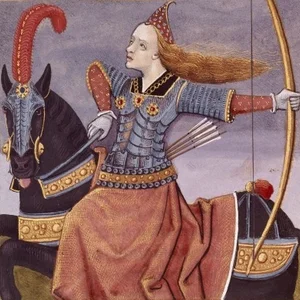

Queen of the Amazons in Greek mythology, daughter of Ares and Otrera. According to the epic tradition, she led her warrior women to the aid of Troy after Hector's death and faced Achilles in single combat, who killed her even as he fell in love with her.
Penthesilea
Penthesilea
7 min read
Frequently asked questions
Key Facts
- Daughter of Ares, god of war, and Otrera, queen of the Amazons — according to Greek mythological tradition
- She accidentally killed her sister Hippolyta during a hunt, which led her to join the Trojan side to atone for her deed
- Her arrival at Troy is recounted in the Aethiopis (a lost epic of the Trojan Cycle, attributed to Arctinus of Miletus, around the 7th century BCE)
- She is slain by Achilles, who, upon removing her helmet, is struck by her beauty and overwhelmed by a mingling of love and grief
- The Greek warrior Thersites mocks this love and is killed by Achilles — an episode symbolizing the conflict between heroic ideals and cynicism
Works & Achievements
Penthesilea led twelve elite warrior women to reinforce besieged Troy. This episode is considered her central heroic deed, comparable to the exploits of the greatest warriors of the Trojan War.
After accidentally killing her sister Hippolyta, Penthesilea sought purification by fighting at Troy. This act of redemption gave her a tragic and spiritual dimension that went far beyond a simple feat of arms.
The image of Penthesilea dying at the hands of Achilles became a canonical motif in Attic pottery and sculpture, most notably on the Parthenon. For the Greeks, her story came to symbolize the confrontation between civilized order and barbarian otherness.
Anecdotes
Penthesilea arrived at Troy after the death of Hector to aid the Trojans, according to the tradition of the Aethiopis. She led twelve elite Amazon warriors. Her courage in battle impressed both sides before Achilles struck her down in single combat.
According to several versions of the myth, when Achilles removed the helmet of the dying Penthesilea, he was struck by her beauty and felt a sudden, overwhelming love for her. This paradox — killing the one you love — made her a tragic symbol throughout ancient literature.
After Penthesilea's death, the Greek warrior Thersites mocked the grieving Achilles, accusing him of weakness. Achilles, enraged, struck him and killed him on the spot. This episode showed that even Greek heroes recognized Penthesilea as a worthy and honorable opponent.
The Amazons, of whom Penthesilea was queen, were said to exclude or mutilate men from their society, consorting with them only for reproduction. As daughters of Ares, god of war, they embodied a warrior femininity radically opposed to Greek norms, which made them both fascinating and threatening in the eyes of ancient authors.
Penthesilea is said to have joined the Trojan War to atone for a transgression: having accidentally killed her sister Hippolyta during a hunt. Only a powerful king, such as Priam, could purify her of this unintentional killing. She therefore fought at Troy as much for honor as out of ritual necessity.
Primary Sources
Penthesilea, daughter of Ares and of Thracian origin, comes to the aid of the Trojans. She performs remarkable deeds before being slain by Achilles, who falls in love with her. Thersites mocks Achilles over this and is killed by him.
She strode forward, like Ares himself, driven by a consuming passion for battle. Her heart knew no fear; she hoped to slay Achilles and return in triumph to the great city of the Trojans.
The Amazons distinguished themselves in war and surpassed men in courage. Their most celebrated queens took part in the greatest conflicts of the heroic age.
Penthesilea, daughter of Ares, came to the aid of the Trojans and was slain by Achilles.
Stories passed down by bards during public performances, recounting the exploits of the heroes of the Trojan War. The figure of Penthesilea circulated among them as an emblematic image of the foreign warrior woman and her tragic fate.
Key Places
The legendary capital of the Amazon kingdom, on the banks of the Thermodon river in Pontus (present-day northern coast of Turkey). This is where Penthesilea ruled before departing for Troy.
The city where Penthesilea led her warrior women to the aid of Priam. It was before its walls that she performed her great deeds and met her death at the hands of Achilles.
The alluvial plain at the foot of Troy's walls where the great epic duels took place. It was here that the fateful battle between Penthesilea and Achilles was fought.
The region where the Greeks imagined the Amazons to have originated in their geographical mythology, associated with the edges of the known world and a sense of radical otherness.
Typical Objects

Emblematic weapon of female warrior cultures in Greek mythology, often associated with the Amazons. Some depictions of Penthesilea show her armed with this double-bladed axe.

The Amazons were renowned for their mastery of mounted archery. Penthesilea, as queen, was said to excel in this art, which demanded both precision and endurance.

In Attic ceramic depictions, Penthesilea often wears a Thracian-style helmet, emphasizing her northern origins and her distinctiveness from Greek warriors.

A lightweight crescent-shaped shield, emblem of the Amazons in Greek tradition. It allowed great mobility in combat — a fighting style attributed to the warrior women of the steppes.

A thrusting weapon used in both mounted and foot combat. Quintus of Smyrna describes Penthesilea hurling javelins at the Greeks with formidable accuracy.

As queen and daughter of Ares, Penthesilea is often depicted wearing richly crafted armor, reflecting her royal rank and her role as war leader.
School Curriculum
Vocabulary & Tags
Key Vocabulary
Tags
Daily Life
Morning
Penthesilea rises at dawn alongside her warriors, training in archery, spear work, and mounted combat on the grassy plains near the Thermodon. As queen, she oversees her troops' drills and inspects horses and armor.
Afternoon
She organizes collective military maneuvers, referees training bouts, and holds council with her Amazon lieutenants. Important decisions on alliances and war expeditions are made in assembly with the most experienced warriors.
Evening
In the evening, Penthesilea and her warriors gather around the fire for rites honoring Ares, their divine father. Epic songs celebrate past deeds and ancestors. The queen settles disputes and delivers justice within the community.
Food
A nomadic warrior's diet: hunted and herded meat (horses, cattle), fermented mare's milk (kumiss, in steppe traditions), grains, legumes, and wild fruits gathered during travels. Communal meals strengthen group cohesion.
Clothing
Outside of battle, a short linen or wool tunic, leather boots suited for riding, and sometimes Scythian-style trousers for horsemanship. Metal ornaments (bracelets, fibulae) signal rank. In battle: a Thracian helmet, bronze or reinforced leather cuirass, and a crescent-shaped shield.
Housing
Amazons are described as semi-nomadic in some traditions. Penthesilea resides in a fortified city or camp on the banks of the Thermodon, in a wood-and-stone dwelling befitting her rank as queen. On military campaigns, she lives in a large leather tent, quickly pitched and struck as the army moves.
Historical Timeline
Period Vocabulary
Visual Style
Style céramique attique (figures rouges et noires), guerrière en armure thrace, composition dynamique de combat épique avec frise géométrique.
Sound Ambience
Sons de bataille héroïque sur la plaine de Troie : choc du bronze, galop des chevaux amazones, cris de guerre et vent de la steppe anatolienne.
Liens externes & ressources
Références
Œuvres
Campagne militaire au secours de Troie
Âge héroïque mythologique (vers -1200 selon la chronologie traditionnelle)
Purification rituelle et rédemption par le combat
Âge héroïque mythologique
Figure fondatrice de l'amazonomachie dans l'art grec
Ve siècle av. J.-C.