
Perseus is a hero of Greek mythology, son of Zeus and Danaë. He is famous for slaying the Gorgon Medusa and rescuing the princess Andromeda from a sea monster. His exploits make him one of the most important heroes in Greek mythology.
Perseus
Perseus
8 min read
Frequently asked questions
Key Facts
- Slew the Gorgon Medusa using an adamantine sickle and the magical shield Aegis gifted by the gods
- Used Medusa's severed head as a weapon in battle, capable of turning his enemies to stone
- Rescued the princess Andromeda by freeing her from the sea monster Cetus, sent by Poseidon
- Flew using the winged sandals (Talaria) gifted by Hermes
- Founded the royal dynasty of Perseus, ancestor of the Perseid family
Works & Achievements
Perseus accomplished his greatest feat by beheading Medusa, the Gorgon with snakes for hair whose gaze turned anyone who met it to stone. This heroic act made him famous and granted him extraordinary powers through the magical artifacts received from the gods.
Perseus rescued the princess Andromeda, who had been chained to a rock as a sacrifice to a sea monster. He slew the monster and married her, binding himself to the royal house of Joppa and cementing his heroic standing.
Perseus founded the city of Mycenae in the Argolid, which went on to become one of the most powerful city-states of ancient Greece. This political achievement established his dynasty and his lasting influence.
Perseus received essential magical objects from the gods: the winged sandals of Hermes, Athena's magical shield, and the adamantine sickle. These artifacts symbolize divine assistance and became his defining attributes.
Perseus placed Medusa's severed head on Athena's shield, creating a formidable defensive weapon. This achievement showcases his ingenuity in transforming victory into lasting power.
Perseus established a royal lineage from which several major heroes of Greek mythology descended, including Heracles. His genealogical legacy secured his importance in ancient Greek mythology.
Anecdotes
Perseus was said to have been raised on the island of Seriphos after his mother Danaë was placed in danger. King Polydectes of Seriphos, who wished to court Danaë, sent Perseus on a quest to retrieve the head of Medusa in order to get rid of him. This is how the hero's most famous adventure began — designed to put him well out of the way.
According to legend, Perseus received magical gifts from Athena and Hermes to help him complete his mission. Athena gave him a shield polished to a mirror-like shine, while Hermes provided him with winged sandals (the talaria) that allowed him to fly, and an adamantine sickle to sever Medusa's head. These wondrous objects symbolize the gods' assistance to mortal heroes.
Perseus slew the Gorgon Medusa by using the reflection in his shield as a mirror, since looking directly at Medusa would turn anyone who saw her to stone. This clever strategy shows that a hero's victory depends not only on strength, but also on cunning and divine aid.
On his way home, Perseus came upon the princess Andromeda chained to a rock as a sacrifice to a sea monster. He rescued her by using the head of Medusa, whose petrifying gaze turned the monster to stone. Perseus later married her, weaving together heroism and love in one of Greek mythology's most celebrated stories.
Perseus is said to have become king of Mycenae after accidentally killing his grandfather Acrisius with a discus during athletic games. This unintended death haunted him and reminded the ancient Greeks that even the greatest heroes could not escape their fate.
Primary Sources
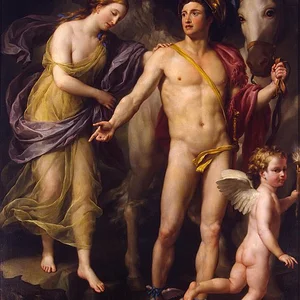
Perseus, son of Jupiter, flew through the air on his winged sandals. He spotted Andromeda chained to a rock and, struck by her beauty, fell in love with her before he even freed her from the sea monster.
Perseus, son of Zeus and Danaë, received from Minerva a shield polished like a mirror and from Mercury winged sandals and an adamantine blade to sever the head of the Gorgon Medusa.
The Gorgon Medusa, once beautiful, was transformed by Minerva. Perseus slew her while she slept, using her reflection in his polished shield.
Perseus is venerated as a divine ancestor among the Greeks. His story, passed down by the poets, recounts his extraordinary feats against monsters and superhuman creatures.
Key Places
Greek city where Perseus was born, son of King Acrisius. It is here that his mother Danaë was locked in a bronze tower before Zeus came to seduce her.
Island in the Cyclades where Perseus grew up after being rescued from the sea with his mother. It was from here that he set out on his quest to slay Medusa.
The region where Perseus confronted and slew the Gorgon Medusa. According to legend, Medusa's blood fell upon the Libyan desert and gave rise to venomous serpents.
Coastal region where Perseus rescued the princess Andromeda, who had been chained to a rock as a sacrifice to the sea monster Cetus. He later married her.
The place where Perseus is said to have left his mother Danaë in safety with King Polydectes before setting off on his great heroic exploits.
A region Perseus is said to have visited during his adventures, symbolizing the legendary reach of his exploits beyond the known Greek world.
Typical Objects

A curved blade made of adamant (an indestructible metal) given to Perseus by Hermes, used to sever the head of Medusa. It is the main weapon that allowed him to accomplish his most famous feat.

Magical shoes given by Hermes that allowed Perseus to fly through the air. Essential to his mobility, they enabled him to flee after slaying Medusa.

A shield given by Athena, adorned with the head of Medusa. This protective object becomes a formidable weapon: anyone who looks at the Medusa head on the shield is turned to stone.

A magical helmet lent by the Graeae that renders its wearer invisible. Perseus uses it to approach Medusa undetected and to escape after killing her.

The severed head of the Gorgon monster with snakes for hair, kept in a satchel. It retains its petrifying power and becomes one of Perseus's greatest trophies.

A flying vehicle used by Perseus on his epic journeys. It symbolizes divine power and the extraordinary mobility granted to Greek heroes favored by the gods.

A ceramic vessel typical of ancient Greece, used to store water, oil, or wine. It represents daily life and the material culture of the ancient world.

A short bladed weapon typical of Greek warriors. Though less famous than the Adamantine Harpe, it represents the standard combat equipment of heroes in ancient Greece.
School Curriculum
Vocabulary & Tags
Key Vocabulary
Daily Life
Morning
Perseus, as a hero and son of Zeus, begins his day with intense physical training: combat drills, wrestling, and weapons practice. Before setting out on a heroic quest or mission, he often consults the gods through sacrifices and religious rituals.
Afternoon
The afternoon is devoted to heroic adventures: hunting monstrous creatures, traveling through legendary lands, or fulfilling divine quests. Perseus may also attend warrior banquets or gatherings of nobles and kings, where he recounts his great deeds.
Evening
In the evening, Perseus joins feasts in royal palaces, welcomed as a hero of honor. These meals feature music, poetry recitations, and tales of his adventures. He may also tend to his magical weapons — the adamantine sword and his divine equipment — in preparation for new quests.
Food
Raised as both a prince and a warrior, Perseus eats heartily: roasted meats (lamb, goat, beef), bread, cheese, olives, fruit, and honey. He drinks wine mixed with water, following Greek custom, and mead on festive occasions.
Clothing
Perseus wears a short tunic (chiton) suited for combat, a warrior's cloak, and light armor. As a divine hero, he bears the marks of his status: a winged cap and a magical helmet (the winged petasus). He is armed with a bronze sword or the adamantine harpe.
Housing
Perseus lives in the royal palaces of ancient Greece, particularly in Argos or as a guest of the kings who receive him. These homes are vast stone structures with colonnades, decorated with mosaics and frescoes. He enjoys the comfort and prestige reserved for heroic figures and children of the gods.
Historical Timeline
Period Vocabulary
Visual Style
Un style inspiré de l'art grec antique classique, mêlant l'esthétique des vases grecs (poterie à figures noires et rouges) avec un éclairage dramatique à la Renaissance. L'atmosphère conjugue noblesse héroïque, divinité et magie, avec des teintes terreuses, des bleus profonds et des accents métalliques évoquant l'Antiquité.
Sound Ambience
Une ambiance sonore épique et mystique qui évoque les exploits légendaires de Persée : mélange de cris surnaturels, de tonnerres divins, de bruits de combat héroïque et de vents magiques, immergé dans une atmosphère antique et mythologique profondément dramatique.
Liens externes & ressources
Références
Œuvres
Tuer la Gorgone Méduse
période légendaire
Sauvetage d'Andromède
période légendaire
Fondation de Mycènes
période légendaire
Obtention des artifacts divins
période légendaire
Transformation de Méduse en talisman
période légendaire
Établissement de la dynastie des Perséides
période légendaire