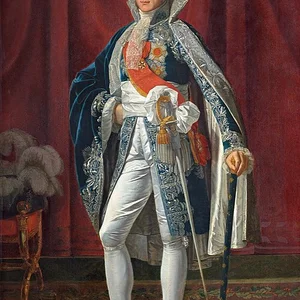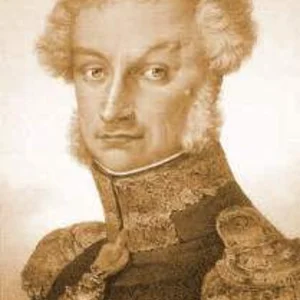

French general of the Grande Armée, Pierre Cambronne commanded a battalion of the Old Guard at Waterloo in 1815. He passed into legend for the “mot de Cambronne” and the phrase “The Guard dies but does not surrender.”
Pierre Cambronne(1770 — 1842)
Pierre Cambronne
France
7 min read
Frequently asked questions
Famous Quotes
« The Guard dies but does not surrender.»
Key Facts
- Born on December 26, 1770, in Nantes.
- Commanded a battalion of the Old Guard at the Battle of Waterloo (June 18, 1815).
- Wounded and taken prisoner at Waterloo; his surrender was long denied.
- The “mot de Cambronne” (attributed by Victor Hugo) entered the French language as a euphemism.
- Died on January 29, 1842; a Paris Métro station (line 6) bears his name.
Works & Achievements
Cambronne was one of the few generals to accompany Napoleon into his first exile, commanding the 600 men of the Guard who formed the escort. This act of loyalty earned him the Emperor's complete trust.
At the head of the last square of the Old Guard, Cambronne held his position against allied charges as the battle was already lost. This command in the face of absolute adversity made him a symbol of heroic resistance.
After his pardon in 1820, Cambronne was gradually reintegrated into the royal army, receiving the title of viscount in 1822. His career under the Restoration illustrates the difficult reconciliation of former Bonapartists with the monarchy.
Anecdotes
At Waterloo, on June 18, 1815, surrounded by British troops under General Colville who was demanding his surrender, Cambronne allegedly uttered a single-syllable word that has gone down in history as the *mot de Cambronne*. Victor Hugo devoted an entire chapter to it in *Les Misérables*, casting it as France's ultimate response — defeated but unbroken.
The famous phrase “The Guard dies but does not surrender” is often attributed to Cambronne, but historians now believe it was probably spoken by General Michel or fabricated after the fact by the royalist press. Cambronne himself always denied having said these words at his trial in 1815 — which did nothing to stop the legend from clinging to him for eternity.
Gravely wounded in the head during the final fighting at Waterloo, Cambronne was left for dead on the battlefield. A British officer recognized him and had him treated. He spent several months as a prisoner in England, where he met and married a Scottish aristocrat, Mary Osburn, in 1820 — a surprising match for a battle-hardened veteran of the Guard.
Sentenced to death in absentia by the Restoration courts in 1816 for having rallied to Napoleon during the Hundred Days, Cambronne was ultimately pardoned in 1820. Louis XVIII even restored his rank and granted him the title of Viscount in 1822 — a striking illustration of the contradictions of this era of difficult national reconciliation.
Cambronne had accompanied Napoleon to the island of Elba in 1814, commanding the escort battalion of the fallen Emperor. This act of absolute loyalty, at a time when so many marshals were switching sides, earned him Napoleon's complete trust — and Napoleon brought him along during the triumphant return of the Hundred Days.
Primary Sources
Napoleon appoints Cambronne to command the imperial escort battalion upon departure for the island of Elba, testifying to the absolute trust placed in this loyal veteran of the Old Guard.
The said Cambronne, brigadier general, is found guilty of having borne arms against the royal government during the Hundred Days and is sentenced to death.
The battalions of the Old Guard bid farewell to the Emperor in the Cour du Cheval-Blanc. Cambronne stood at the head of his grenadiers, motionless, tears in his eyes.
I never uttered the phrase attributed to me. What I said, I scarcely remember, for I was wounded and the enemy was everywhere. But I would never have said that the Guard was surrendering.
Key Places
Cambronne's birthplace, born on December 26, 1770, into a bourgeois family. He returned to settle there after his disgrace and died in the city in 1842; a statue in his honor stands on Place Royale.
It was here, on June 18, 1815, that Cambronne commanded the last square of the Old Guard and entered legend with his famous "word." The site now houses a museum and the Butte du Lion.
The territory where Napoleon was exiled in 1814. Cambronne commanded the imperial escort and lived on the island alongside the Emperor, demonstrating unwavering loyalty in defeat.
The port where Cambronne was held as a prisoner after Waterloo, recovering from a severe head wound. It was during this captivity that he met Mary Osburn, whom he married in 1820.
The imperial residence where Cambronne was received by Napoleon on several occasions, notably during his triumphant return of the Hundred Days in March 1815. There he received his orders for the Belgian campaign.
Liens externes & ressources
Références
Œuvres
Commandement du bataillon d'escorte à l'île d'Elbe
1814-1815
Commandement du 1er bataillon du 1er régiment de grenadiers à pied de la Garde à Waterloo
18 juin 1815
Réhabilitation et service sous la Restauration
1820-1832