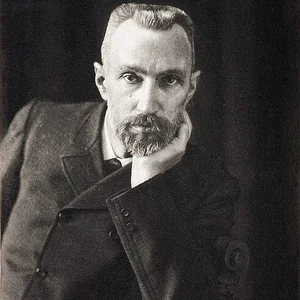

French physicist (1859–1906), he discovered piezoelectricity with his brother Jacques in 1880, then conducted groundbreaking research on radioactivity alongside Marie Curie. A Nobel Prize laureate in Physics in 1903, he is one of the founding fathers of modern physics.
Pierre Curie(1859 — 1906)
Pierre Curie
France
9 min read
Frequently asked questions
Key Facts
- 1859: born in Paris into a family of physicians
- 1880: discovery of piezoelectricity with his brother Jacques Curie
- 1898: discovery of polonium and radium alongside Marie Curie
- 1903: Nobel Prize in Physics shared with Marie Curie and Henri Becquerel
- 1906: accidental death in Paris, struck by a horse-drawn carriage on rue Dauphine
Works & Achievements
By compressing crystals of quartz, tourmaline, and topaz, the Curie brothers established that mechanical stress generates a proportional electric charge. This property, which they named piezoelectricity, underlies the sensors, actuators, and oscillators found in countless modern technologies.
A landmark paper in which Pierre Curie articulates the principle that bears his name: the asymmetry of a physical phenomenon must be present in the cause that produces it. This principle remains a cornerstone of crystallography and contemporary theoretical physics.
In his doctoral thesis, Pierre Curie established the law of inverse proportionality between magnetic susceptibility and absolute temperature, and identified the threshold beyond which a ferromagnetic material loses its properties, now known as the “Curie point.”
By processing tons of pitchblende, Pierre and Marie isolated an unknown, highly radioactive element, which Marie named polonium in honor of her native Poland. This was the first discovery of a chemical element identified solely by its radioactive properties.
Pierre and Marie announced the existence of a second unknown radioactive element, radium, whose extraordinary activity far exceeded that of uranium. Isolating it in pure metallic form would require another four years of relentless chemical work by Marie.
The Nobel Committee recognized Pierre and Marie Curie's research on radioactivity, jointly with Henri Becquerel, who had made its first observation. On this occasion, Marie Curie became the first woman to receive a Nobel Prize.
Anecdotes
Pierre Curie and his brother Jacques discovered piezoelectricity in 1880 by compressing quartz crystals: a simple mechanical pressure generates a measurable electric current. This discovery, made in a modest laboratory, still lies at the heart of technologies found everywhere today: quartz watches, sonars, microphones, and ultrasound devices.
Pierre and Marie Curie worked for years in a dilapidated shed at the Paris School of Physics and Chemistry — with no proper heating or adequate ventilation. Foreign visitors were astonished that such fundamental discoveries as polonium and radium could emerge from such deprivation. The German chemist Wilhelm Ostwald would describe the place as a “miserable barn.”
In 1903, the French government offered Pierre Curie the Legion of Honor, the country's highest national decoration. He flatly refused, believing that science should not be entangled with official honors. He declared that all he needed was a proper laboratory — something he would never receive during his lifetime.
On April 19, 1906, Pierre Curie was crossing the Rue Dauphine in Paris in heavy rain. He slipped on the wet cobblestones and fell under the wheels of a heavy horse-drawn cart. He died instantly, at the age of 46, at the peak of his scientific career. Albert Einstein, who knew him personally, would consider his death an irreparable loss for physics worldwide.
Pierre Curie established in 1895, in his doctoral thesis, the law that bears his name: the magnetic susceptibility of a paramagnetic material is inversely proportional to its absolute temperature. He also identified the temperature threshold beyond which a ferromagnetic material loses its magnetic properties: this critical threshold has since been called the “Curie point” and remains a fundamental concept in materials physics.
Primary Sources
It is dissymmetry that creates the phenomenon. Certain physical phenomena are compatible with certain elements of symmetry of a medium; others are not.
Paramagnetic bodies obey the law χ = C/T, where χ is the magnetic susceptibility, T the absolute temperature, and C a constant specific to each substance.
The various reasons we have just enumerated lead us to believe that the new radioactive substance contains a new element to which we propose to give the name radium.
We investigated whether bodies other than uranium compounds possessed the radioactive property. We found that certain minerals containing uranium are far more active than uranium itself.
I am among those who think, with Nobel, that humanity will draw more good than harm from new discoveries. I am among those who believe that Science is great and beautiful.
Key Places
Pierre Curie was born on **15 May 1859** in Paris. His father, a physician, chose to educate him at home rather than send him to a secondary school, allowing him to progress at his own pace in the sciences.
Pierre Curie worked there as head of practical work from 1882, then as laboratory director. It was in the makeshift shed of this institution that he and Marie conducted their groundbreaking research on radioactivity, discovering polonium and radium.
Pierre Curie earned his physics degree there in **1877** at just 18 years old, and was later appointed professor in **1904**, following the award of the Nobel Prize. He delivered his first lecture in November of that same year.
On **19 April 1906**, Pierre Curie slipped on the wet cobblestones of this street and fell beneath the wheels of a heavy horse-drawn wagon. His sudden death at the age of 46 robbed the global scientific community of a researcher at the very height of his creative powers.
In **April 1995**, the remains of Pierre and Marie Curie were transferred to the Panthéon, the national mausoleum of the great figures of the French Republic. This symbolic transfer enshrined their exceptional place in the history of science and of the nation.
Typical Objects

A precisely cut quartz crystal that Pierre and Jacques Curie compress to produce a measurable electric charge. This central object of their 1880 discovery is the direct ancestor of the piezoelectric sensors used in modern watches and sonar systems.

An instrument designed by Pierre Curie to measure extremely weak electric currents. It became the key tool for Marie and Pierre to quantify the radioactivity of substances — far more precise than the photographic methods used by Becquerel.

A brown-black uranium-rich ore extracted from mines in Bohemia (present-day Czech Republic), of which Pierre and Marie processed several tons to extract minute traces of radium and polonium. Its abnormally high radioactive activity was at the root of their major discoveries.

An indispensable tool in the Curies' laboratory, used to weigh vanishingly small amounts of radioactive substances isolated after months of chemical processing. Pierre's metrological rigor — inherited from his experimental physics training — rested on these milligram-by-milligram measurements.

A partially evacuated glass tube used to study ionizing radiation: cathode rays, X-rays, and later alpha and beta rays. Pierre Curie used it to analyze the properties of radioactive substances and to understand the nature of their emissions.

A fundamental tool in Pierre Curie's research on magnetism, allowing him to measure with precision the temperature at which a material loses its ferromagnetic properties — the threshold that would be named the "Curie point" in his honor.
School Curriculum
Vocabulary & Tags
Key Vocabulary
Daily Life
Morning
Pierre Curie arrives at the EPCI laboratory in the early hours of the morning. He devotes this time to the most delicate experiments — electrical measurements with quartz, crystal preparation, or chemical processing of ores — which demand calm and maximum concentration. His lunch is frugal, often eaten hastily without stepping away from his ongoing work.
Afternoon
The afternoon is divided between writing scientific notes, teaching students at the EPCI, and continuing his experiments. Pierre was renowned for his extreme experimental patience: he would repeat the same measurements dozens of times to guarantee their accuracy. He corresponded by letter with other European physicists, most notably Ernest Rutherford in England.
Evening
In the evening, Pierre and Marie dine together as a family in their apartment near the laboratory. Pierre reads the major scientific journals — the *Comptes Rendus de l'Académie*, the *Philosophical Magazine* — and writes his articles. A lover of nature, he recharges at weekends by hiking or cycling through the countryside around Paris, the only way for him to truly switch off from work.
Food
Pierre eats simply, in the bourgeois fashion of the late nineteenth century: soup, meat, seasonal vegetables, bread. Marie makes sure they do not skip meals despite the intensity of their research. Like all their contemporaries, the Curies were entirely unaware of the dangers of the radioactive rays they handled daily with bare hands and no protection whatsoever.
Clothing
Pierre wears the sober dress of the republican scientist of the *Belle Époque*: a dark frock coat, black tie, and a bowler hat for official outings. In the laboratory he puts on a lab coat or work apron. He pays little attention to sartorial elegance, considering any excessive concern for appearance a waste of precious time.
Housing
After their marriage in 1895, Pierre and Marie lived in a modest apartment in the 13th arrondissement of Paris, a few minutes' cycle ride from the EPCI laboratory. The apartment was functional and simply furnished; their true home was the laboratory. They moved several times, always into lodgings close to their work, prioritising proximity above all other criteria.
Historical Timeline
Period Vocabulary
Liens externes & ressources
Références
Œuvres
Découverte de la piézoélectricité (avec Jacques Curie)
1880
Sur la symétrie dans les phénomènes physiques
1894
Recherches sur le magnétisme — Loi et point de Curie
1895
Découverte du polonium (avec Marie Curie)
1898
Découverte du radium (avec Marie Curie)
1898
Prix Nobel de Physique (avec Marie Curie et Henri Becquerel)
1903