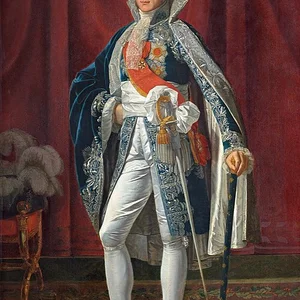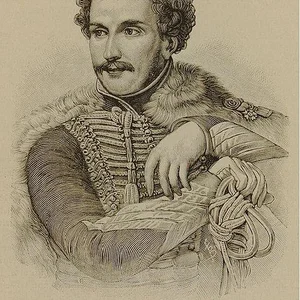

Imperial general born in 1776, he lost a leg at the Battle of Wagram (1809). Governor of the Château de Vincennes, he refused to surrender it to the Allies in 1814 and 1815, delivering his famous retort about his leg. He died of cholera in 1832.
Pierre Daumesnil(1776 — 1832)
Pierre Daumesnil
France
9 min read
Frequently asked questions
Famous Quotes
« I will give back Vincennes when they give me back my leg.»
Key Facts
- Born on July 27, 1776, in Périgueux
- Lost his right leg at the Battle of Wagram in 1809
- Appointed governor of the Château de Vincennes in 1812
- Refused to capitulate before the Allies in 1814 and again in 1815
- Died of cholera on August 17, 1832, in Vincennes
Works & Achievements
During Napoleon's first abdication, Daumesnil refused to surrender the fortress to the coalition powers, holding the position with his garrison until the official capitulation. This act of symbolic resistance earned him immediate national renown.
After the defeat at Waterloo and Napoleon's second abdication, Daumesnil repeated his feat of 1814 by once again refusing to capitulate. His stubborn resistance, in the face of a militarily defeated France, made him a popular hero among all supporters of the Empire.
As an elite cavalryman in Bonaparte's Guides, Daumesnil distinguished himself in the battles of Abukir and the Eastern campaign. This expedition forged his reputation as a fearless soldier alongside the future Napoleon.
Daumesnil earned his spurs during Bonaparte's lightning campaign in Italy, where repeated victories against Austria revealed the military genius of the future Emperor and steeled the generation of future Imperial generals.
Appointed governor by Napoleon as a reward for his war wounds, Daumesnil administered and defended the royal fortress of Vincennes for twenty years, under three successive political regimes, embodying a continuity of the French military state.
Anecdotes
In 1814, when Allied troops demanded the surrender of the Château de Vincennes, Daumesnil, governor of the fortress, replied with legendary pride: “Give me back my leg and I will give you Vincennes.” This retort, immediately reported throughout France, made him a living symbol of Napoleonic resistance against foreign occupation.
Daumesnil lost his right leg at the Battle of Wagram on July 6, 1809, when it was carried away by an Austrian cannonball. Carried from the battlefield, he was amputated within hours. Napoleon, filled with admiration for his courage, visited him and pledged his protection — which soon earned Daumesnil the popular nickname “Wooden Leg.”
During the Hundred Days in 1815, Daumesnil once again defended the Château de Vincennes following Napoleon's second abdication, once more refusing to surrender to the Allies. He only handed over the fortress after the total capitulation of French forces, thus keeping his word of honor to the very end.
Daumesnil had accompanied Bonaparte during the Egyptian Campaign (1798–1799), serving in the Guides du Directoire, an elite light cavalry unit that formed the personal escort of the commander-in-chief. He was wounded at the Battle of Aboukir and distinguished himself there by a bravery that was noted by his superiors.
During the cholera epidemic that ravaged Paris and its surroundings in 1832, Daumesnil refused to abandon his post as governor of Vincennes despite the danger. He succumbed to the disease on August 17, 1832, and was mourned by many veterans of the Grande Armée who saw in him the embodiment of the military virtues of the Napoleonic epic.
Primary Sources
Brigadier General Daumesnil had his leg carried away by a cannonball; he showed in this circumstance the greatest intrepidity.
General Daumesnil, governor of the Château de Vincennes, repulsed all demands to surrender from the Allied powers, declaring that he would yield the fortress only on the express order of the legitimate French government.
Daumesnil, that bravest of the brave, maimed at Wagram, held out against the coalition armies with a handful of soldiers in the old Château de Vincennes, refusing to surrender despite the victors' repeated demands.
The Emperor spoke with emotion of General Daumesnil and his defense of Vincennes, saying that such acts honored France and proved that the spirit of the Grande Armée would outlast its defeat.
On the seventeenth of August, eighteen hundred and thirty-two, died Pierre Daumesnil, divisional general, governor of the Château de Vincennes, born in Périgueux on the twenty-seventh of July, seventeen hundred and seventy-six.
Key Places
Birthplace of Pierre Daumesnil, born on July 27, 1776. This city in the Périgord has honored him by naming a street after him and preserving his memory.
A medieval fortress at the gates of Paris, of which Daumesnil was governor from 1812 until his death in 1832. It was here that he delivered his famous reply, twice resisted the Allied forces, and died of cholera.
Site of the battle of July 5–6, 1809, where Daumesnil was gravely wounded and lost his right leg, taken off by an Austrian cannonball. This event forever shaped his identity and his legend.
Theater of the Egyptian Campaign (1798–1799), in which Daumesnil took part as one of Bonaparte's Guides. He was wounded at the Battle of Aboukir and experienced his first conflict outside of Europe.
Region of the First Italian Campaign (1796–1797), where Daumesnil, a young cavalryman in Bonaparte's Guides, received his baptism of fire and distinguished himself through a courage praised by his officers.
Typical Objects

After the amputation of his right leg at Wagram in 1809, Daumesnil wore an articulated wooden prosthesis, which became the emblem of his resilience and earned him his popular nickname “Jambe de bois” (“Wooden Leg”).

The regulation weapon of the Chasseurs à cheval of the Imperial Guard, with a curved blade suited to mounted charges. Daumesnil carried it during the Italian and Egyptian campaigns.

A midnight-blue coat with gold embroidery, large gold bullion epaulettes, and blue broadcloth trousers — the dress of an Empire general, which Daumesnil wore for ceremonies and inspections at the Château de Vincennes.

The distinctive headwear of Napoleonic general officers, worn side-to-side, adorned with a tricolor cockade and a plume. A visible symbol of rank and military authority.

Created by Napoleon in 1802, this decoration rewarded exceptional military merit. Daumesnil received it in recognition of his acts of bravery during the campaigns of the Revolution and the Empire.

The artillery pieces that Daumesnil maintained and prepared for defense were the concrete instruments of his resistance against the Allies in 1814 and 1815; refusing to hand them over meant refusing to surrender.

As governor, Daumesnil held — both symbolically and physically — the keys to the Château de Vincennes: the very objects the Allies demanded of him, and which he categorically refused to hand over.
School Curriculum
Vocabulary & Tags
Key Vocabulary
Daily Life
Morning
General Daumesnil rose early, in keeping with the unvarying military tradition of the era. His morning began with an inspection of the guards and fortifications of the Château de Vincennes, which he traversed despite his prosthesis with an energy that impressed his soldiers. He then received reports from his junior officers and dictated his administrative correspondence to the garrison secretary.
Afternoon
The afternoon was devoted to training the garrison, maintaining the artillery pieces, and handling the day-to-day affairs of the governorship. Daumesnil received visitors — civilians, military men, or the simply curious — who came in great numbers to see the man with the wooden leg whose reputation had spread across France. He also oversaw maintenance work on the old fortress.
Evening
In the evening, Daumesnil rejoined his family: he had married Léonie Pellet in 1812 and had several children. The garrison officers would sometimes gather at his table, where past campaigns were recalled over a glass of wine. Like many veterans of the Grande Armée, he read the gazettes and followed with melancholy nostalgia the news of Napoleon's exile at Saint Helena.
Food
The diet of a governor-general was that of the military bourgeoisie: white bread, roasted or stewed meats, vegetables, and table wine. Meals were generous, in keeping with military tradition. Meat broth, very strong black coffee, and wheat bread formed the daily staples for senior officers of the Napoleonic era and the Restoration.
Clothing
On duty, Daumesnil wore the uniform of a divisional general: a midnight-blue coat with gold embroidery, heavily fringed epaulettes, white breeches for ceremonial occasions or dark blue cloth trousers for everyday wear. His wooden leg was fitted with a boot specially adapted by a Parisian bootmaker. Off duty, generals of the Empire often remained in a dark, high-buttoned frock coat, maintaining a military bearing in all circumstances.
Housing
Daumesnil lived with his family in the governor's apartments within the Château de Vincennes itself, an austere residence steeped in royal history. These quarters comprised several rooms furnished in the Empire style — mahogany, gilded bronze, dark fabrics — adorned with a few campaign mementos: weapons, military maps, portraits of Napoleon, and decorations displayed as testimony to a life entirely devoted to war.
Historical Timeline
Period Vocabulary
Liens externes & ressources
Références
Œuvres
Défense du château de Vincennes face aux Alliés
Avril 1814
Seconde défense de Vincennes après Waterloo
Juillet 1815
Participation à la campagne d'Égypte
1798-1799
Campagnes d'Italie et participation aux victoires de la Révolution
1796-1797
Gouvernorat du château de Vincennes
1812-1832