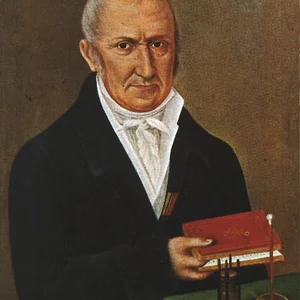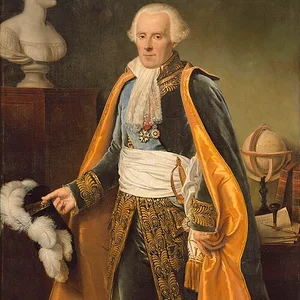

French mathematician and astronomer (1749–1827), Laplace authored the Traité de mécanique céleste and developed the theory of probability. He formulated the nebular hypothesis on the formation of the Solar System.
Pierre-Simon Laplace(1749 — 1827)
Pierre-Simon de Laplace
France
8 min read
Frequently asked questions
Famous Quotes
« I had no need of that hypothesis.»
« The weight of evidence must be proportional to the strangeness of the fact.»
Key Facts
- 1749: born in Beaumont-en-Auge, Normandy
- 1796: publication of the Exposition du système du monde and formulation of the nebular hypothesis
- 1798–1825: publication of the Traité de mécanique céleste in 5 volumes
- 1812: publication of the Théorie analytique des probabilités
- 1827: died in Paris; member of the Académie des sciences and Peer of France
Works & Achievements
Laplace's first major result: he demonstrates that the mutual perturbations of the planets are periodic rather than cumulative, guaranteeing the long-term stability of the solar system. This memoir establishes celestial mechanics as a rigorous mathematical discipline.
An accessible synthesis of Newtonian astronomy, written without a single formula for the educated general public. Laplace introduces here for the first time the nebular hypothesis, proposing that the solar system formed from a rotating cloud of gas.
Laplace's scientific masterpiece, translated into English by Mary Somerville, gathering and developing the complete mathematical theory of the motion of celestial bodies under gravitational forces. The work remained a fundamental reference throughout the entire 19th century.
The founding mathematical treatise of modern probability theory, given here its first systematic and rigorous treatment. Laplace develops in particular the method of generating functions and the application of probability to the social sciences.
A non-technical introduction to the Analytical Theory, written for non-mathematical readers. Laplace sets out his determinist vision of the universe and imagines the famous “Laplace’s demon” — a hypothetical intellect capable of predicting everything.
A pioneering application of probability calculus to judicial verdicts and human error. This work anticipates social statistics and went on to influence thinkers such as Condorcet and, later, Quételet.
Anecdotes
When Napoleon Bonaparte read the *Mécanique céleste* and asked Laplace why God did not appear in it, the scholar reportedly replied with confidence: “Sire, I had no need of that hypothesis.” This celebrated retort illustrates the decisive turning point of the late eighteenth century, when science claimed to explain the universe without recourse to the divine.
Napoleon appointed Laplace as Minister of the Interior in November 1799, but dismissed him after just six weeks, judging that he “brought the spirit of the infinitely small into administration.” Laplace was then appointed Vice-President of the Senate, a post more in keeping with his theoretical temperament.
In his *Essai philosophique sur les probabilités* (1814), Laplace imagined a hypothetical being — which posterity would come to call “Laplace's demon” — capable of knowing the position and velocity of every particle in the universe. For this perfect intellect, he claimed, the future and the past would be as present as the current moment. This stroke of genius fueled debates on determinism well into the twentieth century.
Independently of the German philosopher Kant, Laplace formulated the nebular hypothesis: the solar system would have formed through the progressive condensation of a rotating gas cloud. This idea, presented in 1796 in his *Exposition du système du monde*, long remained speculative but was confirmed in its broad outlines by modern astrophysics.
Renowned for his political opportunism, Laplace navigated the Revolution, the Consulate, the Empire, and the Restoration while always maintaining a favorable position. At the fall of Napoleon, he voted in the Senate for the Emperor's deposition — a move his contemporaries deemed remarkably ungrateful. He died in 1827 laden with honors, shortly after dictating his final corrections to the *Mécanique céleste*.
Primary Sources
"All the revolutions of the planetary system can be regarded as the oscillations of a great clock whose mainspring is universal gravitation."
"I have sought to establish that celestial phenomena and all their variations require no force other than universal gravitation, acting in inverse proportion to the square of the distances."
"We must regard the present state of the universe as the effect of its past state and the cause of the one that is to follow. An intellect which, at a given instant, knew all the forces by which nature is animated… would omit nothing that was uncertain, and the future, just like the past, would be present before its eyes."
"Probability theory is, at bottom, nothing but common sense reduced to calculation."
"I have demonstrated that planetary inequalities are periodic and that the major axes of the orbits cannot undergo secular changes under the mutual gravitational action of the planets."
Key Places
Laplace's birthplace, located in the Calvados department. The son of a prosperous farmer, he received his first lessons from local Benedictine monks before being noticed for his exceptional gifts in mathematics.
The institution where Laplace obtained his first position as a mathematics professor upon his arrival in Paris, thanks to the support of d'Alembert. It was here that he examined the young Bonaparte in 1785 during his admission as an artillery officer.
The central scientific institution of French astronomy, where Laplace collaborated with observers to gather the celestial data that underpinned his theories. His work on planetary perturbations drew directly on measurements taken here.
Laplace's country residence, where he regularly hosted leading scientists — including Berthollet, Gay-Lussac, and Humboldt — within the renowned Société d'Arcueil. This informal circle was one of the most active intellectual hubs in Napoleonic Europe.
The home of the Académie des sciences, where Laplace presented most of his landmark papers and played an organizing role in French science for forty years. He was one of its dominant figures throughout the Empire and the Restoration.
Typical Objects

An essential instrument for 18th-century astronomers, the refracting telescope made it possible to observe planets and measure their positions with precision. Laplace used observations gathered at the Paris Observatory to validate his theories on planetary perturbations.

Before calculators, astronomers and mathematicians depended on extensive logarithm tables to carry out their computations. Laplace consulted them daily to solve the differential equations describing the motions of celestial bodies.

A timekeeping instrument used to time the transit of stars across the meridian, the precision pendulum clock was indispensable for positional astronomy. The data it produced fed the calculations that Laplace turned into mathematical laws.

A three-dimensional representation of the celestial vault, the celestial globe allowed one to visualize constellations and planetary trajectories. Laplace used it to illustrate his lectures and explain his discoveries about the stability of the solar system.

A large instrument fixed to the wall of the observatory, used to measure the elevation angles of celestial bodies with great precision. Measurements taken with this instrument at the Paris Observatory provided Laplace with the observational data underpinning the *Mécanique céleste*.

The universal writing tool of 18th-century scholars, the quill pen was used to draft academic memoirs and the voluminous pages of the *Mécanique céleste*. It is said that Laplace would sometimes leave gaps in his proofs with the remark "it is easy to see that," much to the despair of his readers.
School Curriculum
Vocabulary & Tags
Key Vocabulary
Daily Life
Morning
Laplace rose early and devoted the first hours of the morning to calculations in his study. He was renowned for his intense powers of concentration, filling large sheets of paper with formulas while working in silence, pausing only to verify astronomical observations or consult his logarithm tables.
Afternoon
Afternoons were often reserved for academic duties: sessions at the Institut, reading memoirs submitted by colleagues, and drafting scientific reports. At Arcueil, Laplace received fellow scholars at his villa — Berthollet, Gay-Lussac, Humboldt — for scientific discussions that would stretch on over the dinner table.
Evening
Parisian evenings were decidedly social: Laplace frequented the fashionable literary and scientific salons of the Empire, where science and politics mingled freely. He was known for cultivating connections with those in power and skillfully adapting his positions to shifting circumstances.
Food
The table of a prosperous academician under the Empire was generous: roasted meats, Norman poultry in a nod to his origins, fine wines. At Arcueil, communal meals with the Société d'Arcueil blended good food with lively scientific debate.
Clothing
Laplace wore the dress of the intellectual and administrative elite of his day: embroidered coat for official ceremonies at the Senate or the Institut, plain frock coat for working days. Under the Empire, his role as a senator entitled him to a distinctive official uniform.
Housing
Laplace owned a Parisian apartment in a well-to-do neighbourhood and a villa at Arcueil, south of Paris, where he liked to work away from the bustle of the capital. This country house, equipped with a laboratory shared with his friend Berthollet, served as the hub of the Société d'Arcueil.
Historical Timeline
Period Vocabulary
Liens externes & ressources
Références
Œuvres
Mémoire sur la stabilité du système solaire
1773
Exposition du système du monde
1796
Traité de mécanique céleste (5 tomes)
1799–1825
Théorie analytique des probabilités
1812
Essai philosophique sur les probabilités
1814
Mémoire sur la théorie des probabilités appliquée aux jugements criminels
1816