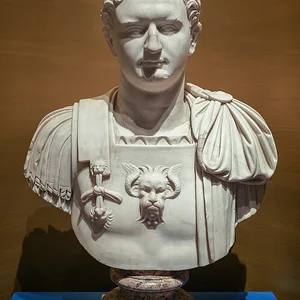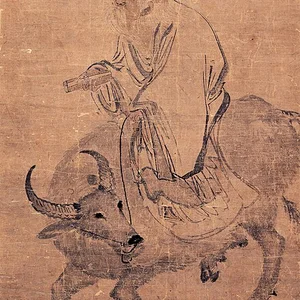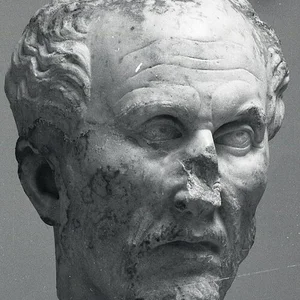

Plotinus is a philosopher of late antiquity, born in Egypt and active in Rome, regarded as the founder of Neoplatonism. His teaching, transmitted and organized by his disciple Porphyry in the *Enneads*, sets out a metaphysics of the One, from which all reality proceeds.
Plotinus(205 — 270)
Plotinus
Rome antique
6 min read
Frequently asked questions
Key Facts
- Born around 205 AD in Egypt (probably in Lycopolis)
- Student of Ammonius Saccas in Alexandria for about ten years
- Founds his school of philosophy in Rome around 244 AD
- His 54 treatises are organized into six groups of nine by his disciple Porphyry, forming the *Enneads*
- Died around 270 AD in Campania (Italy)
Works & Achievements
A collection of fifty-four treatises gathering all of Plotinus's thought. A founding work of Neoplatonism, it shaped Western philosophy and Christian thought.
One of Plotinus's earliest and most famous treatises, on beauty as a reflection of the intelligible. It invites the soul to purify itself as one sculpts a statue.
The central exposition of the doctrine of the One, the ineffable principle from which all reality proceeds. It describes the soul's path toward mystical union.
A refutation of the Gnostic doctrines that scorned the sensible world. In it, Plotinus defends the beauty and order of the cosmos arising from the Intellect.
A systematization of reality into three principles: the One, the Intellect (Nous) and the Soul. This hierarchy structures all later Neoplatonism.
A teaching circle where Plotinus commented on Plato and Aristotle and trained disciples such as Porphyry and Amelius. He ensured the spread of his thought.
Anecdotes
Plotinus was ashamed of having a body: he stubbornly refused to have his portrait made, explaining that he could not even bear the idea of being confined in a material envelope, so leaving behind an image of that image seemed absurd to him. It is his disciple Porphyry who reports this anecdote.
Plotinus had earned such trust that many Romans, on their deathbeds, entrusted him with the guardianship of their children and their property. His house was full of young wards, and he watched scrupulously over their accounts — a philosopher of the One turned guardian of orphans.
Toward the end of his life, Plotinus tried to convince the emperor Gallienus to found a city of philosophers in Campania, to be called Platonopolis and to be governed according to the laws of Plato. The project, appealing on paper, failed because of the intrigues of the court.
According to Porphyry, Plotinus never dictated the same passage twice and never reread what he had written, because his poor eyesight prevented him from doing so: he wrote in a single stroke, thinking of something else while conversing, yet never losing the thread of his argument.
Plotinus claimed to have attained, four times during his life, ecstatic union with the One — that state in which the soul merges with the supreme principle. Porphyry, for his part, says he experienced this only once, at the age of sixty-eight.
Primary Sources
Plotinus, the philosopher of our time, seemed ashamed of being in a body. Because of this disposition, he could not bear to speak of his ancestry, his parents, or his homeland.
One must therefore withdraw into oneself, and there find the principle of all things. The One is everywhere present and nowhere, for it needs nothing in order to subsist.
Withdraw into yourself and look; and if you do not yet find yourself beautiful, do as the sculptor of a statue that must become beautiful: he cuts away this, he scrapes away that.
Four times, during the period I was with him, he attained this goal, not through a power at rest, but through that ineffable act of union with the god.
Key Places
Town in Upper Egypt usually given as Plotinus's birthplace. He nonetheless refused to speak of his origins.
Great intellectual hub of antiquity where Plotinus studied for eleven years under Ammonius Saccas, his decisive teacher.
Capital of the Empire where Plotinus opened his school around 245 and taught for nearly twenty-six years, counting senators among his pupils.
Land of Gordian III's Persian expedition, which Plotinus joined to approach the wisdom of the Magi before the military rout.
Region of southern Italy where Plotinus, gravely ill, withdrew to a friend's estate and where he died around 270.
Typical Objects

Writing surface on which Plotinus composed his treatises in a single flow. Porphyry copied and arranged his master's thoughts onto it.

Pen cut from a reed and dipped in ink, used to write on papyrus. Plotinus, who had poor eyesight, wrote in cramped letters and never reread his work.

Collection of Plotinus's fifty-four treatises, organized by Porphyry into six sets of nine. It became the founding text of Neoplatonism.

A draped woolen cloak, the distinctive mark of Greek philosophy teachers. Plotinus taught in plain dress, scorning bodily luxury.

A small lamp of terracotta or bronze burning olive oil, lighting the school's reading vigils and nighttime discussions.

A wooden tablet coated with wax on which one took erasable notes with a stylus. Disciples recorded Plotinus's oral lessons on it.
School Curriculum
Vocabulary & Tags
Key Vocabulary
Daily Life
Morning
Plotinus began his day with reflection and the reading of the texts of Plato and Aristotle, which he meditated on intensely. His failing eyesight forced him to write in cramped handwriting and without rereading, often in a single sitting.
Afternoon
The afternoon was devoted to teaching: Plotinus received disciples and listeners, encouraged questions, and improvised lengthy demonstrations. He also handled the affairs of the orphans under his guardianship.
Evening
The evening stretched on with philosophical discussions among his close companions, such as Porphyry and Amelius. Plotinus could converse while mentally composing his treatises, never once losing the thread.
Food
Plotinus led a sober and ascetic life, eating little and refusing meat from farm-raised animals. He even abstained from hot baths and from certain remedies derived from animal flesh.
Clothing
He wore the simple woolen cloak of the philosopher, with no taste for luxury. Disdaining his body, he neglected his appearance and refused to have his portrait made.
Housing
In Rome, Plotinus lived in the house of a noble lady named Gemina, surrounded by his wards and his students. He ended his days in retirement on an estate in Campania.
Historical Timeline
Period Vocabulary
Liens externes & ressources
Références
Œuvres
Les Ennéades
rédigées vers 253-270, éditées vers 301
Traité Du Beau (Ennéade I, 6)
vers 253
Traité Du Bien ou de l'Un (Ennéade VI, 9)
vers 260
Traité Contre les Gnostiques (Ennéade II, 9)
vers 265
Doctrine des trois hypostases
milieu du IIIe siècle
Fondation de l'école néoplatonicienne de Rome
à partir de 245