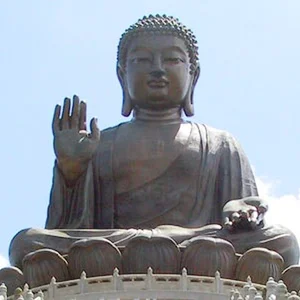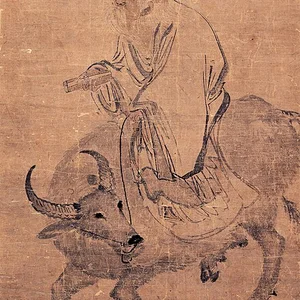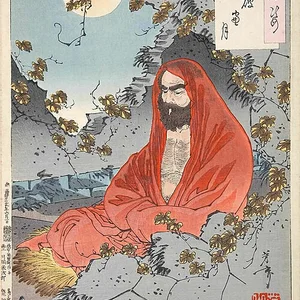

Buddhist monk, regarded as the founder of Chan Buddhism in China, from which Japanese Zen derives. According to tradition, he transmitted a form of Buddhism focused on meditation and the direct experience of awakening, beyond the scriptures.
Frequently asked questions
Key Facts
- According to tradition, originally from South India, he traveled to China in the early 6th century (around 520).
- Regarded as the 28th patriarch of the Indian lineage and the 1st patriarch of Chinese Chan.
- Legend associates him with the Shaolin Monastery and with nine years of meditation facing a wall.
- He founded a tradition transmitted “heart to heart,” without relying on written texts.
- From his Chan teaching derives Japanese Zen, which spread from the 12th century onward.
Works & Achievements
Bodhidharma is regarded as the first patriarch of Chan in China, a school that emphasizes meditation and the direct experience of awakening. From this tradition descend Japanese Zen, Korean Seon, and Vietnamese Thiền.
A short text attributed to him, considered the closest to his authentic teaching. In it he distinguishes the “entrance by principle” (understanding) from the “entrance by practice” (everyday conduct).
A method of silent, motionless, inward-turned meditation that became emblematic of the Chan school. The expression “gazing at the wall” still refers to this practice.
Bodhidharma is said to have transmitted the robe and bowl to his disciple Huike, the second patriarch, inaugurating the chain of master-to-disciple succession characteristic of Chan.
Tradition credits him with physical exercises meant to strengthen the monks, seen as the ancestor of Shaolin kung fu. Historians regard this connection as a later construction.
A code of conduct for the practitioner: accepting hardship, following circumstances, craving nothing, and being in accord with the Dharma. It links inner wisdom to everyday life.
Anecdotes
According to tradition, Bodhidharma is said to have arrived in China by sea after a long journey from India, then met Emperor Wu of Liang, a devout Buddhist. When the emperor asked him what merit he had earned by building temples, Bodhidharma replied: “No merit at all.” This baffling answer illustrates his teaching: true practice is not an accumulation of good deeds, but inner awakening.
Legend has it that after this exchange, Bodhidharma crossed the Yangtze River standing on a single reed, then reached northern China. This image of the monk on a blade of reed became a famous motif in Zen painting in China and Japan.
It is said that Bodhidharma meditated facing a wall for nine years in a cave near the Shaolin Monastery. According to a vivid version of the legend, his legs withered away from sheer stillness — which is said to have inspired the shape of Japanese Daruma dolls, with no arms or legs, that always right themselves when pushed over.
One story tells that Bodhidharma, annoyed at falling asleep during his meditation, cut off his eyelids and threw them to the ground. Where they fell, the first tea plants are said to have grown, their leaves helping the monks stay awake. It is a legendary explanation for the close link between tea and Buddhist meditation.
Tradition credits Bodhidharma with the origin of the Shaolin martial arts: seeing the monks weakened by long hours of motionless meditation, he is said to have taught them physical exercises to strengthen the body. Historians strongly doubt this account, which appeared much later, but it remains central to the folklore of kung fu.
Primary Sources
A monk from the Western Lands named Bodhidharma, a native of Persia in Central Asia, gazed in wonder at the golden towers of Yongning Temple, joining his hands and chanting “namo” for several days, declaring that he was one hundred and fifty years old and had never seen such splendor.
Bodhidharma, a native of southern India and a brahmin by birth, traveled through distant lands to spread the doctrine; he taught the “entrance through principle” and the “entrance through practice,” basing his meditation on the contemplation of the wall.
There are many ways to enter the Way, but they come down to two: entrance through principle and entrance through practice. To enter through principle is, by means of the scriptures, to awaken to the essence and to believe that all beings share the same true nature.
Emperor Wu of Liang asked the great master Bodhidharma: “What is the first principle of the holy truth?” Bodhidharma replied: “Empty, with nothing holy.” The Emperor said: “Who is this standing before me?” Bodhidharma replied: “I do not know.”
Key Places
Region from which tradition says Bodhidharma came, presented as the son of a king or a brahmin of the Pallava country. Starting point of his journey to China.
Great port of southern China where, according to tradition, Bodhidharma landed after his sea voyage from India.
Capital of the Liang dynasty where Bodhidharma is said to have met Emperor Wu during their famous dialogue on merit and the sacred.
Monastery in Henan near which Bodhidharma is said to have meditated for nine years facing a wall. Tradition makes it the cradle of Chan and of Shaolin martial arts.
Cave located above Shaolin where, legend says, Bodhidharma sat in silence for nine years.
Mountain where tradition places Bodhidharma's tomb. A legend claims he was later seen leaving westward, a single sandal in his hand.
Typical Objects

A monastic mantle made of patched pieces that, according to tradition, Bodhidharma passed on to his disciple Huike as proof of the succession of the Dharma. It became the symbol of the Chan lineage.

The vessel with which the wandering monk received his daily food from the faithful. Passed down along with the robe, it sealed the handover from master to disciple.

A single reed stalk on which, legend says, Bodhidharma stood to cross the Yangzi River. It became a famous motif in Zen painting.

The wall of the Shaolin cave that Bodhidharma is said to have contemplated for nine years. “Wall-gazing” (biguan) has become an expression for the practice of Chan.

A round Japanese figurine with no arms or legs, in the likeness of Bodhidharma, whose limbs are said to have atrophied. Weighted at the bottom, it always rights itself — a symbol of perseverance and good fortune.

A staff topped with metal rings that wandering Buddhist monks carried to announce their approach and ward off animals. A typical attribute of the traveling monk that Bodhidharma was.
School Curriculum
Vocabulary & Tags
Key Vocabulary
Daily Life
Morning
Before dawn, the monk would rise at the sound of the bell for a long session of seated meditation, back straight and gaze turned toward the floor or the wall. This was followed by the chanting of sutras and brief prostrations before the altar.
Afternoon
The afternoon combined the study of texts, conversations with disciples, and monastery tasks: sweeping, carrying water, maintaining the grounds. For Bodhidharma, these humble acts were fully part of the practice of the Way.
Evening
Evening brought back silent meditation, sometimes until late into the night. Legend depicts him continuing his contemplation of the wall when the others were already asleep.
Food
His diet was strictly vegetarian, in keeping with Buddhist monastic rules: rice, vegetables, clear soups, and tea. The monks would, as a rule, take their last meal before midday and then fast until the following day.
Clothing
Bodhidharma wore the kasaya, a robe of patched pieces dyed in ochre or dark tones, a mark of renunciation of worldly goods. Iconography often depicts him wrapped in a red cloak, with a bearded face and wide, staring eyes.
Housing
He lived in destitution, moving between the monastic cell, the meditation cave, and the makeshift shelters of the wandering monk. A simple mat, a bowl, and his staff were enough for his existence.
Historical Timeline
Period Vocabulary
Liens externes & ressources
Références
Œuvres
Fondation du bouddhisme Chan
VIe siècle
Traité des deux entrées et des quatre pratiques
VIe siècle
La contemplation du mur (biguan)
VIe siècle
Transmission de la lignée à Huike
VIe siècle
Origine légendaire des arts martiaux Shaolin
VIe siècle (récit tardif)
Les quatre pratiques
VIe siècle