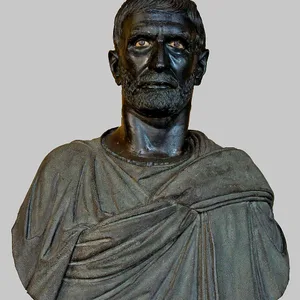

Tyrant of the island of Samos in the 6th century BC, Polycrates raised his city to the height of its power through a formidable fleet and strategic alliances. His brilliant reign, marked by patronage of the arts and prosperity, ended in a violent death at the hands of the Persian satrap Oroites.
Polycrates
Polycrates
8 min read
Frequently asked questions
Key Facts
- Around 538 BC: Polycrates seizes power in Samos alongside his brothers
- He assembles a fleet of one hundred penteconters and an army of one thousand archers
- He maintains an alliance with the Egyptian pharaoh Amasis, then with Persia
- He turns Samos into a flourishing cultural centre, welcoming poets and artists (including Anacreon)
- Around 522 BC: captured by the satrap Oroites, he is put to death and crucified
Works & Achievements
A subterranean aqueduct approximately 1,036 metres long, bored through Mount Castro by the engineer Eupalinos of Megara. This tunnel, cited by Herodotus as one of the three wonders of Samos, represents a unique feat of engineering in the ancient Greek world.
Polycrates commissioned a colossal temple dedicated to Hera on the island of Samos, surpassing in scale every other Greek sanctuary of the time. This monumental project asserted the tyrant's power while rivalling the great temples of Asia Minor.
Polycrates had a large deep-water breakwater built to protect and expand the harbour of Samos, which Herodotus counted among the city's three great achievements. This port infrastructure allowed his powerful war fleet to be sheltered and equipped.
Polycrates expanded the Samian fleet to one hundred penteconters and forty triremes, making Samos the foremost naval power in the Aegean Sea. This fleet enabled him to impose his dominance over numerous islands and coastal cities, inaugurating a form of thalassocracy.
Polycrates welcomed the poets Anacreon of Teos and Ibycus of Rhegium to his court, making Samos a major cultural centre of the Archaic Greek world. This patronage of the arts enhanced the tyrant's prestige and placed his reign within the tradition of the brilliant courts of the age.
Anecdotes
Aware that his exceptional good fortune might attract the jealousy of the gods, Polycrates followed the advice of his Egyptian ally Amasis: he threw his most precious ring into the sea — an emerald set in gold — so as to inflict misfortune upon himself. A few days later, a fisherman brought him a large fish as a gift; when the cooks prepared it, they found the ring inside, perfectly intact. When Amasis heard the news, he immediately broke off their alliance, convinced that no human being could escape his fate.
Master of a fleet of a hundred penteconters and forty triremes, Polycrates made himself feared throughout the Aegean Sea. He practiced a calculated form of piracy: he attacked friends and enemies alike, claiming that an ally whose possessions are returned after being taken is far more grateful than if they had never been taken at all.
Polycrates was a great patron of the arts who attracted the most celebrated poets of his day to his court. Anacreon of Teos and Ibycus of Rhegium lived on Samos under his protection and composed odes in his honor. This patronage of the arts made Samos a brilliant cultural center, rivaling the great courts of the Greek world.
Around 522 BC, the Persian satrap Oroites lured Polycrates to the mainland on the pretext of sharing an immense treasure with him. Despite the warnings of his daughter, who had experienced a prophetic dream, the tyrant of Samos crossed the sea and fell into the trap. Oroites had him put to death and exposed his body — a wretched end for one who had defied fortune for so long.
The great building projects of Polycrates on Samos struck the ancients by their ambition. Herodotus cites three achievements as the most remarkable in the entire Greek world: a tunnel bored through a mountain to supply the city with water, a breakwater protecting the harbor, and the Temple of Hera, one of the largest sanctuaries of the age. These colossal undertakings testified to the exceptional wealth and power of Samos under his rule.
Primary Sources
Polycrates, tyrant of Samos, was the friend and ally of Amasis, king of Egypt. Amasis wrote to him: 'The great prosperity of a friend does not rejoice me as much as it should; for I know the gods, jealous as they are, and I would rather see my friends sometimes flourishing and sometimes meeting with a reverse of fortune.'
Polycrates was the first of the Greeks within our knowledge to aim at the dominion of the sea, if we except Minos of Cnossus. [...] Oroetes put him to death in a manner unworthy of him and his fortune, and exposed his body.
Polycrates, tyrant of Samos, was powerful by his fleet and reduced several islands, including Rheneia, which he dedicated to Apollo of Delos.
Samos produced illustrious men [...] In the time of Polycrates, the city was so prosperous that the great works ordered by the tyrant were counted among the wonders of the Greek world.
Key Places
Island in the Aegean Sea and seat of Polycrates' power. Under his rule, Samos became one of the most prosperous and powerful cities in the Greek world, adorned with great monuments and a formidable fleet.
A great sanctuary dedicated to the goddess Hera, located in the southwest of the island. Polycrates had it enlarged and embellished, making it one of the most imposing temples in the Greek world — cited by Herodotus as one of the three greatest achievements of Samos.
A masterpiece of ancient engineering, bored through Mount Castro to supply Samos with fresh water. Designed by the architect Eupalinos of Megara under the patronage of Polycrates, it was dug simultaneously from both sides of the mountain with remarkable precision.
A city in Asia Minor and the territory of the satrap Oroetes, where Polycrates was lured by false promises of riches and put to death around 522 BC. It was here that the reign of the tyrant of Samos came to a tragic end.
A Greek trading post in Egypt and the seat of Pharaoh Amasis, first an ally and then an adversary of Polycrates. The diplomatic relations between Samos and Egypt had a lasting influence on the tyrant's maritime policy in the eastern Mediterranean.
Typical Objects

A warship with fifty oarsmen, the backbone of the Samian fleet. Polycrates had one hundred penteconters that secured his mastery of the Aegean and allowed him to impose his will on other city-states.

A precious ring that Polycrates threw into the sea to try to ward off fate, on the advice of Amasis. Found days later in the belly of a fish, it became the symbol of his inescapable destiny and the jealousy of the gods.

A warship with three banks of oarsmen, faster and more powerful than the penteconter. Polycrates owned forty triremes, a formidable weapon that made Samos the foremost naval power of the Aegean Sea.

The emblem of the tyrant's personal power, distinct from the symbols of Greek republican institutions. Polycrates exercised absolute and undivided authority over Samos, embodied by this staff of command.

A large vessel used to mix wine and water at aristocratic banquets (symposia). Polycrates' court, frequented by poets such as Anacreon and Ibycus, was the setting for these festive gatherings where fine ceramics played a central role.

A stringed musical instrument associated with celebration and lyric poetry. At Polycrates' court, poets such as Anacreon and Ibycus accompanied themselves on the lyre to sing the tyrant's praises at banquets.
School Curriculum
Vocabulary & Tags
Key Vocabulary
Daily Life
Morning
Polycrates began his day by receiving reports from his admirals and officers on the state of the fleet and the port's commercial activities. He oversaw the major ongoing construction projects — the tunnel, the temple, the harbor mole — consulting with the architects and engineers responsible for these colossal undertakings.
Afternoon
The afternoon was devoted to political and diplomatic affairs: audiences with ambassadors from allied or rival city-states, decisions on naval expeditions, and the management of tributes collected from subjugated cities. Polycrates exercised personal and direct power over every aspect of life on Samos.
Evening
Evenings were marked by symposia, those aristocratic banquets at which Polycrates entertained poets, philosophers, and dignitaries. Anacreon and Ibycus would sing their odes accompanied by the lyre, celebrating the tyrant's glory in a refined atmosphere blending wine, music, and debate.
Food
Polycrates' table reflected the wealth of Samos: abundant fish and seafood (tuna, sea bream, octopus), barley and wheat breads, olives, cheeses, figs, and grapes. Samian wine, renowned throughout the Greek world, flowed freely at banquets, mixed with water in large kraters.
Clothing
Like the tyrants and aristocrats of his time, Polycrates wore a fine linen chiton and a himation (draped cloak) in rich colors, often dyed in purple or saffron — costly hues reserved for the powerful. Worked leather sandals and gold jewelry (rings, fibulae) completed his attire.
Housing
Polycrates resided in a fortified palace overlooking the harbor of Samos, surrounded by his guards and court. The tyrant's residence bore witness to the island's wealth: marble columns, frescoes, precious wooden furniture imported from the East, and vast reception halls for banquets.
Historical Timeline
Period Vocabulary
Liens externes & ressources
Références
Œuvres
Construction du tunnel d'Eupalinos
v. 530-524 av. J.-C.
Agrandissement du temple d'Héra (Héraion)
v. 538-522 av. J.-C.
Construction de la digue et du port de Samos
v. 538-522 av. J.-C.
Constitution d'une flotte de guerre
v. 535-522 av. J.-C.
Mécénat littéraire et artistique
v. 535-522 av. J.-C.