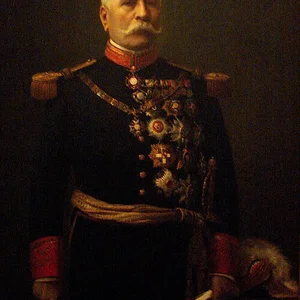

Mexican general and statesman (1830–1915), Porfirio Díaz ruled Mexico from 1876 to 1911 during a period known as the Porfiriato. His authoritarian regime drove economic modernization at the cost of political oppression, ultimately sparking the Mexican Revolution.
Porfirio Díaz(1830 — 1915)
Porfirio Díaz
Mexique
8 min read
Frequently asked questions
Famous Quotes
« Poor Mexico, so far from God, so close to the United States.»
Key Facts
- 1830: Born in Oaxaca, Mexico
- 1876: Seized power following the Battle of Tecoac
- 1876–1911: The Porfiriato — 35 years of near-uninterrupted rule
- 1910: Beginning of the Mexican Revolution against his regime
- 1911: Overthrown and exiled to France, where he died in 1915
Works & Achievements
A revolutionary manifesto proclaiming the principle of no re-election to justify the overthrow of President Lerdo de Tejada. This text established Díaz's initial legitimacy — a principle he would himself betray by remaining in power for over thirty years.
Díaz expanded the railway network from 400 km to over 20,000 km, connecting mines, agricultural regions, and ports. This infrastructure attracted foreign investment but primarily benefited American and British companies.
Legislative reforms opened Mexico's subsoil to foreign investors. Mexico became one of the world's leading silver producers and developed a nascent oil industry, enriching foreign shareholders while doing little to improve conditions for the general population.
Díaz transformed Mexico City into a modern, European-style capital: the Paseo de la Reforma modeled after the Champs-Élysées, a sewage network, electric lighting, and neoclassical buildings. These transformations embodied his vision of "French-style" progress.
Díaz brought an end to decades of civil wars by creating a rural police force (the *Rurales*) and neutralizing political opponents through co-optation or repression. This "Porfirian peace" enabled economic modernization but at the cost of civil liberties.
In September 1910, Díaz organized lavish festivities to mark the centennial of Mexican independence, inviting delegations from around the world. These extravagant celebrations stood in stark contrast to the poverty of the peasantry and preceded the outbreak of the Revolution by just a few weeks.
Anecdotes
Born into a modest family in Oaxaca, Porfirio Díaz was of mixed Mixtec and Spanish descent. As a young man, he first studied law under the mentorship of Benito Juárez, himself a native of Oaxaca, before turning to a military career during the War of Reform between liberals and conservatives.
At the Battle of Puebla on May 5, 1862, the young commander Porfirio Díaz played a decisive role in repelling the French army, which was far better equipped. This unexpected victory over a European power became a national symbol and is still celebrated every year under the name Cinco de Mayo.
In 1876, Díaz launched his armed uprising under the slogan "No Re-election!" to overthrow President Lerdo de Tejada. Ironically, once in power, he had the Constitution amended to allow himself to be re-elected indefinitely, ruling Mexico for more than thirty years without interruption.
In 1908, Díaz granted a landmark interview to American journalist James Creelman, declaring that Mexico was ready for democracy and that he would not seek another term. This statement was taken seriously by his opponents, most notably Francisco Madero, and directly contributed to the outbreak of the Mexican Revolution two years later.
Overthrown by the Revolution in 1911, Díaz went into exile in Paris, where he died in 1915 at the age of 84, having not seen his homeland in four years. His remains were not repatriated to Mexico until a century later, during official commemorations in 2011.
Primary Sources
Que el principio de no reelección del Ejecutivo Federal y gobernadores de los estados, será elevado a precepto constitucional. (The principle of non-re-election of the Federal Executive and state governors shall be elevated to a constitutional precept.)
I welcome an opposition party in the Mexican Republic. If it appears, I will regard it as a blessing, not as an evil. And if it can develop power, not to exploit but to govern, I will stand by it, support it, advise it and forget myself in the successful inauguration of complete democratic government in the country.
El pueblo mexicano... se ha insurreccionado en bandas armadas... He sido árbitro de sus destinos durante más de un cuarto de siglo... No soy el hombre indicado para conjurar el peligro. (The Mexican people have risen up in armed bands... I have been the arbiter of their destiny for more than a quarter of a century... I am not the man chosen to avert the danger.)
Desde niño fui aficionado a las armas y a la vida de campaña; desde joven estuve siempre dispuesto a defender las causas que juzgué justas para mi patria. (From childhood I was drawn to arms and the life of the campaign; from my youth I was always ready to defend the causes I deemed just for my homeland.)
Key Places
Birthplace of Porfirio Díaz, born on September 15, 1830, into a modest family. Also the birthplace of Benito Juárez, this city in southern Mexico was where Díaz received his education and made his first military commitments.
Site of the Battle of May 5, 1862 (Cinco de Mayo), where Díaz distinguished himself by repelling the French army. He also retook the city in 1867 during the restoration of the Republic, cementing his military reputation.
Seat of Mexican executive power and Díaz's main workplace for more than thirty years of his presidency. There he received ambassadors, signed legislation, and directed the modernization of the country.
Official residence of the Mexican president, which Díaz had renovated and expanded in the European style: Empire furniture, French-style gardens, and reception halls. He lived there with his family and received many foreign dignitaries.
City of Díaz's exile following his resignation in May 1911. An admirer of French culture and its model of civilization, he spent his final four years there and died on July 2, 1915, never having returned to Mexico.
Typical Objects

Díaz wore his military uniform with pride — covered in decorations and gold braid, carefully tailored to his imposing frame. The outfit embodied his legitimacy, rooted in his military victories against the French and the Conservatives.

The railroad was the defining symbol of Porfiriato modernization. Díaz expanded the rail network from a few hundred to more than 20,000 km, drawing massive American and European investment to connect mines, ports, and markets.

Acutely aware of his image, Díaz commissioned numerous official photographic portraits in his braided uniform. These images were reproduced and distributed throughout the country to reinforce his authority and build a cult of personality.

Díaz used the telegraph network to control the entire national territory from Mexico City. He is famously associated with the phrase *Mátalos en caliente* ("Kill them on the spot"), reportedly sent to governors to swiftly suppress unrest.

Under the Porfiriato, millions of hectares of indigenous communal lands (*ejidos*) were redistributed to large landowners. These legal documents embodied the dispossession of peasants that directly fueled the Revolution.

An admirer of France and the European model, Díaz had Chapultepec Castle furnished with pieces in the Second Empire style — furniture, chandeliers, and decorative objects. This setting symbolized his vision of progress and his ambition to elevate Mexico to the rank of "civilized" nations.
School Curriculum
Vocabulary & Tags
Key Vocabulary
Tags
Daily Life
Morning
Díaz rose early, true to his military habits. His days began with reading official correspondence and reports from provincial governors, whom he kept under close watch from Mexico City. At Chapultepec Castle, he would have a light breakfast before convening his ministers.
Afternoon
Afternoons were devoted to official audiences, receiving ambassadors, and administrative decisions. Díaz personally oversaw the country's major modernization projects, studying plans and technical reports with his advisors, the *Científicos*, who championed the positivism of Auguste Comte.
Evening
Evenings at the National Palace or Chapultepec frequently featured elaborate diplomatic receptions modeled on European protocol. A music lover, Díaz attended the opera and theater regularly; he also took a keen personal interest in the construction of the future *Palacio de Bellas Artes*, the cultural landmark he envisioned as a symbol of modernity.
Food
Day to day, Díaz ate Mexican food — tortillas, black beans, meats in mole sauce — but official receptions called for a French-style table, with imported wines and elaborate dishes. As he aged, he adopted a more frugal diet on the advice of his personal physician.
Clothing
On ceremonial occasions, Díaz wore his full general's uniform, covered in medals and gold braid, kept immaculate for photographers and foreign delegations. In private, he favored civilian clothes cut in the European style, often ordered from Paris — a reflection of his admiration for French culture.
Housing
Díaz officially resided at Chapultepec Castle, which he had transformed into a presidential residence befitting a European court: reception rooms furnished in the Empire style, crystal chandeliers, and manicured gardens. Within Mexico City itself, he kept apartments at the National Palace for late working nights, and maintained ties to his home state of Oaxaca.
Historical Timeline
Period Vocabulary
Liens externes & ressources
Références
Œuvres
Plan de Tuxtepec
1876
Développement du réseau ferroviaire national
1876-1911
Lois minières et ouverture aux capitaux étrangers
1884-1892
Modernisation urbaine de Mexico
1876-1910
Pacification du territoire et création des Rurales
1876-1880
Célébrations du Centenaire de l'Indépendance
1910