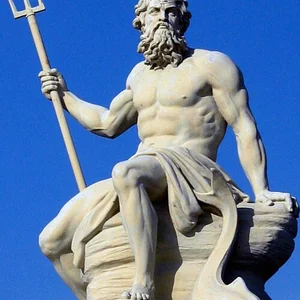

Greek god of the sea, oceans, and earthquakes, worshipped in ancient Greek mythology. Brother of Zeus and Hades, Poseidon rules over the seas and is often depicted wielding a trident. A central figure of the Olympian pantheon, he embodies the power of marine and seismic forces.
Poseidon
Poseidon
8 min read
Frequently asked questions
Key Facts
- Major deity of the Greek Olympian pantheon, worshipped since the Mycenaean period (2nd millennium BCE)
- Depicted carrying a trident as the symbol of his power over the seas and waters
- Venerated as the protector of navigators and sailors throughout the ancient Mediterranean world
- Associated with earthquakes, earning him the epithet 'Poseidon the Earth-Shaker' (Ennosigaios)
- Father of many legendary creatures, including Polyphemus the Cyclops and Pegasus the winged horse
Works & Achievements
A mythic weapon symbolizing the god's power over the seas and earthquakes. The trident is Poseidon's defining attribute and represents his dominion over the three maritime realms.
The founding of organized worship of Poseidon in ancient Greece, expressed notably through the Isthmian Games at Corinth and coastal sanctuaries. This cult reflects the deep religious importance of the god to Mediterranean peoples.
According to mythology, Poseidon is the creator of the horse, a symbol of his power and his connection to the forces of nature. This act of creation establishes him as a life-giving deity.
Poseidon pursues the hero Odysseus for ten years after the Trojan War, punishing him for blinding his son, the Cyclops Polyphemus. This episode illustrates the god's power and his capacity for vengeance over the seas.
Poseidon fathers the Minotaur through his union with Pasiphae, queen of Crete. This monster becomes a central figure in Cretan mythology and embodies the consequences of divine wrath.
Poseidon plays a part in the great flood sent to destroy sinful humanity, underscoring his role as a destructive force capable of reshaping the world. This mythic event symbolizes the god's cataclysmic power.
Poseidon competes with Athena for patronage of Athens by striking the ground to produce a saltwater spring, but Athena wins by gifting the olive tree. This myth explains the goddess's special bond with the city, while Poseidon retained coastal sanctuaries throughout Attica.
Anecdotes
Poseidon was venerated as the protector of Greek sailors and navigators, who offered him sacrifices before setting out to sea. The Greeks believed the god could unleash devastating storms if offended, which explains why ports and coastal sanctuaries were dedicated to him throughout the Mediterranean basin.
Poseidon's trident, his characteristic weapon, symbolized his control over three domains: fresh waters, salt waters, and earthquakes. In Greek artistic representations — especially on coins and vases — the god is almost always shown holding this distinctive trident.
The cult of Poseidon was particularly important in Athens and Corinth, maritime cities that depended heavily on naval trade. The Temple of Poseidon at Sounion, in Attica, was a famous landmark for ancient sailors, its ruins still commanding the Aegean strait today.
According to Greek myths recorded in the works of Hesiod and Homer, Poseidon took part in the drawing of lots to divide the world with his brothers Zeus and Hades, receiving the oceans as his share while Zeus received the sky and Hades the underworld.
The Isthmian Games, one of the major athletic competitions of ancient Greece, were held every two years near the sanctuary of Poseidon at the Isthmus of Corinth, drawing athletes from across Greece to honor the sea god.
Primary Sources
Poseidon, the earth-shaker, rose from the sea and appeared before the Argives. He had the stature of the immortal gods and carried his fearsome trident. The waves rose before him like mountains.
Poseidon, the dark-eyed god of the sea, enraged at Odysseus, stirred up terrible storms and monstrous waves to punish him for blinding his son Polyphemus.
Poseidon received as his domain the kingdom of the grey sea, and Hades the misty realm of the dead, while Zeus was given the vast sky. Thus were the domains divided among the three brothers, sons of Cronus.
I sing of Poseidon, the mighty god who shakes the earth and rules the seas, brother of great Zeus and dark Hades, who received as his share the stormy deep.
Poseidon, lord of the seas, guards the Ocean that girdles the world. Ships and sailors fear him and offer him sacrifices to win his favour.
Key Places
Divine home of the Greek pantheon where Poseidon reigns alongside Zeus and the other Olympian gods. It is the seat of divine power and the place where Poseidon takes part in the assemblies of the gods.
The legendary island created and ruled by Poseidon according to Greek mythology. The god built his temple there and reigned over this mysterious sunken continent, symbolizing his power over the seas.
Greek city where Poseidon had an important sanctuary and a thriving cult. The coastal region of Corinth was particularly devoted to the god who protected seas and sailors.
A promontory of Attica where an ancient temple dedicated to Poseidon stands overlooking the Mediterranean. This sanctuary symbolizes the bond between the god and the sea, serving as a landmark for sailors.
Poseidon plays a crucial role in the Trojan War, supporting the Greeks against the Trojans. He intervenes directly in the fighting and embodies Greek maritime power in its conflict with the city of Asia Minor.
A region of central Greece where Poseidon is venerated as the protector against earthquakes and as a patron of horsemen, with local cults devoted to him closely tied to horses and geological phenomena.
Typical Objects

Poseidon's iconic weapon, consisting of a long shaft topped with three sharp prongs. It symbolizes his power over the seas and his authority among the Olympian gods.

Poseidon's mythical vehicle, drawn by hippocampi — creatures that are half horse, half fish — which carry him across the oceans. It represents his dominion over the marine world.

A royal adornment worn by Poseidon, symbolizing his status as sovereign god of the seas. It is an attribute of divine power within the Greek pantheon.

A sacred creature associated with Poseidon in Greek mythology, symbolizing wisdom and benevolence at sea. Dolphins were revered animals placed under the god's protection.

A Greek warship with three rows of oars, embodying the naval genius of the ancient world. An everyday object of the era that reflects the central importance of the sea in ancient Greece.

A natural phenomenon personified as a manifestation of Poseidon's anger or power. A concrete representation of his domain over the movements of the earth.

A ceramic vessel used in ancient Greece to transport wine or olive oil. A staple of maritime trade closely tied to the economic activity that took place under Poseidon's protection.

An iconographic symbol stamped on ancient Greek coins, bearing witness to the cult of Poseidon. It represents the religious and economic importance of the god for the city-states.
School Curriculum
Vocabulary & Tags
Key Vocabulary
Daily Life
Morning
Poseidon reigns over his aquatic palace deep beneath the ocean, built of gold, silver, and coral. Each morning, he surveys his marine domain, riding his chariot pulled by hippocampi and sea-horses through the waves.
Afternoon
In the afternoon, the god receives tributes from Greek sailors and navigators who offer him sacrifices to ensure their safety at sea. He also intervenes in Olympian and mythological affairs, orchestrating storms, earthquakes, and the emergence of new lands according to his will.
Evening
In the evening, Poseidon presides over divine feasts on Olympus alongside the other gods, or remains in his underwater kingdom surrounded by sea deities such as the Nereids and fantastical marine creatures. He oversees the cults dedicated to him at coastal and island sanctuaries.
Food
Like all the Olympian gods, Poseidon sustains himself on ambrosia and nectar, the foods that grant immortality. He also receives sacrifices from mortals: hecatombs (sacrifices of a hundred animals), offerings of fish, and marine products during religious festivals.
Clothing
Poseidon is depicted wearing a royal cape or cloak, often bearded with a majestic and powerful appearance. He carries his distinctive emblem — the trident, symbol of his power over the seas — and wears a crown of flowing waves upon his head.
Housing
His palace lies in the ocean depths, a divine structure built of precious metals and splendid marine ornaments, unlike anything found in human Greek dwellings. This underwater realm is also home to sea creatures and lesser deities who honor their king of the seas.
Historical Timeline
Period Vocabulary
Visual Style
Un style inspiré de la céramique grecque antique fusionné avec la composition dramatique de la Renaissance, capturant la puissance divine et tempétueuse de Poséidon à travers des jeux de lumière contrastés, des motifs géométriques grecs et une représentation équilibrée entre la beauté sereine et la force chaotique de l'océan.
Sound Ambience
Une ambiance sonore épique et souveraine mêlant le grondement des vagues déferlantes, le tonnerre lointain et les tremblements de terre, enrichie d'instruments antiques grecs et de chants sacrés, évoquant la puissance divine et terrifiante du dieu des mers et des tremblements de terre.
Liens externes & ressources
Références
Œuvres
Le Trident de Poséidon
inconnue
Fondation du culte de Poséidon
IIe millénaire av. J.-C.
La création du cheval
inconnue
Le châtiment d'Odysseus
inconnue
La création du Minotaure
inconnue
Le déluge de Deucalion
inconnue
La compétition avec Athéna pour Athènes
inconnue