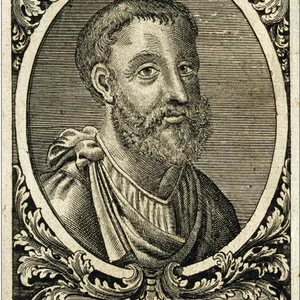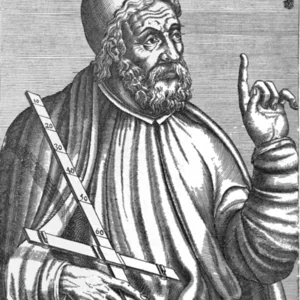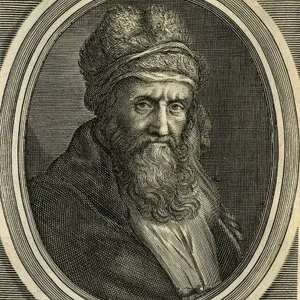

Greek Neoplatonist philosopher of the 5th century, the last great master of the School of Athens. He was also an influential commentator on Greek mathematics, particularly on Euclid.
Proclus(412 — 485)
Proclus
Empire byzantin
6 min read
Frequently asked questions
Key Facts
- Born around 412 in Constantinople, died in 485 in Athens
- Led the Neoplatonic School of Athens (heir to the Academy) until his death
- Author of the 'Elements of Theology', a systematic exposition of Neoplatonic metaphysics
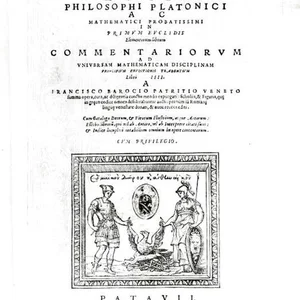
- Wrote a famous 'Commentary on the First Book of Euclid's Elements', a major source on the history of Greek mathematics
- A figure of pagan resistance against the triumphant Christianity of Late Antiquity
Works & Achievements
A systematic presentation of Neoplatonic metaphysics in 211 propositions arranged geometrically. A major work that profoundly influenced medieval Arabic, Byzantine, and Latin thought.
A vast synthesis that reorganizes all of Plato's doctrine into a coherent theological system concerning the gods and the principles of reality.
A philosophical reflection on the nature of mathematics, a precious source for the lost history of Greek geometry.
An in-depth study of Plato's dialogue on the origin of the cosmos, considered by Proclus himself to be one of his favourite works.
An analysis of Plato's most metaphysical dialogue, in which Proclus develops his doctrine of the One beyond being.
A series of essays on Plato's great political dialogue, also addressing poetry, myths, and the immortality of the soul.
A collection of religious poems addressed to the Greek gods, blending devotional fervour with philosophical speculation.
A presentation of the astronomical models of antiquity, attesting to Proclus's interest in the sciences of the heavens.
Anecdotes
Proclus was born in Constantinople but grew up in Xanthos, in Lycia, before leaving to study in Alexandria and then in Athens. It is said that upon his arrival in Athens, the goddess Athena appeared to him in a dream to invite him to study philosophy: he saw in this the sign that his vocation was to become the guardian of ancient Greek wisdom.
According to his biographer and disciple Marinus, Proclus led a life of extreme discipline: he taught up to five classes a day, wrote hundreds of lines, prayed at all hours, and scrupulously observed the religious festivals of every people, saying that a philosopher should not be the priest of a single city but of the entire universe.
Proclus wrote a famous commentary on the first book of Euclid's *Elements*. It is thanks to him that we know a great deal of the ancient history of Greek mathematics: in it he cites authors such as Eudemus of Rhodes, whose writings are now lost.
Marinus recounts that Proclus was a vegetarian and remained celibate, devoting all his energy to study and contemplation. He is said to have healed the sick daughter of one of his friends through his prayers, which strengthened his reputation as a man close to the divine.
At a time when Christianity was becoming dominant in the Empire, Proclus remained a fervent defender of the traditional Greek religion and gods. The pressures became so great that he had to leave Athens for a time and take refuge in Lydia, before returning to lead his school.
Primary Sources
Proclus was born under a lucky star, and all the goods of the soul and of the body fell to him as his portion. Athena herself appeared to him and urged him to devote himself to philosophy.
Mathematics holds the middle ground between intelligible things and sensible things, and it lifts the soul toward the contemplation of higher realities.
Every multiplicity participates in some way in the One. For if it did not participate in the One at all, neither would its whole be one, nor would each of its parts.
The first principle of all things is beyond being, beyond intelligence, ineffable and unknowable by the ordinary means of reason.
Key Places
Capital of the Eastern Roman Empire, where Proclus was born in 412. His family, from Lycia, was staying there at the time.
A city in Lycia, in Asia Minor, where Proclus spent his childhood. His family came from there, and it was where he received his first education.
A great intellectual center of Egypt where Proclus studied rhetoric, philosophy, and mathematics before moving to Athens.
The home of Neoplatonism, where Proclus studied under Syrianus, then led the School (the Academy) for nearly fifty years, until his death in 485.
A region of Asia Minor where Proclus took refuge for about a year, when Christian pressure against the pagans became too strong in Athens.
Typical Objects

The medium on which Proclus wrote his countless commentaries and philosophical treatises. Ancient libraries preserved knowledge in the form of scrolls carefully copied by hand.

A cut reed used as a pen, dipped in ink to write on papyrus or parchment. It was the everyday instrument of the philosopher and the scribe.

A small board coated with wax on which erasable notes were scratched with a pointed stylus. Students and masters used it for exercises and rough drafts.

The geometer's instruments, indispensable for drawing the figures of Euclid's proofs that Proclus commented on. Greek geometry relied on these two tools alone.

An astronomical model made of rings representing the movements of the heavenly bodies. Proclus, who wrote on astronomy, took an interest in these instruments that depicted the order of the cosmos.

A long draped woolen cloak worn by Greek philosophers, which became the distinctive mark of their station. Proclus wore it as an heir to the tradition of Plato.

A small altar where Proclus performed his prayers and offerings to the traditional gods, several times a day according to Marinus. Ritual piety was at the heart of his Neoplatonism.
School Curriculum
Vocabulary & Tags
Key Vocabulary
Tags
Daily Life
Morning
Proclus rose early and began the day with prayers to the rising sun, faithful to his piety toward the gods. He then devoted his first hours to reading and writing, before the arrival of his students.
Afternoon
The afternoon was structured around teaching: Marinus reports that he could give up to five lessons in a day and hold seminars commenting on the texts of Plato and Aristotle. Discussions with his disciples would extend into philosophical debates.
Evening
In the evening, Proclus continued his writing, sometimes composing hundreds of lines. He ended the day with further prayers and a time of contemplation, seeking the union of the soul with the divine.
Food
Proclus followed a frugal, vegetarian diet, out of philosophical discipline and respect for religious prescriptions. He fasted during the sacred festivals and made do with simple food.
Clothing
He wore the himation, the draped woolen cloak of the Greek philosophers, a mark of his faithfulness to the tradition of Plato. His plain attire reflected his ascetic way of life.
Housing
Proclus lived in Athens in a house near the Acropolis and the sanctuary of Asclepius, where he could honor the gods. His home also served as a place of teaching and a library for his disciples.
Historical Timeline
Period Vocabulary
Liens externes & ressources
Références
Œuvres
Éléments de théologie (Stoicheiôsis theologikê)
Ve siècle
Théologie platonicienne
Ve siècle
Commentaire sur le premier livre des Éléments d'Euclide
Ve siècle
Commentaire sur le Timée de Platon
Ve siècle
Commentaire sur le Parménide de Platon
Ve siècle
Commentaire sur la République de Platon
Ve siècle
Hymnes
Ve siècle