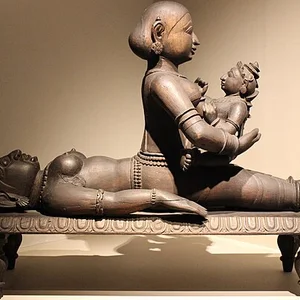

Putana is a demoness from Hindu mythology, sent by King Kamsa to kill the infant Krishna by nursing him with poisoned milk. Krishna, recognizing her divine nature, slew her while granting her spiritual liberation.
Putana
Putana
8 min read
Frequently asked questions
Key Facts
- Putana is described in the Bhagavata Purana as a Rakshasi (demoness) in the service of King Kamsa
- She disguises herself as a beautiful woman to approach the infant Krishna and attempt to poison him
- Krishna suckles her poisoned milk and draws out her life force, killing her instantly
- Despite her evil act, she receives moksha (liberation) because she nursed Krishna, even unwillingly
Works & Achievements
The foundational story in which the infant Krishna kills the demoness Putana by draining her poisoned milk. Considered Krishna's first heroic feat as a child, it opens the cycle of Krishnalilas in the Puranic texts.
The most complete and revered text narrating Krishna's life, devoting several chapters to the Putana episode. The foundation of bhakti devotion, it has been commented upon by thousands of Hindu theologians over the centuries.
One of the earliest texts to give narrative form to the Putana episode within the genealogical framework of Krishna's life. It represents a key milestone in the literary shaping of Krishnaite mythology.
Putana has been depicted in Indian art since antiquity, appearing on bas-reliefs at Mathura and Amaravati: she is shown nursing Krishna or dying in his divine embrace, a powerful motif in Krishnaite religious art.
Theatrical and dance performances of episodes from Krishna's life. The Putana episode is among the most frequently staged, especially in Vrindavan during Krishnaite festivals, keeping the Puranic traditions alive and vivid.
Anecdotes
According to the Bhagavata Purana, Putana was a fearsome demoness capable of shapeshifting into a beautiful woman. To approach the infant Krishna without arousing the suspicions of Gokul's inhabitants, she coated her breasts with a powerful poison before presenting herself as a kind mother wishing to nurse the child.
When Putana took little Krishna in her arms to nurse him, the infant immediately recognized her demonic nature. Instead of being killed, he began to suckle with such force that he drew out not only the poisoned milk, but also the demoness's entire life force, killing her on the spot in terrible convulsions.
As she died, Putana reverted to her gigantic demonic form: according to the Puranic texts, her body stretched across several leagues. The inhabitants of Vraja were astounded, but when they burned her body, it released a pleasant celestial fragrance — a sign interpreted by the sages as proof that Krishna had granted her spiritual liberation (moksha).
Hindu theologians have long pondered the paradox of Putana: although she intended to kill Krishna with poisoned milk, she nonetheless played the role of a nursing mother. Krishna, it is said, always honors whoever feeds him, even unwillingly, by granting them liberation from the cycle of rebirths.
In devotional traditions (bhakti), Putana is held up as a figure of universal redemption: she illustrates that even an evil intention, once it comes into intimate physical contact with the divine, can lead to liberation. Some Krishnaite hymns affectionately refer to her as the “foster mother” of the child god.
Primary Sources
Kamsa sent Putana, the child-slayer, to take the life of divine newborns. Taking the form of a beautiful woman, she traveled through towns and villages until she reached Gokula and approached the home of Nanda. She took the child in her arms and offered him her poison-laced breast; Krishna grasped the breast and drank, drawing out her very life along with the milk.
The demoness Putana, sent by Kamsa, coated her breast with poison and approached the sleeping Krishna. The child grasped her breast and drank, drawing out her life at the same time. Putana let out a terrible cry, her body resumed its gigantic form, and she died, crushing the surrounding forests.
Kamsa, upon learning of Krishna's birth, called upon Putana to destroy the child. She advanced toward Vraja in a seductive form and, having smeared her breast with deadly venom, approached the son of Yashoda. The child grasped her breast with tremendous force.
Krishna, though an infant, grasped Putana's breast and drew out not only the milk but her very life. Purified by this divine contact, Putana was granted the status of Krishna's spiritual mother and was liberated from the cycle of rebirths, ascending to the celestial realms.
Key Places
Village in the Braj region where Nanda, Yashoda, and the young Krishna lived. It was here that Putana came to carry out her murderous mission and met her death — and simultaneously the spiritual liberation granted by the divine child.
Capital of King Kamsa, who sent Putana from this city to eliminate Krishna. Mathura is also the birthplace of Krishna, the central hub of sacred Krishnaite geography and a major pilgrimage site.
Sacred forest on the banks of the Yamuna river, the setting for Krishna's childhood and divine play (*lilas*). The episode of Putana represents the intrusion of evil into this idyllic pastoral world — and its immediate defeat at the hands of the divine.
Vast sacred territory encompassing Mathura, Vrindavan, and Gokul, the setting for Krishna's entire childhood. Pilgrims still walk these lands today in remembrance of the Puranic episodes, including the victory over Putana.
Typical Objects

Putana's primary weapon: a deadly poison smeared on her breasts before nursing Krishna. Paradoxically, this murderous act became the path to her own redemption, as the nurturing contact with the divine erases even the darkest intentions.

Putana mastered the art of transformation (maya), taking on the appearance of a beautiful and kind woman to deceive the people of Gokul and approach the divine infant without arousing suspicion.

At death, Putana reverted to her true form as a colossal rakshasi, stretching over several leagues. This monumental corpse symbolizes the defeat of the forces of evil before the divine, even in its guise of a helpless infant.

After Putana's death, the people of Gokul used clarified butter (ghee) and sacred herbs for her funeral pyre — a rite normally reserved for humans, a sign that her liberation granted her a new dignity.

Faced with the threat of Putana and the other demons sent by Kamsa, the cowherd guardians (gopas) wore amulets and performed protective rites to keep infants safe — a testament to the fear of child-killing yakshinis in folk tradition.

The Puranic texts describe the poison used by Putana as having devastating potency, capable of killing on mere contact. In Hindu symbolism, this poison represents spiritual ignorance (avidya) that Krishna, the divine light, dissolves instantaneously.
School Curriculum
Vocabulary & Tags
Key Vocabulary
Daily Life
Morning
In Hindu cosmology, Putana dwells in the demonic realms (patala) alongside other rakshasas. She devotes her mornings to channeling her maya powers to take on deceptive human forms, preparing for the murderous missions ordered by King Kamsa against divine infants.
Afternoon
Putana travels through the Braj lands using her supernatural powers, scouting villages where infants live. Acting as a yakshini who slays children, she infiltrates families under her seductive guise, carrying her poisons and exploiting the trust that her borrowed beauty earns her.
Evening
In Puranic texts, rakshasas return to their true form at nightfall. Putana resumes her gigantic and terrifying stature in the underworld realms to report to Kamsa on her missions. After her death and liberation by Krishna, tradition places her in the celestial worlds, purified by her contact with the divine.
Food
As a rakshasi, Putana feeds — according to the texts — on vital essences stolen from the living. The poisoned milk she offers Krishna symbolizes the demonic inversion of nourishing food: what should give life becomes an instrument of death — an inversion that Krishna ultimately turns against her.
Clothing
In her transformed appearance, Putana dons the attire of a noble woman: fine silk garments, golden ornaments, and flowers in her hair, so as to inspire trust among the inhabitants of Gokul. Her true rakshasi form is described in the Puranas as monstrous, with disproportionate limbs, wild hair, and a dark complexion.
Housing
Putana belongs to the world of rakshasas, whose mythical dwellings are located in underground spaces (patala), dark forests, or crossroads — places regarded as boundaries between the world of the living and that of malevolent spirits in ancient Hindu cosmology.
Historical Timeline
Period Vocabulary
Liens externes & ressources
Références
Œuvres
Épisode du Putana-vadha (destruction de Putana)
Temps mythique ; codifié dans les Puranas entre le IVe et le Xe siècle apr. J.-C.
Bhagavata Purana, Livre X — vie et exploits de Krishna
VIIIe–Xe siècle apr. J.-C. (forme canonique)
Harivamsa — appendice héroïque du Mahabharata
Entre le IIe siècle av. J.-C. et le IVe siècle apr. J.-C.
Représentations sculptées du Putana-vadha
IIe siècle av. J.-C. – époque contemporaine
Théâtre Ras Lila — représentations des Krishnalilas
Tradition continue depuis le XVIe siècle, réformée par Chaitanya Mahaprabhu