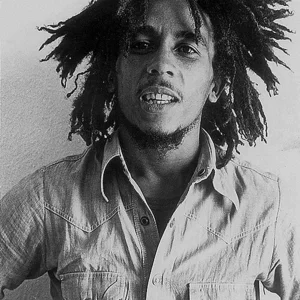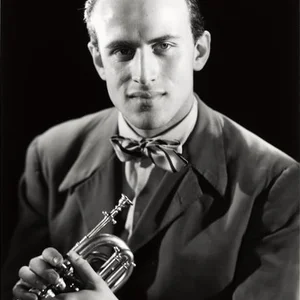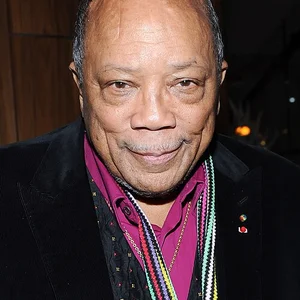

Quincy Jones (1933-2024) is one of the most influential musicians and producers of the 20th century. A jazz composer, arranger, and bandleader, he is also the producer of Michael Jackson's best-selling albums, including Thriller.
Quincy Jones(1933 — 2024)
Quincy Jones
États-Unis
8 min read
Frequently asked questions
Famous Quotes
« I've always thought that music is the best medicine.»
« You have to put your ego away when you're producing someone else's music.»
Key Facts
- Born on March 14, 1933 in Chicago, Illinois
- Arranger for Count Basie, Frank Sinatra, and Miles Davis in the 1950s–1960s
- Produced Michael Jackson's Thriller in 1982, the best-selling album in history
- Organized the humanitarian concert We Are the World in 1985
- Died on November 3, 2024 in Los Angeles
Works & Achievements
A jazz fusion album that won the Grammy Award for Best Jazz Arrangement. It showcases Quincy Jones's ability to reinvent jazz by opening it up to new rhythmic and harmonic influences.
Music for the landmark television miniseries tracing the history of an African-American family from slavery to freedom. This work drew Quincy Jones into the storytelling of Black American memory.
The first album Quincy Jones produced for Michael Jackson. Blending soul, funk, and pop, it launched Jackson into an entirely new artistic dimension and foreshadowed the worldwide triumph of Thriller.
Produced by Quincy Jones, it remains the best-selling album in music history with over 66 million copies sold, featuring iconic tracks such as "Billie Jean" and "Beat It."
A charity single co-written by Michael Jackson and Lionel Richie and produced by Quincy Jones, bringing together 45 American artists to raise tens of millions of dollars for famine victims in Africa.
Music for Steven Spielberg's film adapted from Alice Walker's novel. Quincy Jones composed a sensitive and socially engaged score exploring the lives of Black women in America, and also co-produced the film.
An album that won six Grammy Awards by bringing together jazz legends such as Dizzy Gillespie and Miles Davis alongside contemporary hip-hop artists, reflecting Quincy Jones's inclusive, cross-generational musical vision.
Anecdotes
At the age of 14, Quincy Jones broke into a building in Seattle with some friends and stumbled upon a piano in a refrigerated room. This unexpected encounter with the instrument triggered an immediate revelation: he knew he wanted to dedicate his life to music, and from that moment on he never stopped learning.
Around 1947, in Seattle, Quincy Jones met a 17-year-old blind teenager named Ray Charles. Both boys shared a passion for music and came from disadvantaged backgrounds; they became close friends and supported each other in their first artistic steps. That friendship would last more than fifty years, until Ray Charles's death in 2004.
In the 1950s, Quincy Jones won a scholarship to study classical composition in Paris under Nadia Boulanger, the renowned French pedagogue who had taught composers such as Aaron Copland and Astor Piazzolla. This immersion in European classical music profoundly enriched his approach to orchestral arranging.
During the recording session for 'We Are the World' in January 1985, Quincy Jones had a sign posted at the studio entrance reading 'Check your egos at the door.' Forty-five of America's biggest stars — from Michael Jackson and Bruce Springsteen to Diana Ross — complied, and together they recorded this landmark charity single intended to aid Africa.
Over the course of his career, Quincy Jones received 80 Grammy nominations and won 28, a record for an individual artist. He also received an Oscar, seven Emmy Awards, and was made a Commander of the Legion of Honor by France — a testament to the universal reach of his cultural influence.
Primary Sources
Quincy Jones describes his childhood in poverty in Chicago and then Seattle, and the moment he discovered the piano: 'Music was the only thing that made me feel like I existed, like I had a place in a world that didn't wish us well.'
On his collaboration with Michael Jackson: 'We knew we were making something different. Michael brought an energy we had never seen before, and I was trying to build a musical framework worthy of what he carried inside him.'
He pays tribute to the jazz pioneers who paved the way for him — Dizzy Gillespie, Count Basie, Duke Ellington — and highlights the role of music as a bridge between peoples: 'Music has no skin color. That's why I've dedicated my life to it.'
He asks each artist to set aside their ego and star habits: 'Tonight, we are not stars. We are messengers. The only star here is Africa.'
Key Places
Birthplace of Quincy Jones in 1933. He grew up in a context of extreme poverty and racial segregation in the South Side neighborhood before his family moved to Seattle.
The city where Quincy Jones grew up, developed his passion for music, met Ray Charles, and began playing trumpet in local jazz clubs as a teenager.
In the 1950s, Quincy Jones came to Paris to study under Nadia Boulanger and Olivier Messiaen. This experience greatly deepened his grounding in European classical music.
The city where Quincy Jones established himself as an arranger and artistic director in the 1960s, notably at Mercury Records, where he became the label's first African American vice president.
The capital of the American music and film industry, Los Angeles is the city where Quincy Jones produced his most iconic works — including Michael Jackson's albums — and where he passed away in 2024.
Typical Objects

Quincy Jones learned the trumpet as a teenager, and it was as a trumpeter that he launched his professional career in jazz big bands during the 1950s.

At the heart of his work as a producer, the mixing console allowed him to assemble, balance, and sculpt the sounds recorded by the dozens of musicians he directed in the studio.

A gifted arranger, Quincy Jones wrote detailed scores by hand for each instrument, adapting compositions for ensembles ranging from small jazz combos to full symphony orchestras.

Multitrack recording technology, developed during the 1960s and 1970s, revolutionized his work by allowing him to record each instrument separately before mixing everything together.

An accomplished conductor, Quincy Jones led large jazz and symphonic ensembles with the baton, the symbolic instrument of his mastery of orchestration.

The dominant medium for recorded music from 1948 through the 1980s, vinyl is the format on which Quincy Jones's entire major discography was first released and distributed around the world.
School Curriculum
Vocabulary & Tags
Key Vocabulary
Tags
Daily Life
Morning
Quincy Jones was known for working very late into the night and starting his day in the late morning. He would often begin by replaying the previous day's recordings, pen in hand, noting adjustments to be made to the arrangements and mixes.
Afternoon
His afternoons were devoted to studio sessions with artists, meetings with record labels, and score revisions. He personally oversaw every detail of his productions, frequently working with orchestras of fifty musicians or more, with an absolute demand for sonic quality.
Evening
Evenings and nights were the peak of his creative activity. Recording sessions typically kicked off in the early evening and could stretch until dawn. Most of the songs on Thriller were recorded in an atmosphere that was at once exacting and electric.
Food
Quincy Jones often spoke of a childhood marked by food deprivation in Chicago and Seattle. As an adult and a star living in Los Angeles, he had a deep appreciation for traditional African American cuisine. After two brain aneurysms in 1974, he adopted a more health-conscious lifestyle under medical supervision.
Clothing
On stage and at awards ceremonies, Quincy Jones wore elegant, often colorful suits that reflected his charisma and his status as an international star. In the studio, he favored relaxed clothing suited to long hours of intensive work.
Housing
Based in Los Angeles since the 1960s, Quincy Jones lived in a luxurious villa in Bel Air, the upscale residential neighborhood favored by Hollywood celebrities. His home was known as a hub of ongoing musical encounters and collaborations, where artists and producers from around the world would regularly cross paths.