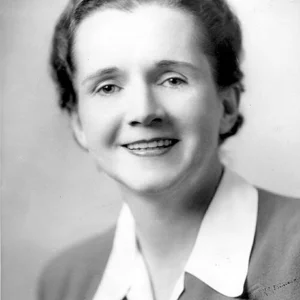

Marine biologist and American writer, Rachel Carson is the pioneer of the modern environmental movement. Her book *Silent Spring* (1962) exposed the massive use of pesticides and their devastating impact on ecosystems, sparking a global awakening on environmental protection.
Rachel Carson(1907 — 1964)
Rachel Carson
États-Unis
9 min read
Frequently asked questions
Famous Quotes
« In nature, nothing exists alone.»
« Man is a part of nature, and his war against nature is inevitably a war against himself.»
Key Facts
- 1907: Born in Springdale, Pennsylvania
- 1941: Publication of *Under the Sea Wind*, her first book on marine life
- 1951: *The Sea Around Us* becomes a worldwide bestseller and brings her international fame
- 1962: Publication of *Silent Spring*, exposing the effects of DDT and pesticides
- 1964: Death from breast cancer; her work would lead to the ban of DDT in the United States in 1972
Works & Achievements
Carson's first book, telling the story of marine life through the eyes of its inhabitants — a mackerel, an eel, a shorebird. Little noticed on publication, it was reissued in 1952 following the success of 'The Sea Around Us'.
A masterwork of popular science exploring the history and mysteries of the oceans, the book was an immediate worldwide success. It earned Carson the National Book Award and allowed her to leave her government post to write full time.
A guide to life in the intertidal zones of the American East Coast, blending scientific rigor with poetic prose. Carson invites readers to closely observe the biodiversity of beaches, rocky shores, and coastal marshes.
A landmark work exposing the devastating effects of chemical pesticides on ecosystems and human health. Widely regarded as the founding text of modern environmental politics, it led to the ban on DDT in the United States.
An illustrated essay on the importance of nurturing children's curiosity about the natural world, inspired by her explorations with her grandnephew Roger. Published after her death, it remains one of her most moving and beloved works.
Anecdotes
At the age of ten, Rachel Carson published her first story in the children's literary magazine 'St. Nicholas'. She received a silver badge and saw her text in print, convincing her from an early age that she would become a writer. No one suspected then that she would combine writing and science to change the world.
In 1952, Rachel Carson won the National Book Award for 'The Sea Around Us', a work of popular science about the oceans. The book stayed at the top of the New York Times bestseller list for eighty-six consecutive weeks. A marine biologist, then little known to the general public, suddenly became a national celebrity.
When she published 'Silent Spring' in 1962, the chemical industry launched a fierce campaign to discredit her, going so far as to call her a 'nature fanatic' and questioning her scientific credentials. Carson, already gravely ill with breast cancer, nonetheless testified before the U.S. Congress with a calm and precision that impressed the senators.
Rachel Carson maintained a very intimate correspondence with her friend Dorothy Freeman, whom she had met in Maine in 1953. Their letters, published after their deaths, reveal a deep relationship and a sensitive soul who found in nature both a refuge and a subject of scientific study.
Following the publication of 'Silent Spring', President John F. Kennedy created a scientific advisory committee to examine the dangers of pesticides. The 1963 report confirmed Carson's findings and led, years later, to the ban on DDT in the United States in 1972. Rachel Carson died in 1964, never seeing this ultimate victory.
Primary Sources
Can anyone believe it is possible to lay down such a barrage of poisons on the surface of the earth without making it unfit for all life? They should not be called 'insecticides,' but 'biocides.'
We still talk in terms of conquest. We still haven't become mature enough to think of ourselves as only a tiny part of a vast and incredible universe. Man's attitude toward nature is today critically important simply because we have now acquired a fateful power to alter and destroy nature.
The sea lies all about us. The commerce of all lands must cross it. The very winds that move over the lands have been cradled on its broad expanse and seek ever to return to it.
It is a curious situation that the sea, from which life first arose, should now be threatened by the activities of one form of that life. But the sea, though changed in a sinister way, will continue to exist; the threat is rather to life itself.
If a child is to keep alive his inborn sense of wonder, he needs the companionship of at least one adult who can share it, rediscovering with him the joy, excitement and mystery of the world we live in.
Key Places
Carson was born on May 27, 1907, in this small industrial town in the Allegheny Valley. Her mother instilled in her a love of nature from an early age on their 65-acre family farm, laying the foundation for her lifelong ecological sensibility.
Carson completed her first internships at the Marine Biological Laboratory in Woods Hole in 1929, seeing the ocean for the very first time. The place would remain central to her scientific training and to her enduring fascination with the sea.
Carson worked for this federal agency from 1936 to 1952, first as a biologist and then as editor-in-chief of its publications. It was here that she developed unparalleled expertise in ecosystems and accumulated the data that would fuel her books.
Carson acquired a small cottage on this Maine island in 1953, where she spent her summers exploring the rocky shores with her niece and her close friend Dorothy Freeman. The setting directly inspired 'The Edge of the Sea' and her celebrated essay 'The Sense of Wonder'.
Carson lived in Silver Spring from 1936 until her death in 1964. It was in her home in this leafy Washington suburb that she wrote 'Silent Spring', having witnessed firsthand the gradual disappearance of birds from her own garden.
Typical Objects

Carson regularly used portable magnifying glasses and microscopes during her coastal explorations to observe marine microorganisms and insects, fueling both her scientific research and her sense of wonder.

She kept detailed notebooks of her field observations, combining precise biological records with literary notes that later fed into her popular science books.

To explore intertidal zones, Carson wore tall wading boots and suited up to enter the water and directly observe the coastal flora and fauna of New England.

Carson wrote her books and correspondence on a manual typewriter, often late at night after long days working at the U.S. Fish and Wildlife Service.

To document Silent Spring, Carson compiled and annotated hundreds of government reports and scientific studies on the effects of pesticides, building a rigorous body of evidence to withstand attacks from the chemical industry.

A passionate birdwatcher since childhood, Carson regularly used binoculars to observe coastal species and detect early signs of disruption caused by pesticides in bird populations.

Like any marine biologist of her era, Carson collected and preserved marine specimens in glass jars for study and reference — a central practice in her research for the Fish and Wildlife Service.
School Curriculum
Vocabulary & Tags
Key Vocabulary
Tags
Daily Life
Morning
Carson rises early to write, her most productive working period. She prepares a simple breakfast before settling at her typewriter, often at dawn, taking advantage of the quiet before the demands of her day job as a federal civil servant at the Fish and Wildlife Service.
Afternoon
Her afternoons at the Bureau are devoted to reading scientific reports, drafting popular science bulletins, and meeting with her fellow biologists. Summers in Maine, she explores the intertidal zones at low tide, notebook and magnifying glass in hand, sometimes until dusk.
Evening
In the evenings, Carson rarely entertains; she prefers to read, correspond with scientists and readers, or listen to classical music. She also cares for her mother, with whom she is very close and who lives with her, and later for her grandnephew Roger, whose guardianship she takes on.
Food
Carson eats simply, in the American style of the 1950s: soups, sandwiches, fish and seafood — which she particularly enjoys since discovering the coast. She cooks little, preferring to save her energy for writing, and struggles for years with health problems that complicate her diet.
Clothing
At work, Carson wears the sober, practical attire of an American civil servant of the 1940s–50s: a dark suit, simple blouse, flat shoes. In the field along the coast, she dons rubber boots, a raincoat, and functional clothing, with no particular concern for appearances.
Housing
Carson lives in a modest house in Silver Spring, Maryland, which she shares with her mother and niece. From 1953 onward, she also owns a small summer cottage on Southport Island, Maine, facing the ocean, where she spends her most creative hours surrounded by unspoiled nature.
Historical Timeline
Period Vocabulary
Visual Style
L'univers visuel de Rachel Carson mêle l'esthétique naturaliste des atlas marins américains des années 1950 à la gravité documentaire des alertes environnementales, entre beauté côtière et désolation des paysages empoisonnés.
Sound Ambience
Les sons de l'œuvre de Rachel Carson oscillent entre les rivages rocheux du Maine qu'elle explorait à l'aube et le silence inquiétant des jardins américains privés du chant des oiseaux par les pesticides.
Liens externes & ressources
Références
Œuvres
Under the Sea-Wind
1941
The Sea Around Us (La Mer autour de nous)
1951
The Edge of the Sea (Le Bord de la mer)
1955
Silent Spring (Printemps silencieux)
1962
The Sense of Wonder (Le Sens de l'émerveillement)
1965 (posthume)