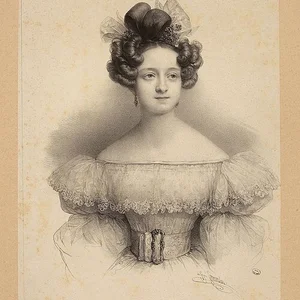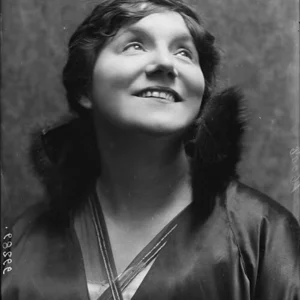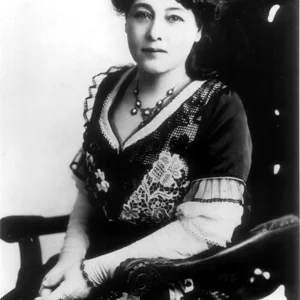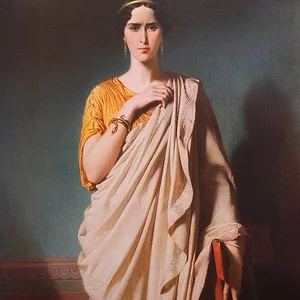

A brilliant tragedienne of the Comédie-Française, Rachel Félix (1821–1858) revived French classical tragedy in the nineteenth century. Born into a modest Jewish family, she rose to fame through her electrifying performances in the roles of Racine and Corneille, becoming the most celebrated actress in Europe.
Rachel Félix(1821 — 1858)
Rachel Félix
France
10 min read
Frequently asked questions
Famous Quotes
« Talent is the will to do.»
Key Facts
- Born in 1821 in Mumpf (Switzerland) into a wandering Jewish family
- Made her debut at the Comédie-Française in 1838 and triumphed from her very first performances
- Revitalized French classical tragedy (Racine, Corneille), which had fallen out of fashion
- Toured Europe, Russia, and the United States, becoming an international celebrity
- Died of tuberculosis in 1858, at just 36 years old, at the height of her fame
Works & Achievements
The role of her triumphant debut at the Comédie-Française, at the age of seventeen. Her portrayal of the sister torn between fraternal love and patriotism revealed Paris to an extraordinary tragedian, and marked the renaissance of classical tragedy in France.
Rachel excelled in this role of a Greek princess consumed by murderous jealousy. Her rendering of Hermione's lovesick madness — with a contained inner violence that built to an explosion — was considered unrivalled by the critics of the time.
Considered her absolute masterpiece, this role of a queen consumed by incestuous love earned her triumphs across all of Europe. Gautier wrote that upon seeing Rachel in Phèdre, one finally understood why Racine had written the play.
The role of the biblical queen considered unplayable since the seventeenth century. Rachel turned it into a stunning creation, proving that Racinian tragedy could still move a Romantic audience accustomed to the excesses of modern drama.
A unique and historic moment: following the February Revolution, Rachel performed the national anthem on the stage of the Comédie-Française, draped in the tricolour. This act — at once political and artistic — made her beloved far beyond cultivated circles.
The role of a woman torn between human love and a nascent religious faith. Rachel brought to Pauline a gravity and gentleness that contrasted with her usual passionate characters, revealing the full range of her dramatic register.
Anecdotes
A child of the streets, Rachel sang for a few coins on the pavements of Lyon and Paris alongside her father and siblings, before being noticed by the singing teacher Étienne Choron. Struck by the quality of her voice and her natural expressiveness, he offered her free lessons and introduced her to Parisian artistic circles, forever changing the destiny of this impoverished little girl.
On June 12, 1838, at her official debut at the Comédie-Française in the role of Camille (Corneille's Horace), the seventeen-year-old actress burst onto the stage with such natural intensity — so far removed from the artificial declamation that was customary — that the Parisian audience, initially stunned, broke into frenzied applause. Within a few weeks, the girl who had been singing in the streets just years before had become the darling of all Paris.
In February 1848, in the wake of the Revolution that had overthrown Louis-Philippe, Rachel gave an improvised performance of La Marseillaise on the stage of the Comédie-Française, draped in a tricolor shawl, standing like an allegory of the Republic. The audience, initially silent, joined in the refrain in a frenzy. This act — as much political as artistic — made her a popular icon far beyond cultivated circles.
During her tour of the United States in 1855–1856, Rachel encountered an America ill-prepared for classical French tragedy in alexandrine verse. Halls were often half-empty, and American critics found her too cerebral. Exhausted and already gravely ill with tuberculosis, she returned to France having suffered considerable financial losses, yet having never consented to alter her repertoire to please an uncomprehending audience.
Rachel was known for her impetuous temperament and her formidable head for business. She personally negotiated her fees with theater directors, refused roles that did not suit her, and demanded exceptional terms from the full company members of the Comédie-Française. In a world of entertainment dominated by men, this woman born into poverty established herself as a true entrepreneur, managing her career with a commercial intelligence that astonished her contemporaries.
Primary Sources
Rachel is not beautiful in the ordinary sense of the word, but she possesses that particular beauty unique to dramatic actresses — made of intensity of expression, mobile features, and that inner flame which blazes forth in the great moments of drama. When she plays Phèdre, one ceases to see an actress; one sees the queen herself.
She has lifted tragedy from its long torpor. Racine, whom we believed dead for our generation, found in her an interpreter worthy of him. The voice, the gesture, the gaze: everything in her is tragic, everything is grand, nothing is feigned.
Rachel is the high priestess of French tragedy. She does not merely interpret Racine's verses — she embodies them. Before her, Antiquity comes back to life, and the most elegant Parisiennes tremble as if they were truly watching Phèdre die of love.
I have seen acting before, but never anything like this: never anything which astonished Hope and hushed Desire, which outstripped Impulse and paled Conception. It was a marvellous sight — a mighty revelation. She passed like a meteor across the stage.
Key Places
A German-speaking Swiss village where Rachel Félix was born on February 28, 1821, into a Jewish family of traveling peddlers. Nothing about this birth into poverty seemed to foretell one of the greatest theatrical careers of nineteenth-century Europe.
The Maison de Molière, on Place Colette in Paris, was the stage of Rachel's entire career. It was here that she made her triumphant debut in 1838, became a full member of the company, and forever transformed the way French classical tragedy was performed.
It was in this town near Cannes that Rachel came seeking the Mediterranean sun to treat her tuberculosis. She died there on January 3, 1858, at the age of 36, surrounded by her family, after having been the most celebrated actress in Europe.
Rachel performed in Saint Petersburg before the Russian imperial court, which received her with frenzied enthusiasm. Tsar Nicholas I presented her with lavish gifts; the tour confirmed her status as a universal actress, transcending borders and languages.
Rachel was buried at Père-Lachaise in the section reserved for the Jewish community. Her tomb, still visible today, receives tributes from lovers of classical theatre who come to honor the woman who saved Racine from oblivion.
Typical Objects

Rachel wore on stage costumes inspired by Greek and Roman Antiquity — white tunics draped in the manner of classical statues, designed to emphasize every tragic gesture. These costumes, crafted in collaboration with her costume designer, contributed to the illusion of a resurrection of Antiquity on the Parisian stage.

Rachel owned her own copies of the tragedies of Racine and Corneille, annotated in her own hand for inflections, pauses, and dramatic intentions. These carefully worked texts were her most precious working tools — the foundation of an art that nevertheless appeared entirely spontaneous.

In the 19th century, stage makeup was applied using colored grease sticks and powders by candlelight in the cramped dressing rooms of the theatre. Rachel spent long hours preparing before each performance, transforming her ordinary face into a tragic mask of striking pallor.

Rachel maintained an extensive correspondence with prominent figures from the political, artistic, and aristocratic worlds of Europe. Her letters, written in refined French, bear witness to a remarkable intelligence and a mastery of the written word that was astonishing for a child who had never attended school.

Rachel was the subject of numerous lithographs, engravings, and medals struck in her likeness and distributed throughout Europe. Owning a portrait of Rachel was a mark of cultural distinction; her face was as recognizable as those of crowned heads.

Afflicted with tuberculosis from the early 1850s, Rachel carried on tour an entire arsenal of remedies of the era: pectoral syrups, tinctures of opium, and sea baths prescribed by doctors. These treatments, sadly ineffective, punctuated her days and bore witness to the relentless battle she waged against the disease while continuing to perform.
School Curriculum
Vocabulary & Tags
Key Vocabulary
Daily Life
Morning
Rachel rose late, often after ten o'clock, as performances ended past midnight. Her mornings were devoted to correspondence — dozens of letters from admirers, journalists, and notable figures arrived every day. She would have a light lunch and browse through the feuilletons in the major Parisian newspapers commenting on her performances.
Afternoon
In the afternoons, Rachel rehearsed at the Comédie-Française or worked on her roles with her teachers. She also received visitors in her dressing room or at home: men of letters, artists, and aristocrats crowded into her salon. She granted interviews to her collaborators and sometimes negotiated her contracts directly with foreign theater directors, refusing to use middlemen.
Evening
On performance evenings, Rachel arrived at the theater several hours before the curtain rose to prepare her makeup and warm up her voice. After the show — during which applause could last for long minutes — she often supped with friends or admirers at the elegant restaurants along the grands boulevards, savoring this moment of relaxation after the intense effort of the stage.
Food
Rachel followed a diet dictated by her pulmonary fragility: light broths, tender meats, and fresh fruit. She avoided alcohol, which would have damaged her voice, and overly spiced dishes. During her tours abroad, she struggled with local cuisine and had French provisions brought to her; in Russia, she was astonished by the generosity of the imperial table but remained true to her frugal habits.
Clothing
On stage, Rachel wore carefully researched neo-antique costumes: white or colored draperies, strapped sandals, and laurel crowns depending on the role. In everyday life, she dressed with sober elegance, preferring dark dresses that highlighted the pallor of her complexion. Her illness gradually forced her to wear cashmere shawls even in summer to protect her fragile chest.
Housing
Rachel lived in a well-appointed apartment in the bourgeois districts of Paris, tastefully furnished and decorated thanks to the considerable fees her career brought in. Having grown up in the direst poverty, she placed great importance on her comfortable home. On tour, she demanded the best hotel suites and refused the mediocre accommodations sometimes offered to visiting performers.
Historical Timeline
Period Vocabulary
Liens externes & ressources
Références
Œuvres
Camille dans Horace (Corneille)
1838
Hermione dans Andromaque (Racine)
1839
Phèdre dans Phèdre (Racine)
1843
Athalie dans Athalie (Racine)
1847
Interprétation de La Marseillaise
1848
Pauline dans Polyeucte (Corneille)
1840