 flip
flipPalusami
Palusami
Why this dish? *Palusami* is an everyday dish throughout Fiji, made with the ubiquitous taro leaves around villages. On Bau as in Levuka, this nourishing dish accompanied fish or boiled taro. It is the food of Cakobau's people, the one he saw prepared every day in his village.
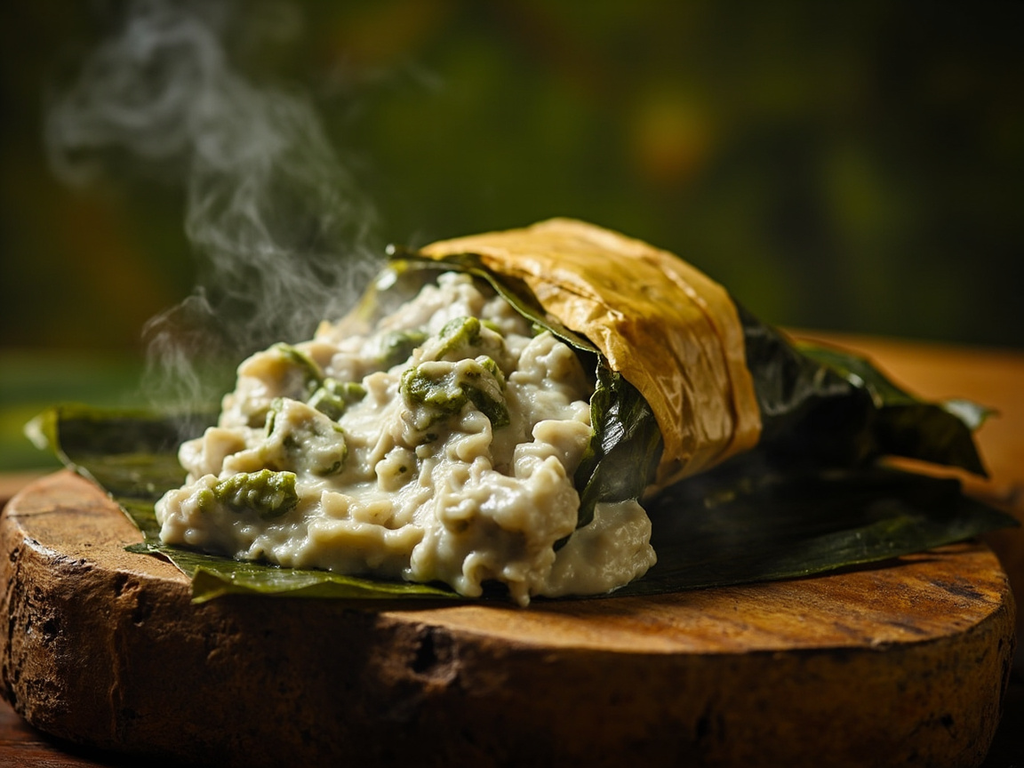
Young taro leaves stuffed with coconut cream and onion, tied into parcels and slowly baked in an oven or *lovo*. The leaves become tender and silky, infused with the richness of coconut.
Even a *Vunivalu* eats what the land gives him every day. *Dalo* leaves grow everywhere on Bau, and the women know how to choose them — the young, the tender ones that melt in *lolo*. They fold them with care, tie them, and the *lovo* does the rest. This is the food of my people, not only of chiefs. When I left for Levuka to negotiate with the British, it was this taste that reminded me of my land.
- •Young taro leaves (rourou) — An armful (Green base)
- •Thick coconut cream (lolo) — Generously (Sauce and binder)
- •Wild onion — A few (Aromatic)
- •Sea salt — To taste (Seasoning)
Palusami
Young taro leaves stuffed with coconut cream and onion, tied into parcels and slowly baked in an oven or *lovo*. The leaves become tender and silky, infused with the richness of coconut.
Why this dish? *Palusami* is an everyday dish throughout Fiji, made with the ubiquitous taro leaves around villages. On Bau as in Levuka, this nourishing dish accompanied fish or boiled taro. It is the food of Cakobau's people, the one he saw prepared every day in his village.
Even a *Vunivalu* eats what the land gives him every day. *Dalo* leaves grow everywhere on Bau, and the women know how to choose them — the young, the tender ones that melt in *lolo*. They fold them with care, tie them, and the *lovo* does the rest. This is the food of my people, not only of chiefs. When I left for Levuka to negotiate with the British, it was this taste that reminded me of my land.
Ingredients (period version)
- Young taro leaves (rourou) — An armful (Green base)
- Thick coconut cream (lolo) — Generously (Sauce and binder)
- Wild onion — A few (Aromatic)
- Sea salt — To taste (Seasoning)
Ingredients
- Taro leaves (or Swiss chard as substitute) — 300 g (Green base)
- Thick coconut cream — 250 ml (Sauce and binder)
- Onion — 1 (Aromatic)
- Salt — 1/2 tsp (Seasoning)
- Aluminum foil or banana leaves — 4 sheets (Cooking wrap)
Method
- If using taro leaves, wash thoroughly and remove tough stems. If using Swiss chard, wash and dry.
- Finely chop the onion.
- Layer 3-4 taro leaves (or a handful of chard) on a square of aluminum foil or softened banana leaf.
- Place a little chopped onion in the center, season with salt, then pour 3-4 tablespoons of thick coconut cream.
- Fold the leaves to form a tight parcel. Repeat to make 4 parcels.
- Bake at 180°C for 1 hour, or steam for 45 minutes. The leaves should be completely tender.
- Serve the parcels closed, to be opened directly on the plate. The *lolo* inside forms a creamy sauce.
How it was made : *Palusami* (or *rourou vakalolo*) is documented throughout the western Pacific — Samoa, Tonga, Fiji. Taro leaves contain calcium oxalate, which causes irritation if undercooked, hence the need for long cooking. This knowledge was passed from mother to daughter.
The contemporary twist : Add a small spoonful of freshly grated ginger into each parcel for a revamped *palusami* with a tonic aroma.
Sources : Howe, K.R., Kiste, Robert C., and Lal, Brij V., eds., Tides of History: The Pacific Islands in the Twentieth Century, University of Hawaii Press, 1994 · Pollock, Nancy J., These Roots Remain, University of Hawaii Press, 1992
Ratu Seru Cakobau · Charactorium