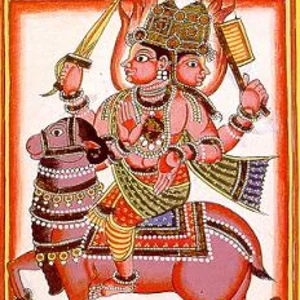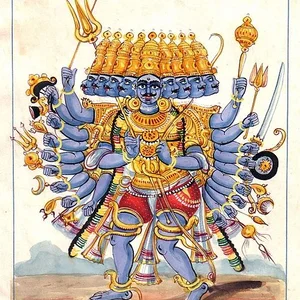

Ravana is the ten-headed demon king of Lanka in the Hindu epic the Ramayana. As the principal antagonist, he abducts Sita, the wife of Rama, triggering a cosmic war. Despite his demonic nature, he is recognized as a scholar, accomplished musician, and devoted worshipper of Shiva.
Ravana
Ravana
9 min read
Frequently asked questions
Key Facts
- Ravana possesses ten heads symbolizing his mastery of the four Vedas and the six Upanishads
- He abducts Sita, wife of Rama, and takes her to Lanka, triggering the war of the Ramayana
- He is defeated and slain by Rama with the help of the monkey army led by Hanuman
- Despite his status as a demon (rakshasa), he is regarded as a great devotee of Shiva and a scholar of sacred texts
- His story illustrates the downfall of a powerful being consumed by pride and desire
Works & Achievements
A hymn of 16 Sanskrit stanzas in praise of Shiva's cosmic dance, of exceptional metrical and poetic complexity. Still recited today in Shaivite temples, it illustrates Ravana's identity as a scholar and musician.
An Ayurvedic medical treatise on medicinal plants and healing practices. Its attribution to Ravana underscores his reputation as a universal scholar within Indian learned traditions.
A collection of astrological and esoteric texts bearing his name, used in certain tantric practices. It reflects Ravana's association with occult knowledge and the divinatory arts.
According to tradition, Lanka was built by the divine architect Vishvakarma for Shiva, before being granted to Ravana. His capital is described as an architectural wonder of golden towers and celestial gardens.
Ravana is the dramatic engine of the epic: his act of abducting Sita sets the entire heroic and spiritual narrative in motion. Without him, there would be no war of Lanka, and no triumph of dharma.
Anecdotes
Ravana possessed ten heads and twenty arms, symbols of his immense learning and power: according to tradition, his ten heads represented his mastery of the four Vedas, the six Upangas, and the fields of philosophy, music, and martial arts. This symbolic multiplicity made him one of the most learned beings in the Hindu universe.
A fervent devotee of Shiva, Ravana composed the hymn Shiva Tandava Stotram, using his own flesh as a stringed instrument after the god blocked his path on Mount Kailash. Moved by this extreme devotion, Shiva granted him immense powers and conditional immortality.
Ravana obtained from Brahma a boon of invincibility against gods and demons, but in his arrogance he neglected to ask for protection against men — a fatal flaw that left him vulnerable to Rama, a human avatar of Vishnu. This mythological hubris lies at the heart of the Ramayana's moral teaching.
According to some versions of the Ramayana, Ravana was originally a celestial guardian (dvarapala) of Vishnu's heaven, condemned to three mortal lives as punishment for a transgression. His existence as a powerful demon was paradoxically a path toward spiritual liberation, as he would be slain by Vishnu himself in each incarnation.
Although he abducted Sita, Ravana never forced himself upon her, bound by a sacred oath. He kept her captive in the Ashoka garden, offering her wealth and protection, waiting for her consent. This moral complexity in the character reflects the ethical tensions that run throughout Sanskrit epic literature.
Primary Sources
Then Ravana, disguised as an ascetic, approached Sita and said: 'I am the king of the rakshasas, lord of Lanka of a thousand towers. Who are you, fair woman, who dares to dwell alone in this forest?'
Rama, standing on the battlefield, loosed the arrow of Brahma into Ravana's chest. It pierced the demon's ten heads and returned, purified, to the hero's quiver. Ravana fell like a tree struck down by lightning.
Jatatavigalajjala pravahapavitasthale, gale 'valambya lambitam bhujangamazamgamalikam — Upon the neck purified by the streams flowing from the mass of his matted hair, he wears a garland of serpents hanging down.
The scholars who looked upon Ravana's body on the battlefield wept and said: 'The world has lost today not only a warrior, but a master of the Vedas, an unrivaled musician, and a king who had raised Lanka to the height of glory.'
Brahma himself descends to honor the fallen Ravana and declares: 'You were the greatest of Shiva's devotees, the most learned of kings. Your death at the hands of Rama, avatar of Vishnu, has granted you supreme liberation.'
Key Places
A golden island city of which Ravana was the absolute ruler, described in the Ramayana as a magnificent metropolis surrounded by impregnable fortresses. Identified by some scholars with the island of Sri Lanka, it remains the symbol of organized demonic power.
The enchanted garden of Lanka where Ravana held Sita captive, surrounded by ashoka trees (Saraca asoca). This place symbolizes Sita's time of ordeal and the confrontation between purity and the seduction of power.
The abode of Shiva that Ravana attempted to lift in a fit of pride — a defining moment in his ambivalent relationship with the god. Kailash is still venerated as the spiritual center of the world in Hindu, Buddhist, and Jain traditions.
A chain of rocks connecting southern India to northern Sri Lanka, associated with the bridge built by Rama's army to march on Lanka. Satellite images reveal a series of natural shoals matching the epic's description.
Capital of Rama's kingdom and the starting point of the epic. It is from Ayodhya that Rama is sent into exile, that the quest to rescue Sita begins, and where dharma ultimately triumphs after the fall of Ravana.
Typical Objects

A stringed instrument that Ravana is said to have invented or perfected, playing it with his twenty hands. Tradition credits him with creating fundamental musical forms of Carnatic music, making him a divine musician despite his demonic nature.

A celestial sword given to Ravana by Shiva as a reward for his devotion. An invincible weapon of cosmic destructive power, it embodies the paradox of Ravana: blessed by the very gods he defies.

A celestial chariot capable of flying through the air at its occupant's will, stolen from Kubera. Ravana used it to abduct Sita, and it stands as one of the earliest descriptions of an aerial vehicle in world literature.

A royal headdress symbolizing his ten heads, the defining iconographic emblem of Ravana throughout Hindu art. Each head represents an aspect of his scholarship, or one of the deadly sins he must overcome according to some interpretations.

According to the Ramayana, Ravana kept a store of amrita in his navel, the source of his ability to regenerate during battle. Only the destruction of this nectar by Rama could finally bring about his death.

Ravana is depicted holding sacred texts or scrolls, symbols of his mastery of the four Vedas, Ayurveda, statecraft (arthashastra), and music. He embodies the paradoxical union of supreme knowledge and evil.
School Curriculum
Vocabulary & Tags
Key Vocabulary
Tags
Daily Life
Morning
Ravana begins his day with long ritual ablutions in Lanka's royal baths, reciting Vedic mantras and offering flowers and water to Shiva. He then holds the royal council (sabha) in his golden throne room, surrounded by his ten heads — each symbolizing his mastery of the arts and sciences.
Afternoon
The afternoon is devoted to study and musical practice: Ravana composes hymns on his twenty-stringed vina, oversees the military training of his rakshasa armies, and consults his astrologers on celestial omens. He also receives ambassadors from conquered kingdoms who come to pay him tribute.
Evening
In the evening, Ravana presides over grand feasts in his gem-encrusted palaces, surrounded by musicians, dancers, and poets. He performs the evening rituals (sandhya vandana) before the sacred fire before retiring to his chambers, meditating on his quest for absolute power and his devotion to Shiva.
Food
Ravana is described as consuming lavish delicacies worthy of a king of the three worlds: exotic fruits, rice prepared as ritual offerings, and sacred meats during sacrifices (yajna). Despite his nature as a rakshasa, his high Brahmin birth calls for dietary practices governed by Vedic rites.
Clothing
Ravana wears royal garments of fine silk in scarlet and gold, adorned with gold embroidery and precious stones. His multiplied crown symbolizes his ten heads, and he bears the sacred Brahmin thread (yajnopavita) alongside heavy bracelets and necklaces — outward signs of his dual nature as both scholar and warrior.
Housing
Lanka is described as a golden city with impregnable ramparts, built on an island surrounded by the ocean. Ravana's palace contains audience halls with crystal pillars, ashoka gardens filled with intoxicating fragrances, and towers of ivory and gold visible for hundreds of leagues, encircled by moats and celestial fortifications.
Historical Timeline
Period Vocabulary
Visual Style
Style miniature hindou rajpoute et peinture de Tanjore : personnage à dix têtes couronnées sur fond d'architecture dorée de Lanka, palette de laques profondes, or, cramoisi et lapis-lazuli, ornements somptueux.
Sound Ambience
Ambiance sonore de Lanka dorée : drones de vina, tambours de guerre, récitations védiques et fracas de batailles cosmiques mêlés aux bruits de la mer tropicale et du vent sur les remparts d'or.
Liens externes & ressources
Références
Œuvres
Shiva Tandava Stotram
Composition mythique attribuée à Ravana (texte fixé Xe–XIIe s. apr. J.-C.)
Arka Prakasha — traité d'Ayurveda
Attribué traditionnellement à Ravana
Ravana Samhita
Attribué traditionnellement à Ravana
Construction de Lanka d'or (Suvarna Lanka)
Temps mythiques
Le Ramayana de Valmiki (rôle antagoniste)
IVe – IIe siècle av. J.-C.