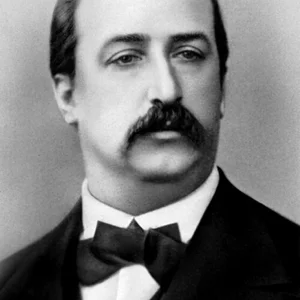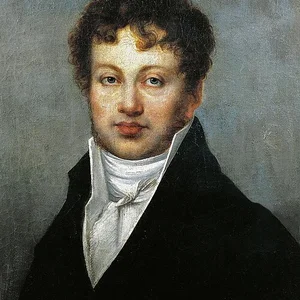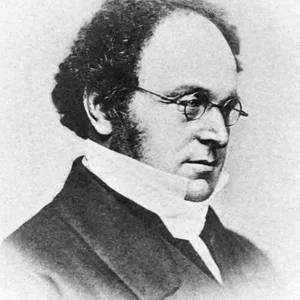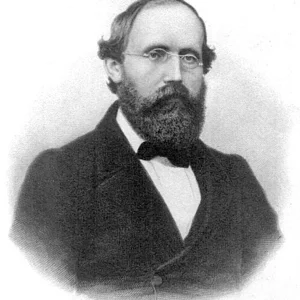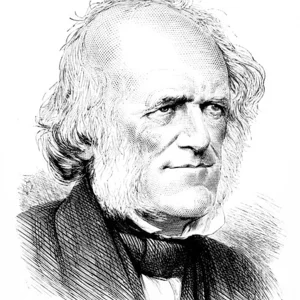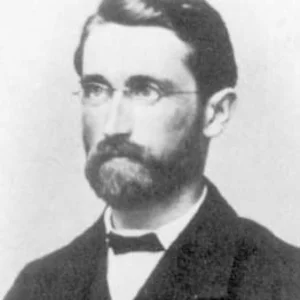

German mathematician, a student of Gauss and Dirichlet, he profoundly renewed algebra and number theory. We owe to him a rigorous construction of the real numbers and the notion of an ideal.
Richard Dedekind(1831 — 1916)
Richard Dedekind
duché de Brunswick
6 min read
Frequently asked questions
Famous Quotes
« Numbers are a free creation of the human mind.»
Key Facts
- Born in 1831 in Brunswick (Brunswick, Germany)
- The last student to defend a doctoral thesis under the supervision of Gauss, in 1852
- Introduced the “Dedekind cuts” to rigorously construct the real numbers (1872)
- Published “Was sind und was sollen die Zahlen?” (What are numbers and what should they be?) in 1888, laying the axiomatic foundations of arithmetic
- Developed the theory of ideals in algebraic number theory; died in 1916 in Brunswick
Works & Achievements
Dedekind edited and expanded the lectures of his teacher Dirichlet; it was in the supplements that he gradually introduced his theory of ideals.
Invention of the notion of an ideal, which restores the uniqueness of factorization in algebraic numbers and lays the foundation of modern algebra.
Rigorous construction of the real numbers through “cuts,” which finally gives analysis a solid foundation.
An attempt to axiomatize arithmetic from the notions of set and mapping; a founding text of mathematical logic.
A clear and self-contained presentation of his theory of algebraic numbers and ideals, which spread his ideas across France and Europe.
Decisive exchanges on infinity and set theory, in which Dedekind supported and discussed Cantor's discoveries.
Anecdotes
Richard Dedekind was the very last student to defend his doctoral thesis under the supervision of Carl Friedrich Gauss, at Göttingen in 1852, when he was only 21 years old. The old master, sparing with compliments, recognized his promising talent.
It was while preparing an analysis course in Zurich in 1858 that Dedekind, uncomfortable at having to rely on geometric intuition to discuss continuity, invented the idea of “cuts.” He defined each real number as a cut of the set of rational numbers into two parts, at last giving the irrational numbers a rigorous foundation.
Dedekind remained a discreet and modest man all his life, living in Brunswick with his sister Julie, and never marrying. He taught for decades at the technical school of his hometown rather than chasing after a prestigious university chair.
His mathematical fame was such that a famous encyclopedia declared him dead in 1899. Dedekind, very much alive, wrote with humor to the editor that on that very day he had in fact had a lively and stimulating conversation with his friend Georg Cantor.
Rather than publishing his greatest ideas under his own name alone, Dedekind tucked his revolutionary theory of “ideals” into supplements to the lectures of his teacher Dirichlet, which he faithfully edited after the latter's death. This generosity has sometimes obscured the scope of his own invention.
Primary Sources
If we divide all the points of the line into two classes such that every point of the first class lies to the left of every point of the second class, then there exists one and only one point that produces this division.
Numbers are free creations of the human mind; they serve as a means of grasping more easily and more clearly the diversity of things.
In these supplements, Dedekind introduces the notion of the ideal to restore the uniqueness of factorization in fields of algebraic numbers.
In these letters, the two mathematicians discuss the nature of infinity; Cantor confides his doubts and receives Dedekind's attentive remarks.
Key Places
Dedekind's birthplace, where he returned to teach and spent most of his life with his sister. He died there in 1916.
A leading center of mathematics where Dedekind studied, defended his thesis under Gauss, and worked alongside Riemann and Dirichlet.
The Swiss polytechnic school where Dedekind was a professor from 1858 to 1862, and where he conceived the idea of cuts.
The technical college in his hometown where Dedekind taught for over fifty years, far from the great universities.
Typical Objects

The mathematician's everyday writing tool, used to draft proofs, letters and manuscripts. His entire body of work was set down on paper by hand.

The teaching surface on which Dedekind laid out his reasoning for his students at the Brunswick Polytechnic. A central tool for passing on mathematics.

His correspondence, notably with Georg Cantor, was a true laboratory of ideas about infinity and sets. These letters rank among the most precious sources in the history of mathematics.

The printed books and supplements in which Dedekind published cuts and ideals spread his ideas across scholarly Europe. The printed book was the great vehicle of knowledge in the 19th century.

A fine musician, Dedekind played the piano and the cello, and music held an important place in his family life in Brunswick. The German middle-class household readily cultivated chamber music.

Although it is not a material object, the “cut” is Dedekind's emblematic conceptual tool: splitting the rationals in two to define a real number. It is his most famous invention.
School Curriculum
Vocabulary & Tags
Key Vocabulary
Tags
Daily Life
Morning
A methodical professor, Dedekind devoted his mornings to preparing and giving his lectures at the polytechnic school in Brunswick. The rigor and clarity of his lessons were appreciated by his students.
Afternoon
Afternoons were often dedicated to research: reflecting on number theory, writing proofs, and reading the work of his contemporaries. He worked slowly, seeking the most perfect formulation.
Evening
In the evening, in the house he shared with his sister Julie, he read, wrote to correspondents such as Cantor, or played music. His life was peaceful, studious, and free of social glamour.
Food
A nineteenth-century German bourgeois, he ate simple and regular food: bread, potatoes, meats, soups, and the coffee enjoyed throughout Germany. Meals set the rhythm of a well-ordered day.
Clothing
He wore the sober attire of the nineteenth-century professor: a dark frock coat or jacket, a stiff-collared shirt, and a necktie. His appearance was neat but made no effort at elegance.
Housing
Dedekind lived for a long time in a bourgeois house in Brunswick with his sister Julie, in quiet and comfortable surroundings. This family home was the setting for his entire life as a scholar.
Historical Timeline
Period Vocabulary
Liens externes & ressources
Références
Œuvres
Édition des Vorlesungen über Zahlentheorie de Dirichlet
1863
Théorie des idéaux (Supplément XI)
1871
Stetigkeit und irrationale Zahlen (Continuité et nombres irrationnels)
1872
Was sind und was sollen die Zahlen ? (Que sont et que doivent être les nombres ?)
1888
Über die Theorie der ganzen algebraischen Zahlen
1877
Correspondance avec Georg Cantor
1874-1899