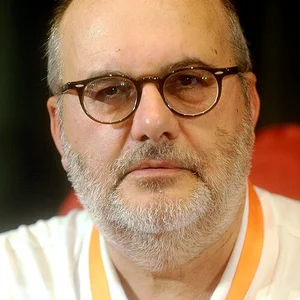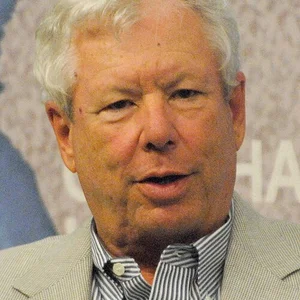

Richard Thaler is an American economist and a leading figure in behavioral economics. He showed how psychological biases influence economic decisions, challenging the assumption of perfect rationality. He received the Nobel Prize in Economics in 2017.
Richard Thaler(1945 — ?)
Richard Thaler
États-Unis
6 min read
Frequently asked questions
Key Facts
- Born on September 12, 1945, in East Orange, New Jersey
- In 2008, co-authored the book 'Nudge' with Cass Sunstein, popularizing the concept of the behavioral nudge
- Received the Nobel Prize in Economics (the Sveriges Riksbank Prize) in 2017 for his contributions to behavioral economics
- Professor at the Booth School of Business at the University of Chicago
- Pioneer in factoring psychological biases into economic theory
Works & Achievements
A collection of his columns on economic anomalies. Using concrete examples, he shows that people do not behave the way theory predicts.
A savings scheme designed with Shlomo Benartzi. By automatically increasing contributions, it has helped millions of employees better prepare for retirement.
A global bestseller on the idea of the “gentle nudge.” It has inspired public policy in many countries, from the United Kingdom to the United States.
An autobiographical account of the birth of behavioral economics, recounting his battles against traditional economists.
A major concept explaining how people sort their money into imaginary “boxes,” which leads them to make less than rational choices.
An award honoring his life's work, for incorporating realistic psychological assumptions into economic analysis.
Anecdotes
When the Nobel committee asked him what he would do with his prize of more than a million dollars in 2017, Richard Thaler answered with humor that he planned to spend it “in the most irrational way possible” — a perfect nod to his own theory about human decision-making.
Thaler keeps a list he calls “the anomalies cupboard”: economic behaviors that classical theory cannot explain. Instead of ignoring them as his colleagues did, he made them the heart of his entire research career.
In 2015, Richard Thaler appears in the film “The Big Short” about the 2008 financial crisis. Seated at a casino table beside the singer Selena Gomez, he explains the “hot hand bias” to the general public in person.
To illustrate one of his concepts, Thaler used to tell how he once refused to sell a bottle of wine bought for 10 dollars that had become very expensive, while also refusing to buy an identical one at that high price: living proof of “the endowment effect” he was studying.
Thaler liked to repeat a phrase that became famous: to truly understand economics, you have to accept that people are not “Econs” (perfectly rational beings) but “Humans” (humans full of flaws and emotions).
Primary Sources
A nudge is any aspect of the choice architecture that alters people's behavior in a predictable way without forbidding any options or significantly changing their economic incentives.
Ordinary people are not emotionless beings who calculate like computers and don't suffer from self-control problems. They are Humans.
To advance economic science, we must incorporate the fact that agents are human, with limited rationality and social preferences.
An anomaly is a fact that contradicts the predictions of standard economic theory; ignoring them does not make them go away.
Key Places
American city where Richard Thaler was born in 1945. It's the starting point of his life.
Institution in New York State where Thaler earned his master's degree and then his doctorate in economics.
University where Thaler taught for many years and conducted his first major research on economic anomalies.
Where Thaler has taught since 1995, at the heart of a university renowned for the classical economics he helped shake up.
Capital where Thaler received the Nobel Prize in Economics at the ceremony in December 2017.
Typical Objects

Award given to Thaler in 2017 by the Bank of Sweden in memory of Alfred Nobel. It marks the entry of psychology into economic science.

A book co-written with Cass Sunstein, translated into dozens of languages. It explains how small adjustments can steer choices without coercion.

Thaler's favorite example: placing fruit at eye level and sweets farther away changes our food choices. It is a concrete illustration of the “choice architecture.”

At the heart of Thaler's “Save More Tomorrow” program. By making saving automatic by default, you sharply increase the number of people who save for their retirement.

Tool of the teacher-researcher at the University of Chicago, covered in equations and curves. Thaler used it to show the gaps between theory and real behavior.

An ordinary object made famous by Thaler's experiments on the “endowment effect”: once you own a mug, you demand far more money to sell it than you would have agreed to pay to buy it.
School Curriculum
Vocabulary & Tags
Key Vocabulary
Tags
Daily Life
Morning
Thaler, a professor at Chicago, often began his morning by reading the financial press over a cup of coffee. He would prepare his classes or rework a research paper, always on the lookout for a new “anomaly” to explain.
Afternoon
His afternoon was devoted to teaching, to discussions with students and colleagues, and to designing experiments. Thaler enjoyed debating, sometimes heatedly, with the defenders of classical economics.
Evening
In the evening, he continued writing his books for the general public, keen to make economics accessible. He also enjoyed a good meal and a glass of wine, the subject of several of his anecdotes.
Food
Like many American academics of his time, Thaler ate in a varied and modern way. A lover of fine wine, he often used food and drink as concrete examples in his research.
Clothing
Thaler wore the classic attire of a university professor of the late 20th and early 21st centuries: a sober jacket, shirt, and trousers, usually without a tie, in a relaxed and approachable style.
Housing
He lived in a comfortable house near the University of Chicago, in the American Midwest. His living environment was that of a renowned academic, divided between his home and his office on campus.
Historical Timeline
Period Vocabulary
Liens externes & ressources
Références
Œuvres
« The Winner's Curse » (La malédiction du vainqueur)
1992
Programme « Save More Tomorrow »
2004
« Nudge » (avec Cass Sunstein)
2008
« Misbehaving » (Quand la psychologie éclaire l'économie)
2015
Théorie de la comptabilité mentale
1985
Prix Nobel d'économie
2017