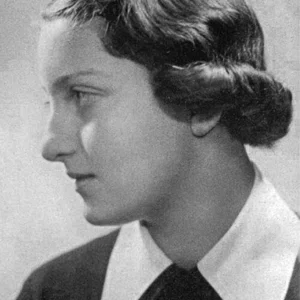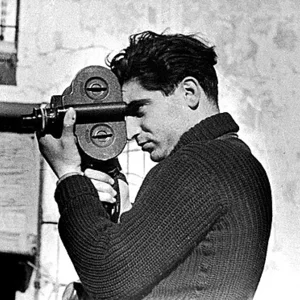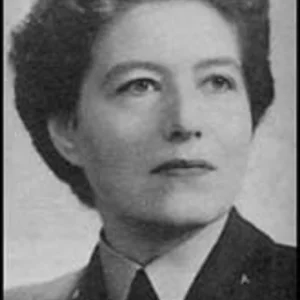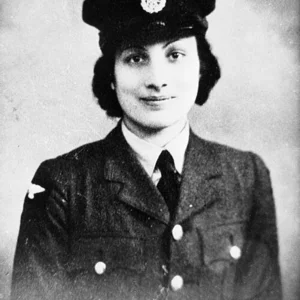

A radio operator for the British Special Operations Executive (SOE), of Indian origin and Sufi tradition, she was parachuted into occupied France in 1943. Arrested by the Gestapo, she was executed at the Dachau camp in 1944 and posthumously awarded the George Cross.
Noor Inayat Khan(1914 — 1944)
Noor Inayat Khan
Royaume-Uni, Raj britannique
6 min read
Frequently asked questions
Key Facts
- Born in 1914 in Moscow, a descendant of the Indian sultan Tipu Sahib and the daughter of a Sufi master
- Recruited by the SOE, in 1943 she became the first female radio operator infiltrated into occupied France (Prosper network, Paris region)
- Arrested by the Gestapo in Paris in the autumn of 1943, she refused to give up information despite the interrogations
- Executed at the Dachau concentration camp on 13 September 1944
- Posthumously awarded the British George Cross (1949) and the French Croix de guerre
Works & Achievements
A collection of Indian tales for children, reflecting her literary sensibility and her spiritual heritage before the war.
The first woman sent as a radio operator into occupied France by the SOE, a vital link between the Resistance and London.
For months the only active operator in Paris, she maintained the radio link under extremely perilous conditions.
She refused to give the Gestapo the slightest piece of information despite imprisonment and mistreatment.
Britain's highest civilian award for bravery, honoring her exceptional moral and physical courage.
A French military distinction recognizing her commitment to the liberation of the country.
Anecdotes
Before the war, Noor Inayat Khan wrote children's stories. In 1939, she published 'Twenty Jataka Tales', a collection of Buddhist fables adapted from the Indian tradition. Yet this gentle, dreamy woman would become one of the agents most wanted by the Gestapo.
When almost her entire Paris network, the 'Prosper' network, was dismantled by arrests, London offered to bring her home. Noor refused: she remained the last active British radio operator in Paris, transmitting vital messages for months even though it was the most dangerous post of all.
Betrayed and arrested in the autumn of 1943, she attempted to escape twice, once through a skylight on the roof of the Gestapo headquarters on Avenue Foch. Deemed “extremely dangerous”, she was put in chains and sent to Germany.
According to testimonies gathered after the war, her final word before being executed at Dachau on 13 September 1944 was said to be 'Liberté' (Freedom). She had never given her interrogators a single piece of intelligence.
A great-granddaughter of Tipu Sultan, the famous ruler of Mysore, and the daughter of an Indian Sufi master, Noor embodied a message of non-violence. Yet she chose to fight Nazism, posthumously receiving the British George Cross and the French Croix de Guerre.
Primary Sources
Assistant Section Officer Noor Inayat Khan displayed the most conspicuous courage, both moral and physical, over a period of more than twelve months.
A collection of traditional Indian fables retold for children, illustrating the values of compassion and sacrifice.
The collected testimonies establish that she refused to give any information and was executed with a shot to the head on 13 September 1944.
Key Places
Town where Noor grew up in the family Sufi house, the 'Fazal Manzil'. A statue there honours her memory today.
Parisian headquarters of the Gestapo, where Noor was interrogated and held after her arrest, and from which she attempted to escape.
Estate where the SOE trained its agents in clandestine techniques and radio transmission.
German prison where Noor was held in solitary confinement and kept in chains for nearly ten months.
Nazi camp near Munich where Noor Inayat Khan was executed on 13 September 1944.
Noor's birthplace in 1914, where her father taught Sufism before the Russian Revolution.
Typical Objects

Short-wave radio suitcase used to transmit intelligence to London in Morse code. Heavy and bulky, it had to be moved constantly to escape detection.

A notebook of codes and keys used to encrypt and decrypt radio messages. Its loss or capture could compromise an entire network.

Falsified documents establishing a false French identity to move about without arousing suspicion. Noor operated under the name Jeanne-Marie Regnier.

A handgun issued to SOE agents for their personal defence. Noor was trained in shooting but favoured discretion.

A poison capsule issued to secret agents to avoid talking under torture if captured. A symbol of the extreme danger of the clandestine agent's work.

Equipment allowing SOE agents to be dropped at night over occupied territory. Noor was parachuted and inserted into France in the spring of 1943.

A British medal rewarding the most exceptional acts of bravery away from the battlefield. Awarded to Noor posthumously in 1949.
School Curriculum
Vocabulary & Tags
Key Vocabulary
Tags
Daily Life
Morning
On assignment, Noor would rise early and frequently changed lodgings to cover her tracks. She checked her radio equipment and prepared the encrypted messages to send to London, always listening closely to the noises of the street.
Afternoon
Afternoons were used for discreet meetings with members of the network and for scouting safe places to transmit. Every trip by bicycle or on foot through occupied Paris demanded constant vigilance in the face of German checkpoints.
Evening
At nightfall, she would set up her antenna and transmit in Morse code during brief windows, since the German radio-detection vans hunted for broadcasts. The evening was also a time of solitude and relentless tension.
Food
Under the Occupation, food depended on rationing: stale bread, rutabagas, soups, and whatever the black market could provide. Agents ate little and irregularly, depending on their hideouts.
Clothing
She wore ordinary civilian clothes to blend into the Parisian crowd, avoiding any detail that might draw attention. An outfit too elegant or too shabby could arouse suspicion.
Housing
Noor lived in hiding, moving from apartment to apartment among Resistance members or sympathizers. She never stayed in the same place for long, so as not to be located through her radio.
Historical Timeline
Period Vocabulary
Liens externes & ressources
Références
Œuvres
Twenty Jataka Tales
1939
Résistance sous interrogatoire
1943-1944
George Cross (à titre posthume)
1949
Croix de guerre française (à titre posthume)
1946