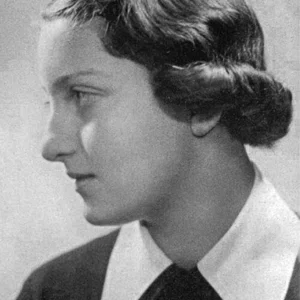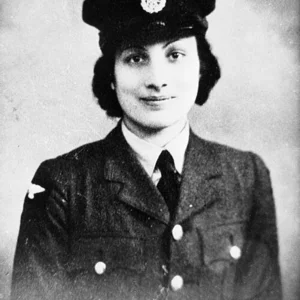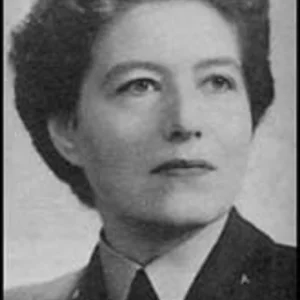

Vera Atkins was a British intelligence officer of Romanian origin and a leading figure in the French section of the Special Operations Executive (SOE) during the Second World War. As a recruiter and trainer of the agents sent into occupied France, she devoted the post-war years to tracing the fate of the agents who had gone missing, especially the women who had been deported.
Vera Atkins(1908 — 2000)
Vera Atkins
Royaume-Uni
6 min read
Frequently asked questions
Key Facts
- Born in 1908 in Galați (Romania) into a Jewish family, she settled in the United Kingdom before the war
- Joined Section F (France) of the Special Operations Executive in 1941 as an intelligence assistant
- Played a central role in recruiting and preparing the agents infiltrated into occupied France, including many women
- After 1945, she led an investigation to establish the fate of 118 missing SOE agents, among them Noor Inayat Khan and Violette Szabo
- Died in 2000, her work was widely recognised only late in life (CBE in 1997)
Works & Achievements
Vera Atkins selected, prepared and supported dozens of agents, many of them women, sent into occupied France for intelligence and sabotage.
A personal mission carried out in post-war Germany to trace the agents reported missing; she established the fate of all but one.
Her interrogations and testimonies helped establish responsibility for the execution of SOE women agents, notably at Natzweiler and Ravensbrück.
Her work gave back a name and a story to women such as Noor Inayat Khan and Violette Szabo, contributing to their memory and their posthumous decorations.
Anecdotes
Born Vera Rosenberg in Galați, Romania, in 1908, she took her mother's maiden name, Atkins, when she settled in England. Of Jewish origin, she was not naturalized as a British citizen until 1944, even though she had already been working at the heart of the secret services for years — a paradox that left her in a vulnerable position.
Within Section F of the SOE, Vera Atkins knew the life of each of her agents by heart: their false identity, their family, down to the smallest detail that might betray them. It is said that she checked that the clothes and objects taken into France bore no label or British coin that could have given them away.
After the war, refusing to abandon the agents reported missing, she conducted her own investigation across a ruined Germany to trace 118 SOE agents. She managed to establish the fate of all but one, following their trail right into the concentration camps.
She interrogated Nazi war criminals, including Rudolf Höss, the former commandant of Auschwitz, to piece together the final days of her executed women agents such as Noor Inayat Khan and Violette Szabo. Her persistence finally allowed the families to learn what had become of their loved ones.
Discreet and enigmatic, Vera Atkins is said to have inspired the character of Miss Moneypenny in the James Bond novels — Ian Fleming himself having worked in intelligence during the war. She remained reserved about her secret activities all her life.
Primary Sources
The files record the fate of the deported and executed female agents of Section F, reconstructed through the interrogations Atkins conducted in occupied Germany.
The definitive biography retracing, from archives and testimonies, Atkins's work at the SOE and her postwar quest to find the missing agents.
Atkins's investigations helped establish responsibility for the execution of four female SOE agents at the Natzweiler camp in 1944.
Key Places
Danube port city where Vera Atkins was born in 1908 into a well-off Jewish family.
Headquarters of the Special Operations Executive, nicknamed “the Baker Street Irregulars.” Vera Atkins worked there at the heart of the French section.
Nazi concentration camp where four SOE women agents were executed in 1944. After the war, Atkins pieced together their fate.
Concentration camp for women where several SOE agents, including Violette Szabo, were executed. A key stage in Atkins's investigation.
Coastal town in Sussex where Vera Atkins spent her final years and died in 2000.
Liens externes & ressources
Références
Œuvres
Recrutement et formation des agents de la section F du SOE
1941-1944
Enquête sur le sort des 118 agents disparus du SOE
1945-1947
Contribution aux procès de criminels de guerre nazis
1946
Reconnaissance du sacrifice des agentes du SOE
après 1945