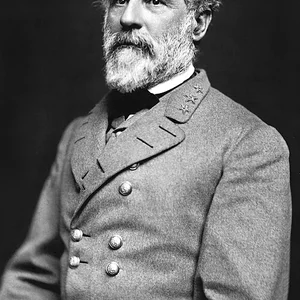

Robert E. Lee was the principal general of the Confederate army of the Southern states during the American Civil War. A brilliant tactician commanding the Army of Northern Virginia, he surrendered at Appomattox in 1865, sealing the Southern defeat.
Robert E. Lee(1807 — 1870)
Robert Lee
États-Unis, États confédérés d'Amérique
5 min read
Frequently asked questions
Key Facts
- Born in 1807 in Virginia into a family of planters, graduated from the West Point military academy in 1829
- Declined command of the Union army in 1861 and joined the Confederacy upon Virginia's secession
- Commanded the Army of Northern Virginia from 1862, winning victories such as Chancellorsville (1863)
- Suffered a decisive defeat at the Battle of Gettysburg in July 1863
- Surrendered to Ulysses S. Grant at Appomattox on April 9, 1865, ending the war, then died in 1870
Works & Achievements
As a young engineer, Lee directs works to control the river's course at St. Louis, demonstrating his technical skills.
An engineering officer under General Scott, Lee distinguishes himself through daring reconnaissance missions, laying the foundations of his reputation.
As superintendent, Lee modernizes the teaching and infrastructure of the prestigious military academy.
Lee transforms this army into a formidable force and wins several defensive victories despite the South's numerical inferiority.
Regarded as his tactical masterpiece: Lee divides his forces against a far larger army and prevails.
After the war, Lee devotes himself to education and reconciliation; the institution would become Washington and Lee University.
Anecdotes
Before the war, Robert E. Lee served in the federal army for more than thirty years and was even a brilliant military engineer. In 1859, it was he who commanded the troops sent to put down abolitionist John Brown's raid at Harpers Ferry.
In April 1861, President Lincoln offered him command of the Union army. Lee declined: loyal to his native state of Virginia, he chose to resign and join the Confederacy, despite his personal misgivings about secession.
Lee earned the nickname “Marble Model” at the West Point military academy, where he graduated second in his class in 1829 without receiving a single disciplinary penalty, an almost unique feat.
At the surrender at Appomattox in April 1865, the Northern general Ulysses S. Grant granted lenient terms: the Southern soldiers were allowed to return home and keep their horses for the spring planting. Lee, dressed in his finest uniform, saluted this gesture.
After the war, Lee became president of the modest Washington College in Virginia. He devoted his final years to the education of the young, calling for reconciliation between the North and the South.
Primary Sources
I can anticipate no greater calamity for the country than a dissolution of the Union. Still, I cannot raise my hand against my native State.
After four years of arduous service marked by unsurpassed courage and fortitude, the Army of Northern Virginia has been compelled to yield to overwhelming numbers and resources.
The officers will give their individual paroles for themselves and their men not to take up arms against the Government of the United States. The arms and equipment are to be laid down.
My earnest desire is to see the restoration of peace and harmony throughout the country.
Key Places
Family estate where Robert E. Lee was born in 1807, into one of Virginia's great families.
United States military academy where Lee was trained and to which he returned as superintendent from 1852 to 1855.
Site of the decisive battle of July 1863 where Lee's army suffered a major defeat, a turning point of the war.
Village where Lee surrendered to Grant on April 9, 1865, sealing the end of the Confederacy.
Town where Lee led Washington College after the war and where he died in 1870.
Typical Objects

Officer's sabre that Lee wore at the surrender at Appomattox. Contrary to a persistent legend, Grant never asked him to surrender it.

Gray military attire bearing Confederate insignia. Lee donned his finest uniform for the surrender, out of dignity.

Optical instrument used to observe troop movements from the heights. An indispensable tool for a general on the battlefield.

Lee's favorite mount throughout the war, who became almost as famous as his rider. The general remained deeply attached to him until his death.

Annotated topographic map used to plan maneuvers. Lee drew on his training as an engineer to exploit the Virginia terrain.

Mobile artillery piece at the heart of the battles of the Civil War. The South was short of them against Northern industry.
School Curriculum
Vocabulary & Tags
Key Vocabulary
Tags
Daily Life
Morning
On campaign, Lee rose before dawn, attended a short prayer, then studied his scouts' reports. He ate a frugal breakfast in his tent before mounting his horse to inspect his lines.
Afternoon
His afternoons were divided between studying maps, holding councils of war with his lieutenants, and drafting orders. During battles, he observed the terrain from high ground, often mounted on Traveller.
Evening
In the evening, Lee dictated his correspondence, wrote to his family, and planned the next day's movements by candlelight. He went to bed late, anxious about the well-being of his poorly supplied soldiers.
Food
Lee gladly shared the ordinary fare of his troops: cornbread, salt pork, and coffee — provisions that grew increasingly scarce in a South starved by the Northern blockade. He refused the privileges of the table that his rank afforded him.
Clothing
He wore the gray uniform of Confederate officers, plain despite his general's insignia, and a wide felt hat. His impeccable attire stood in contrast to the rags worn by many of his soldiers.
Housing
On campaign, Lee lived in a simple headquarters tent, refusing to requisition houses. Born into a great Virginian family, he had grown up between the Stratford Hall plantation and the Arlington estate, his wife's property.
Historical Timeline
Period Vocabulary
Liens externes & ressources
Références
Œuvres
Travaux du génie sur le Mississippi
années 1830
Campagne de la guerre américano-mexicaine
1846-1848
Direction de l'académie de West Point
1852-1855
Commandement de l'armée de Virginie du Nord
1862-1865
Victoire de Chancellorsville
mai 1863
Présidence du Washington College
1865-1870