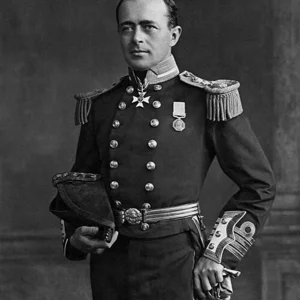

A British Royal Navy officer, Robert Falcon Scott led two expeditions to Antarctica. During his second expedition (1910–1913), he reached the South Pole in January 1912, only to discover that Amundsen had beaten him by a month. Scott and his four companions perished on the return journey.
Robert Falcon Scott(1868 — 1912)
Robert Falcon Scott
Royaume-Uni de Grande-Bretagne et d'Irlande
7 min read
Frequently asked questions
Famous Quotes
« It seems to me that we are going to face a very hard end, but I am still proud to have come this far.»
« Great God! This is an awful place and terrible enough for us to have laboured to it without the reward of priority.»
Key Facts
- 1868: Born in Devonport, England
- 1901–1904: First Antarctic expedition aboard the Discovery
- 17 January 1912: Reached the South Pole, one month after Roald Amundsen
- 29 March 1912: Death of Scott and his four companions (Wilson, Oates, Bowers, Evans) on the return journey, only 18 km from a supply depot
- 1913: Scott's bodies and journals discovered by a search party
Works & Achievements
Account of Scott's first Antarctic expedition (1901–1904). This work, combining a ship's log with a scientific report, earned him international renown and established him as a leading explorer.
Diaries kept by Scott until his final days, published under the title *Scott's Last Expedition*. They became a worldwide bestseller and lastingly shaped the heroic image of their author.
Construction of a scientific hut equipped with a laboratory, a photographic darkroom, and a library. This base camp illustrates the scientific ambition of the Terra Nova expedition, beyond the mere conquest of the Pole.
Fossils, rocks, zoological specimens, and meteorological records brought back despite extreme conditions, including *Glossopteris* fossils proving that Antarctica was once covered by forests.
Anecdotes
During his first expedition (1901–1904), Scott discovered the Antarctic plateau and reached, alongside Shackleton and Wilson, the 82nd parallel South — a record at the time. They had to contend with scurvy and extreme conditions, but brought back valuable scientific data that made Scott a national hero in Great Britain.
In January 1912, after hauling their heavy sledges themselves over 1,500 km, Scott and his companions found a Norwegian tent and Amundsen's flag at the South Pole. In his journal, Scott wrote: “The Pole. Yes, but under very different circumstances from those expected.” Amundsen had beaten them by thirty-four days.
On 16 March 1912, Lawrence Oates, one of Scott’s companions, suffering from frostbite so severe he could barely walk, stepped out of the tent alone into a blizzard, saying: “I am just going outside and may be some time.” He never returned. This act of deliberate self-sacrifice, so as not to slow his comrades down, became one of the great legends of polar exploration.
The bodies of Scott, Wilson, and Bowers were found in November 1912 just 18 km from the supply depot known as ‘One Ton Depot,’ which might have saved them. Scott’s journal, intact, revealed his final messages to his wife and to the British nation. His writings transformed a defeat into a moral epic celebrated throughout the British Empire.
Primary Sources
We took risks, we knew we took them; things have come out against us, and therefore we have no cause for complaint, but bow to the will of Providence, determined still to do our best to the last.
We have found a continent of ice and mystery. Each day's march reveals landscapes no man has ever laid eyes upon.
You know I have always had confidence in our success, and I still hope that you will hold on to that confidence. Be strong, take care of our son.
The expedition reached the South Pole on 17 January 1912 at 90° south latitude. Scientific observations were carried out throughout the journey, in accordance with the original objectives.
Key Places
Robert Falcon Scott's birthplace, where he grew up in a modest family before joining the Royal Navy at the age of thirteen.
The main base of the Terra Nova expedition. The wooden hut built in 1911 served as Scott and his team's headquarters; it is today preserved as a historic monument.
The ultimate goal of the polar race, reached by Scott on 17 January 1912. There he found Amundsen's tent and flag, confirming his defeat in the competition.
A supply depot of food and fuel established at 80°S. Scott and his companions died in their tent just 18 km from this relief point, trapped by a devastating blizzard.
The institution where the scientific collections brought back by Scott — rocks, fossils, and zoological specimens — are preserved and studied, bearing witness to the scientific dimension of his expeditions.
Liens externes & ressources
Références
Œuvres
The Voyage of the Discovery
1905
Journaux de l'expédition Terra Nova (publiés posthumément)
1913
Etablissement de la base de Cape Evans
1911
Collections scientifiques de l'expédition Terra Nova
1910-1912