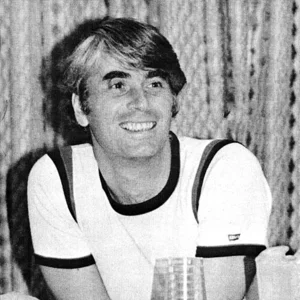

American philosopher, a major figure in 20th-century political philosophy. A professor at Harvard, he was the great theorist of libertarianism and the chief opponent of John Rawls.
Robert Nozick(1938 — 2002)
Robert Nozick
États-Unis
6 min read
Frequently asked questions
Famous Quotes
« Individuals have rights, and there are things no person or group may do to them without violating their rights.»
Key Facts
- Born in 1938 in Brooklyn (New York) into a family of Russian Jewish immigrants.
- Published *Anarchy, State, and Utopia* in 1974, a libertarian response to John Rawls's *A Theory of Justice* (1971).
- Won the National Book Award in 1975 for this work.
- Professor of philosophy at Harvard University for most of his career.
- Died in 2002 in Cambridge (Massachusetts).
Works & Achievements
Major work defending the minimal state and individual rights; a libertarian response to Rawls and winner of the National Book Award.
A sweeping work exploring personal identity, knowledge, free will, and the meaning of life, grounded in a method of “explanation” rather than proof.
A collection of more personal meditations on love, death, wisdom, and happiness, featuring the experience machine.
A philosophical analysis of rationality, decision-making, and the principles that guide human reasoning.
A collection of essays and articles tackling a variety of philosophical puzzles, from Newcomb's paradox to animal ethics.
Nozick's last book, devoted to the nature of objectivity, truth, and consciousness.
Anecdotes
In 1974, Robert Nozick published *Anarchy, State, and Utopia* just three years after the famous *A Theory of Justice* by John Rawls, his colleague at Harvard. The two books became the opposing pillars of contemporary debate: Rawls defends redistribution in the name of justice, Nozick a minimal state in the name of individual liberty.
Nozick was known for never wanting to repeat himself. After upending political philosophy, he refused to become “the philosopher of libertarianism” and went on to explore the theory of knowledge, ethics, rationality, and the meaning of life, changing subject with almost every book.
To defend the idea that perfect equality is impossible to maintain without coercion, Nozick imagines the example of the basketball player Wilt Chamberlain: if thousands of people willingly pay to watch a star play, inequalities of wealth reappear at once from a starting point of equality. This argument has remained one of the most discussed in political philosophy.
Nozick devised a famous thought experiment, the “experience machine”: a machine capable of giving us every pleasant sensation we could wish for. He observes that most people would refuse to plug into it for life, which proves, in his view, that we genuinely want to live and act, not merely to feel pleasure.
Diagnosed with stomach cancer in 1994, Nozick continued to teach and write for eight years. His last book, *Invariances*, appeared in 2001, shortly before his death in 2002.
Primary Sources
Individuals have rights, and there are things no person or group may do to them without violating those rights.
A minimal state, limited to the narrow functions of protection against force, theft, and fraud, and to the enforcement of contracts, is justified; any more extensive state will violate persons' rights.
I do not wish to compel the reader to accept my views, but rather to offer an explanation of them, showing how things might hang together.
Imagine an experience machine that would give you any experience you desired. Would you plug in for life? If not, then something matters to us beyond our sensations alone.
Key Places
Neighborhood of New York where Nozick was born in 1938 into a family of Jewish immigrants. He grew up there before going to university.
University where Nozick earned his bachelor's degree in 1959 and discovered philosophy as well as political debate.
Site of his doctorate in philosophy, defended in 1963 under the supervision of Carl Hempel.
University where Nozick taught philosophy from 1969 until his death. There he worked alongside John Rawls and wrote his major works.
University town where Nozick lived and died on January 23, 2002, at the age of 63, from cancer.
Typical Objects

The 1974 work that founds the philosophical defense of the minimal state and answers John Rawls. It becomes a worldwide reference in political philosophy.

Everyday tool of Nozick the teacher, who loved to reason live in front of his students. On it he would unfold thought experiments and logical arguments.

A thought experiment imagined by Nozick: a machine that provides any sensation you desire. It serves to show that we want to live for real, not merely to feel pleasure.

Nozick wrote by freely exploring many subjects, never wanting to repeat himself from one book to the next. His works bear the mark of this exuberant style.

The book by John Rawls that Nozick read and criticized. The adversarial dialogue between the two Harvard thinkers shapes contemporary political philosophy.

American distinction received for “Anarchy, State, and Utopia.” It marks the institutional recognition of Nozick's work.
School Curriculum
Vocabulary & Tags
Key Vocabulary
Tags
Daily Life
Morning
A professor at Harvard, Nozick often began his day with reading and preparing his lectures in his office in Cambridge. He liked to think freely, following ideas as they arose rather than sticking to a rigid plan.
Afternoon
His afternoons were paced by lectures and seminars, where he worked through his reasoning live in front of students. He readily chatted with his colleagues, including John Rawls, in the hallways of the philosophy department.
Evening
In the evening, Nozick read widely across many fields — science, economics, literature — feeding his encyclopedic curiosity. He wrote his books by exploring a new subject each time.
Food
Nozick led the ordinary life of a twentieth-century American academic, sharing meals and coffees on the Harvard campus. No particular diet set him apart, aside from an intense intellectual life.
Clothing
He wore the classic attire of the university professor of his era: a jacket, shirt, and understated trousers, suited to teaching and conferences.
Housing
Nozick lived in Cambridge, Massachusetts, near Harvard University, where he taught. His living environment was that of an intellectual settled in a major university city on the East Coast.
Historical Timeline
Period Vocabulary
Liens externes & ressources
Références
Œuvres
Anarchie, État et utopie
1974
Philosophical Explanations
1981
The Examined Life (La vie pensée)
1989
The Nature of Rationality
1993
Socratic Puzzles
1997
Invariances: The Structure of the Objective World
2001